Showing posts with label Sonderkommando 1005. Show all posts

Sunday, May 24, 2026

Willi Lenz: The “Doctor” of the Kulmhof (Chełmno) Extermination Camp

When Soviet troops reached the area around Chełmno nad Nerem in January 1945, the Nazi extermination camp Kulmhof had already been largely dismantled.1 Nevertheless, contemporary documents and witness testimony preserve evidence about the men who operated the camp.

One name appears repeatedly in these sources: Willi Lenz, a Polizeimeister of the Schutzpolizei. At Kulmhof, he supervised Jewish forced laborers in the so-called forest camp, personally carried out shootings, and oversaw the disposal of the corpses.

Studies of Kulmhof describe Lenz as an exceptionally brutal person (see endnote 1), but provide little information about his background and career. Using contemporary civil records, police files, NSDAP membership documentation and postwar testimony, this article establishes his identity and reconstructs a life-spanning, though still fragmentary, biography of Willi Lenz. 

Friday, March 08, 2024

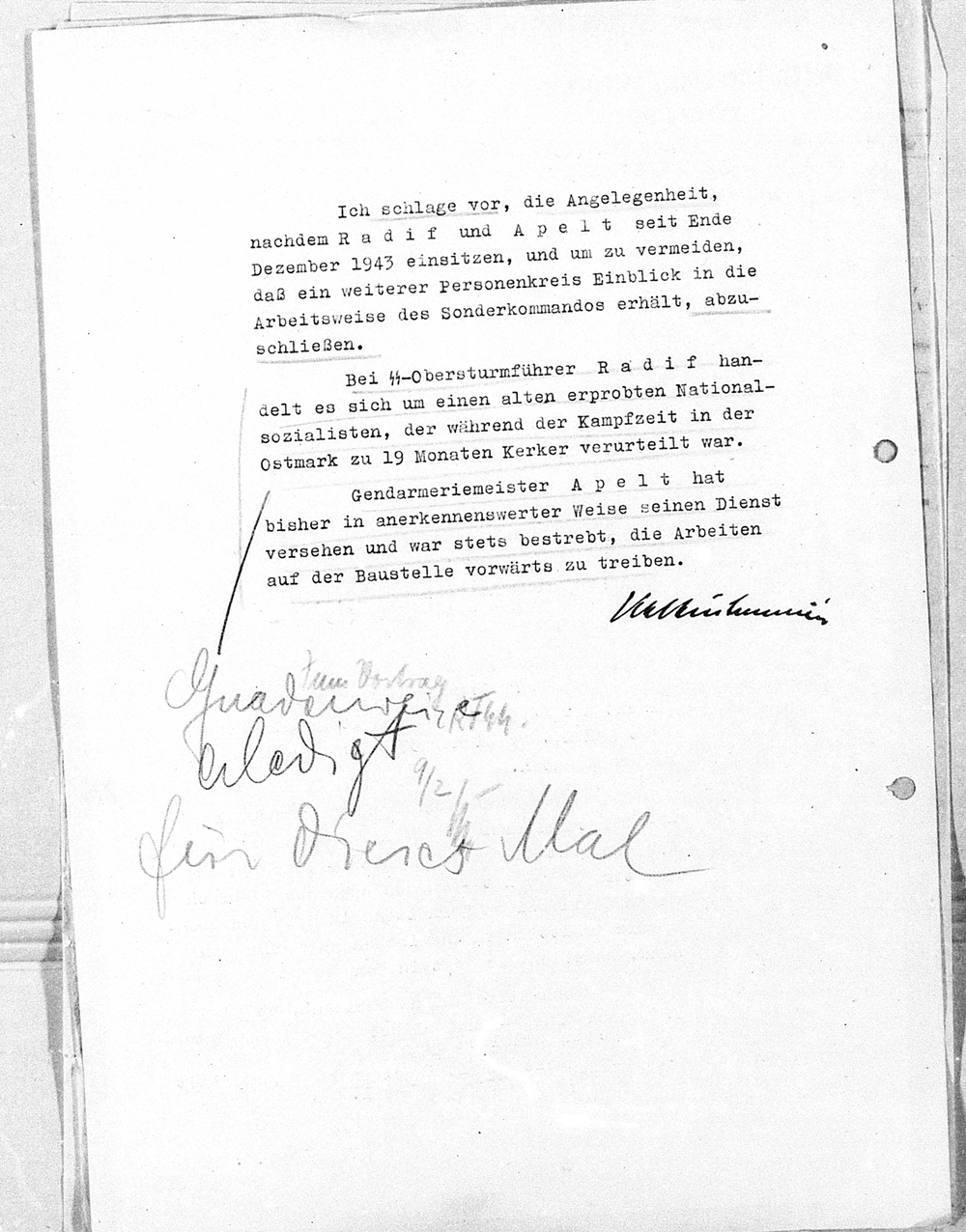
Kaltenbrunner on Aktion 1005: "...to avoid that another group of persons gains insight into the operation of the Sonderkommando."

On February 3, 1944, Eichmann's office dispatched a letter, signed by the head of the RSHA, Ernst Kaltenbrunner, to Reichsführer-SS Heinrich Himmler. The letter requested a decision on how to handle the SS and police personnel responsible for the escape of Jewish prisoners from Sonderkommando 1005 at Fort Kauen.

Kaltenbrunner proposed "the matter should be concluded within our jurisdiction" instead of involving the SS and police court "to avoid another group of persons gaining insight into the operation of the Sonderkommando". 

By the way, I have yet to come across any explanation from Holocaust deniers regarding the true nature of Aktion 1005. It remains a top-secret operation involving the clearance of mass graves containing evidence of Nazi atrocities. 

If any deniers possess information on an alternative interpretation, I invite them to share their insights in the comments along with supporting evidence.

DOCUMENT


Saturday, July 27, 2019

Blobel, Eichmann's Office and a Denier's Ignorance

We have already observed the pattern that whenever the denier Carlo Mattogno claims on the Holocaust that something or someone is not known, had nothing to do with something else or did not exist, then there is a good chance that the exact opposite is true.

Examples:
  • Josef "quite unknown" Spacil (SS-Standartenführer, BdS Niederlande, SS economist at the HSSPF Süd-Russland, head of RSHA II)

  • Johann "completely unknown" Ernst (SS-Untersturmführer and Technischer Obersekretär, head of SiPo repair garages)

  • Guido "completely unknown" Huhn (SS-Obersturmführer, SS-Sondereinheit at concentration camp Auschwitz)

  • Friedrich "not a Major in any way" Pradel (SS-Sturmbannführer and Major der Schutzpolizei, RSHA II D 3 a)

  • on Sonderkommando 1005 German documents that "there are none" and that the designation "was invented by the Soviets".

  • on the Minsk gas-chamber dossier that the "signature of the note in question is by a different hand and is a rather clumsy attempted imitation" and that "there is no trace of any record of the presumed visit to Minsk itself by any Italian fascist delegation".

  • on homicidal gas vans that "the word 'Gaswagen,' in the sense of 'mobile homicidal gas chamber' was coined only after the Second World War by the victorious powers".

  • on homicidal gas vans that "the term 'Gaskammer' can only refer to a stationary 'gas chamber'".

  • on Saurer gasoline driven gas vans that "all Saurer trucks had diesel engines"

  • on intercepted decodes on the mass killing unit Sonderkommando Lange that "there is no mention of Sonderkommando Lange, or gas vans, or Novgorod, or mental patients to be killed!".

  • on a gas van document that "[c]ontrary to normal practise, the typed name of the author of the letter is missing, as are his name [sic!] and rank and  that steel bottles with carbon oxide "does not appear in any document".

  • on the testimony of von dem Bach-Zelewski that "the Jewish editors of Aufbau falsified the original document, shamelessly interpolating and adding entire paragraphs".

  • on the Auschwitz Jewish Sonderkommando that "not a single one had anything whatsoever to do with the crematoria" 

Mattogno never gets tired to deliver explosive ammunition that would have destroyed his reputation as a researcher - if he ever had one. In this posting, we take a look at another case in point from his recent "Holocaust Handbooks": Mattogno argues that the Aktion 1005 leader Paul Blobel "had nothing to do" with Eichmann's office - which is straight away refuted by numerous contemporary German documents.

Sunday, October 28, 2018

SK Lange and Mattogno's Italian Book on the Einsatzgruppen

A few days ago, Germar Rudolf indiscreetly revealed on the Holocaust Handbooks site that he has "submitted a long list of open issues -- including remarks made by the HC blog" to Carlo Mattogno for review for an already translated and edited, but not yet published English edition of his Einsatzgruppen book. I don't want to miss the opportunity to add to this list his (mis)treatment of Sonderkommando Lange, if it's not yet on it. I have already blogged extensively on SK Lange, but I will again roll out some of it in this posting specifically to address Mattogno's Italian edition of his Einsatzgruppen book.

Scrolling through the footnotes (Mattogno, Gli Einsatzgruppen nei territori orientali occupati, parte I, p. 279 - 286), it strikes one right away that his knowledge of literature is marginal, his use of documents selective and his study of testimonial evidence virtually non-existent.

His main source is the more than 30 years old article by Beer, Die Entwicklung der Gaswagen beim Mord an den Juden (1987). He does not use in this context or know of the more recent works specifically on the killing of mentally ill people and SK Lange, like 
  • Rieß, Die Anfänge der Vernichtung lebensunwerten Lebens in Danzig und Wartheland 1939/40 (1995)
  • Alberti, Die Verfolgung und Vernichtung der Juden im Reichsgau Warthegau 1939-1945 (2006)
  • Topp et al., Die Provinz Ostpreußen und die nationalsozialistische "Euthanasie" SS-"Aktion Lange" und "Aktion T4", Medizinhistorisches Journal, 43 (2008) 
  • Montague, Chelmno and the Holocaust (2012)  [only cited later on]
  • Leidinger, Das Schicksal der polnischen Psychiatrie unter deutscher Besatzung im Zweiten Weltkrieg, Psychatrische Praxis, 41 (2014)
  • Schwanke, Die Landesheil- und Pflegeanstalt Tiegenhof (2015)
Mattogno pours in some snippets from Gerlach's Kalkulierte Morde and Longerich's Holocaust - not exactly specialist literature on the subject - and some British intercepts of radio signals. But this does not change the overall picture that he is mainly stuck in the 80s, both in terms of literature knowledge and his method, that does not seem to have advanced since then.

His limited knowledge of sources combined with his usual double standards, systematic misinterpretation, destructive approach of dismissing evidence for no real reason without offering any own narrative seems to provide him with the false certainty that he has somehow neutralised the momentum of SK Lange on gas vans and the Holocaust. 

Saturday, September 16, 2017

Sonderkommando Kulmhof in German Documents - Body Disposal

Mass Killing Unit of Warthegau

Sonderkommando Lange in German Documents:

Sonderkommando Kulmhof in German Documents:
Part III: Body Disposal (Appendix)
Part V: Funding
Part IX: Farewell (1943)

Sonderkommando Kulmhof in German Documents - Body Disposal (Appendix)

Mass Killing Unit of Warthegau

Sonderkommando Lange in German Documents:

Sonderkommando Kulmhof in German Documents:
Part III: Body Disposal (Appendix)
Part V: Funding
Part IX: Farewell (1943)


Saturday, May 06, 2017

Busted: Jürgen Graf caught lying. Again.

That Jürgen Graf is a discredited liar has been established long ago. See e.g. the articles "Jürgen Graf is a Liar", "He sure is".

As I mentioned in the postings "Deniers on Sonderkommando 1005" (published in 2006) and "Once More, With Feeling: Deniers And Aktion 1005, 10 Years Later" (2016 with several 2017 updates), Mattogno and Graf told an untruth about there being no documentary evidence for Aktion 1005.

Whether or not this untruth was deliberate or a result of the fraudulently ignorant pseudoscholarship is now less relevant, since in 2011 Graf published an article "The Moral and Intellectual Bankruptcy of a Scholar" (about Christian Lindtner, a former denier who saw through the dishonesty of the denier dogma) in which he wrote about Jens Hoffmann's fine book about Aktion 1005:
It suffices to read Jens Hoffmann’s book about the "Aktion 1005”[15] to realize that the whole tale is exclusively based on "eyewitness evidence”, "confessions” and post-war trials where such "eyewitness evidence” and "confessions” formed the sole basis of the accusation.
This is however a blatant lie since Hoffmann cited two German wartime documents mentioning Aktion 1005, both cited by me here.

Fast forward to February 2017, when the fourth (!) revised edition of Jürgen Graf's books Der Holocaust. Die Argumente appeared (Graf wrote an introductory note on 03.02.2017). In it on pp. 104-5 he calls Aktion 1005 "mythical", refers to his and Mattogno's Treblinka book (whose treatment of this particular issue was debunked in 2006, not to mention the 2016 update, see links above), and repeats the above-cited sentence about the history of the operation being based solely on witnesses and court acts, referring specifically to Hoffmann's book:
Dass die ganze Geschichte von der “Aktion 1005” ausschließlich auf “Augenzeugenberichten” und “Tätergeständnisse” sowie auf Gerichtsakten fußt, bei denen solche Zeugenaussagen und Geständnisse das einzige Beweismaterial bildeten, geht aus dem anno 2008 erschienenen Buch eines Jens Hoffmann eindeutig hervor.295
295 Jens Hoffmann, “Das kann man nicht erzählen.” ‘Aktion 1005.’ Wie die Nazis die Spuren ihrer Massenmorde in Osteuropa beseitigten, Hamburg 2008. 
Graf should know full well about our refutation of this claim and knows full well about the fact that Hoffman's book cited two German wartime documents mentioning Aktion 1005 and that Shmuel Spector's article quoted one such document.

Jürgen Graf is a proven liar.

Saturday, March 18, 2017

Evidence on the Babi Yar Massacre 29 & 30 September 1941: Testimonies

Part I: Contemporary Sources
German Sources (20 documents + 13 photographs)
Diaries of Local Population (2)
Swiss (3), Soviet (6), Polish (1), US Sources (1)

German Military, Paramilitary & Ukrainian Police Forces (29)
German Civilians (1)
Local Population and Prisoners (32)


NB: Many of the Russian testimonies have not been translated into English, however a decent understanding is obtained from machine translators such as google translate.

Sunday, September 11, 2016

From the vocabulary of Aktion 1005

With time the members of Aktion 1005, whose task was destroying the traces of the Nazi crimes by incinerating corpses from mass graves, developed their own slang to denote their activities. Some of the terms became sort of official, as we will see. Since the issue of the Nazi code words crops up from time to time in denial-related discussions, I decided to gather what I could about several terms most often used by the corpse-burning brigades.

Saturday, August 27, 2016

“The Jews buried in a little wood near Kulmhof”: Documenting Cremation at Chelmno

In his brochure Chełmno: A German Camp in History and Propaganda, Carlo Mattogno declared (p.83):
Not a single document exists on the alleged Chełmno crematoria

Unfortunately for “the world’s premier revisionist scholar”, this assertion is false.


Saturday, April 23, 2016

Another 1005 mini-update.

I have now added a new document to "Once More, With Feeling: Deniers And Aktion 1005, 10 Years Later". While a minor reference, a mention is a mention.

But I can also reveal that in addition to the 7 published documents in that post we have now been able to identify 14(!) more German wartime documents, which, to our knowledge, haven't been published, which contain explicit mentions of 1005 - 13 of them specifically refer to Sonderkommando 1005a.

That is, at present we have identified 21 German wartime documents explicitly referring to the designation 1005. All of them easily available to the researchers willing to do some basic legwork. We think that the  published 7 documents are more than enough to make our point about the denier huckster Mattogno and his lapdog Graf, so we're not in a hurry to release the rest of our cache, but we just thought we would let our readers know that the amount of evidence out there is pretty staggering. And this concerns not only the limited issue of 1005 but most of the topics the deniers try to tackle in their clownish ways.

(Updated to retroactively reflect the new number of documents on 18.05.2016.)

Update 26.05.2016: we have now identified yet another German wartime document (apparently previously unpublished), the one that explicitly mentions SK 1005 a and b. So the score is 22 now.

Saturday, April 09, 2016

A short update on Mattogno and Aktion 1005

I have just added one more document to my post "Once More, With Feeling: Deniers And Aktion 1005, 10 Years Later". It not only explicitly mentions  both SK1005a and SK1005b, it also calls them a task of the Reichsführer-SS Himmler which was a secret Reich matter and which was given to Paul Blobel - something Mattogno and his freaky sidekick Graf have always desperately tried to deny.

That means that thus far at least 5 German wartime documents mentioning the designation 1005 are available to researchers (not including the letter from Müller to Luther, the treatment of which Mattogno completely botched, and not including the documents that clearly speak about this action but do not mention the designation). Wheareas Mattogno claimed that there are none, which, to repeat, makes him a fraudulent clown.

Monday, February 01, 2016

Once More, With Feeling: Deniers And Aktion 1005, 10 Years Later

About 10 years ago I composed a blog post about Mattogno and Graf's treatment of Aktion 1005.

I pointed out that Mattogno and Graf couldn't get the simplest things about the documentary evidence straight: they made a mess of the letter from Müller to Luther and the letter from Himmler to Müller - schoolboy level, one might be tempted to say, but even a schoolboy could have done better; they had no idea about Shmuel Spector's seminal article, which fact demonstrated their utterly dismal level of research; and finally, they made an outlandish claim that the very designation "1005" was a Soviet invention - something that is outright contradicted by Spector's article, which cites this German wartime document:
By special order of the Reichsfuehrer SS, Sonderkommando 1005 arrived, to execute special duties in the area of the army.
Of course, other deniers didn't fail to parrot this ignorant assertion. Denier guru Rudolf in his Lectures on the Holocaust (2nd ed., p. 276):

Sunday, August 06, 2006

That's why it is denial, not revisionism. Part VI: Deniers and Babiy Yar massacre (4)

John Ball's argument has been uncritically accepted by many deniers. Here are just some "revisionist" sources happily swallowing Ball's BS: 1, 2, 3, 4, 5, 6, 7, 8. Etc. Suckers.

One source should interest us in particular - the book about Treblinka by our favorite victims, Mattogno and Graf. In a review of this book Graf writes:
Treblinka: Extermination Camp or Transfer Camp? is mostly the work of Carlo Mattogno, since he edited seven of the nine chapters. I am the author of the first and fifth chapter, and the introduction and conclusion...
I.e. the author of the chapter we've been discussing in this series is Carlo Mattogno. Of course, Graf himself also wrote about Babiy Yar in The Giant with Feet of Clay and Holocaust or Hoax? claiming that the "case of Babi Yar provides an irrefutable proof of the falseness of these Operational Reports", rehashing arguments of Tiedemann and Ball, and generally spouting the usual uninspired nonsense. But Graf is a lesser half of the duo, Mattogno being the main researcher and a "mastermind". So someone could expected a somewhat more refined analysis from him. Oh boy, would that someone be in for a disappointment!

Read more!

I guess it should be mentioned only in passing that Mattogno finds Ball and Tiedemann credible:
"e. Babi Yar
In the “Activity and Situation Report no. 6 of the Einsatzgruppen of the Securty Police and the SD in the USSR,” we read this concerning the time period from October 1 to 31, 1941:595 “In Kiev all the Jews were arrested and on September 29 and 30, a total of 33,771 Jews were executed.” This deals with the (in)famous ‘Massacre of Babi Yar.’ However, as Udo Walendy and Herbert Tiedemann have proved, this did not happen, at least not remotely in the scope claimed.596 Presumable near Kiev, as in Simferopol, several hundred people were shot. We will come back to the case of Babi Yar.
595 102-R. IMT, Vol. XXXVIII, pp. 292f.
596 Udo Walendy, “Babi Jar - Die Schlucht ‘mit 33,771 murdered Jews’?”, in: Historische Tatsachen
no. 51, Verlag für Volkstum und Zeitgeschichtsforschung, Vlotho 1992. Herbert
Tiedemann, “Babi Jar: Critical Questions and Comments”, in: Germar Rudolf (ed.), op. cit.
(note 81), pp. 501-528."
On September 26, the Luftwaffe took an aerial photograph of the area, in which Babi Yar was located. John Ball has published it with the following commentary:[...]
Regarding an enlarged section of the same photograph, Ball says:[...]
Ball deduces from this:[...]
These findings have all the more value since, according to the sole witness, the cremation of the bodies in Babi Yar is supposed to have been completed on September 25 or 26, corresponding to the same day or the day before the air photos were taken.
Then pure idiocy begins:
This Vladirmir K. Davidov is apparently the only witness who claims to have participated in the cremation of bodies of Babi Yar. His tale is wholly unbelievable. The number of bodies - 70,000 - is more than double the number shot according to the Event Report, which in itself is already hugely excessive.
"Apparently the only witness". This alone disqualifies Mattogno from being a serious researcher. This means that he did not take pains to study the available literature on the massacre and the following events. Here's a (probably incomplete) list of literature available at the time Mattogno wrote this phrase, which contains testimonies of Sonderkommandos other than Davydov:
  • the 1993 book with the Russian, English and German versions of the testimonies of Babiy Yar Sonderkommandos Jakov Kaper and David Budnik, edited by the Babiy Yar researcher Erhard Roy Wiehn and published by Hartung-Gorre Publishers, D-78465 Konstanz/Germany (Hartung.Gorre@t-online.de) under ISBN 3-89191-666-3 (last time I checked it was still available);

  • the English translations from this book, available at http://www.ess.uwe.ac.uk/genocide/content.htm, at least since 1999;

  • the Russian edition of Babyi Yar Sonderkommando Zakhar Trubakov's memoir, available at http://www.geocities.com/svr_2000svr_us/bkv/ at least since 2000;

  • Anatolij Kuznetsov's excellent Babi Yar: A Document in the Form of a Novel, from which Mattogno could learn that when Kuznetsov was writing the book, at least nine Sonderkommandos were still alive: Jakov Stejuk, Vladimir Davydov, Vladislav Kuklya, Jakov Kaper, Zakhar Trubakov, David Budnik, Semyon Berlyand, Leonid Ostrovskij and Grigorij Iovenko;

  • protocols of interrogations of Berlyant, Stejuk and Davydov published in 1991 (Babij Jar. K pyatidesyatiletiju tragedii 29, 30 sentyabrya 1941 goda, Jerusalem, 1991; "Babyn Jar (veresen' 1941 - veresen' 1943)", Ukrainskij istorychnyj zhurnal, 1991, no. 12).
Plus, Sonderkommandos' testimonies were used in different war crimes trials, such as SK1005 trial in Stuttgart in 1969; they also gave testimonies to the Extraordinary Commission. (For completeness' sake I will mention that Sonderkommandos and other witnesses were also interrogated many times since 1943, but most of these documents have been published only recently, in the 2004 volume cited previously.)

Last, but not the least, is the 1944 Soviet Extraordinary Commission report (courtesy of David Thompson), which states (p. 201, Eng. edn.):
Witnesses L. K. Ostrovsky, S. B. Berlyand, V. Yu. Davydov, Ya. A. Steyuk and I. M. Brodsky who escaped the shooting in Babi Yar on September 29, 1943 have testified the following: "As prisoners-of-war we were kept in the Syrets camp in the outskirts of Kiev. On August, 18, 100 of us were sent to Babi Yar. There we were chained into shackles and ordered to dug out and burn the bodies of Soviet citizens exterminated by the Germans [...]"
Detailed description of the process follows.

How come Mattogno did not examine this report?

"The number of bodies - 70,000 - is more than double the number shot according to the Event Report, which in itself is already hugely excessive." Mattogno's ignorance shows again. He doesn't show that the number in the German war-time documents is "hugely excessive". And it is clear that he doesn't understand that according to numerous witnesses, the ravine served as an execution site for two years since the initial massacre. So the number of corpses in the ravine should not correspond to the number of victims in the German reports, and not all of the victims were Jewish.


The real number of victims will never be known. We know from many testimonies (e.g. those published in Babij Jar book cited in the previous posting) that shootings continued for several days afterwards the initial action. How many were shot is not known. We know from testimonies that executions continued afterwards, for two years - many thousands (possibly, 20,000-25,000) of Soviet POWs were shot and buried in a nearby ditch; Gypsies, partisans, Ukrainian nationalists and others were shot in the ravine. Gas vans were also used.

We have numerous testimonies of Jewish survivors who worked in the ravine and burned the bodies. I have summed up their testimonies about the number of corpses here. As is only to be expected, there are differing estimates and details. I think it will be reasonable to estimate the minimum number of victims as 70,000. Possibly, the real number is about 100,000. It is not known how many of the victims were Jewish and how many non-Jewish. Probably, if we accept the lower estimate, the ratio is about 1:1, while with the larger estimates we have more non-Jewish victims than Jewish ones.

Later Mattogno reasserts his ignorance:
Thus, the most important material evidence for the shooting of 33,771 (or 70,000) Jews...


Next, Mattogno explores the issue of physical evidence. First, what should have remained:
With the data specified in the fourth chapter, the cremation of 33,771 bodies would have required approximately 4,500 tons of firewood and approximately 430 tons of wood ashes and about 190 tons of human ashes would have been generated by the process.
Let's take the data from Roberto's posting about Mattogno and Belzec (keeping in mind that it may have to be corrected in the future, if the new data arrives), and assume 100,000 bodies with an average weight of 45 kg (there were lots of children and women among the victims, though probably not as many as in Belzec). That's about 4,500 tons of corpses. 5% of that is 225 tons (if we follow Mattogno's rules). Again, accepting Roberto's generous assumptions (i.e. no regard for decomposition of corpses), the wood ashes would constitute about 360 tons. Together - 585 tons. SKs testified that they were mixing the ashes with sand and earth inside and around the ravine, and dumping it in nearby kitchengardens, fields, etc. They were working for about 40 days. I.e. on average they would have to transport and disperse around 14.6 tons of ashes per day. They were working for 12-15 hours, according to their testimonies. Assuming 12-hour working day, they had to disperse 1.2 tons of ashes per hour. Assuming 30 kg per person, they would need about 40 SKs busy with dispersing ashes - each having to disperse 30 kg per hour. And they had at least 300 people working in the ravine. These numbers are very rough, and possibly the situation was much better from a logistical POV, the wiggle room is quite large. Suppose they were always working for 15 hours. Then they would need just 32 men. Suppose they didn't need an hour to disperse 30 kg of ashes... Etc., etc., etc. So yes, it was possible to spread ashes and bones around the area. No, it wouldn't be possible to obliterate the ashes and pieces of bones completely, but then, nobody claims that it was done.

E.g. in his book Anatolij Kuznetsov describes his trip to the ravine with his friend not long after the incineration had stopped:
We knew this stream perfectly... It contained coarse-grained sand, but now for some reason it was full of white stones.

I stooped and took one to take a closer look. It was a burned piece of a bone, size of a nail, white on one side, black on the other. The stream washed away them from somewhere. [...]

So we walked for a long time over these bones, until we reached the very beginning of the ravine, where the stream disappeared - here it originated from many sources seeping from sandy layers, and that's where the bones came from.

The ravine became narrow ... and in one place the sand became gray. Suddenly we understood that were were walking on human ashes.

[...]

We walked around a little bit, found many whole bones, fresh skull (still wet) and again pieces of black ashes among the gray sand.

I picked up one piece, about two kilograms, took it with me and kept it. This is the ashes of many people, everything is mixed in it - international ashes, so to say.
(JFYI, Kuznetsov wasn't Jewish, he was half-Ukrainian, half-Russian; he escaped from USSR in 1969, taking the uncensored Babij Jar with him. The full version is extremely critical of the Stalinist regime, so, of course, it couldn't have been published in USSR in full. In a 1965 letter to Shlomo Even-Shoshan Kuznetsov wrote:
I belong neither to Zionists, nor to antisemites - both [ideologies] are equally repulsive to me, and I'm writing my story from what I think is the only right position - internationalist.
)

Now consider Mattogno's blather about the photos made by the Soviet commission:
After the Soviets had reconquered Kiev, an investigatory commission made its way to Babi Yar and took some photographs, which were immortalized in an album. Three of the photos supposedly show a first and a second "zone where the bodies were burned."[643] In another, the "remnants of the ovens and the grotto, into which the prisoners who had cremated the bodies had escaped" are allegedly shown.[644] The captions to these pictures are absurd; the only actual, clearly recognizable objects are a few rotted shoes and some rags, which were painstakingly photographed by the Soviets and were described as follows:[643]

"Remnants of shoes and pieces of clothing from Soviet citizens shot by the Germans."
Why are the captions "absurd"? Photos by themselves are not enough, and the captions provide context. Indeed, exactly because not much is "recognizable" on the photos, the captions are needed.
Thus, the most important material evidence for the shooting of 33,771 (or 70,000) Jews and the later excavation and cremation of their bodies, which was discovered at the scene of the crime by the Soviets, consisted of a few shoes and some rags! If, however, the Soviets took such great pains to document things, which had no connection with the charges, what a propaganda circus would they have put on if they had really discovered mass graves with a total of far more than a million murdered Jews (as well as countless non-Jews)? Yet such a propaganda circus failed to occur, since the Soviets found nothing, which would have been comparable to the discoveries made by the Germans in Katyn and Vinnitsa!
Suddenly Mattogno jumps from the issue of Babiy Yar to the issue of the mass graves in general, with which we have dealt here and here. In what specifically concerns Babyi Yar, there were no longer mass graves there, nothing for "propaganda circus". The focus, therefore, was on investigation of the nearby Syretsky camp, in which many unburned corpses have been found.

Not that I know of any "propaganda circus" associated with these gruesome findings.

The real circus here is deniers' treatment of the Babiy Yar massacre, which mirrors their treatment of the Holocaust in general.

Previous << Part V: Deniers and Babiy Yar massacre (3)

Next >> Part VII: Other pathetic objections to Einsatzgruppen reports

Wednesday, May 10, 2006

Sonderkommando 1005 in PRO decodes

Stephen Tyas, British researcher who discovered the famous Hoefle telegram (you can read his and Peter Witte's article about it in Holocaust and Genocide Studies [1 MB PDF]), has kindly supplied me with copies of two documents dealing with actions of Sonderkommando 1005, which he has discovered in the Public Records Office (Kew, HW 19/238).

The first researcher to refer to these documents in a publication was Robert Hanyok, who received the decodes from Tyas. In his study Eavesdropping on Hell [PDF] Hanyok wrote:
In late 1943, as the Axis forces retreated west all along the front before the resurgent Red Army, the Nazi authorities were faced with the problem of destroying the evidence of the earlier massacres perpetrated by the Einsatzgruppen, police and SS formations. In October 1943 intercepted and decoded radio messages of the SD revealed that the Germans were in the process of exhuming the sites of mass executions and destroying the remains. The texts of the intercepted messages were written in the obtuse language that the Germans used for all matters pertaining to the Holocaust. These messages indicated that such work, executed by Sonderkommandos (Special Detachments), and included cleaning up "special places of work" in the Baltic region southwest of Leningrad, near the cities of Novgorod and Pskov. Interestingly, in trying to identify the murder sites, SS officials had to rely on information from Latvian and Russian collaborators.

Even though these documents don't mention the number "1005", still, they help to debunk - once again - the crazy claim made by the deniers that SK1005 was nothing but a figment of imagination, a Soviet or Allied invention. Moreover, they elucidate the method which Blobel and his men used to find the graves, thus also debunking deniers' argument, that they would have to have an extensive set of maps, etc.

One of these decodes is also interesting in that it may yet haunt a certain still living Russian émigré who collaborated with the Nazis.

What follows is a transcription of the decodes (it seems only the translations exist) with comments based on research by Stephen Tyas (and my small contribution).

Read more!


[...]
GROUP XIII/27
BERLIN to CRIMEA area
[...] 1641 GMT 12/10/43 [...]
For ROEDER1. For the completion of urgent business of
winding up in the sphere of the EK 1 and EK 2, exact
details are required immediately concerning special
places of work from November 1941 up to July 1943.
Positional details, special places of work, particularly
in GRIGOROVO2 near NOVGOROD, are to be transmitted
at once to SS Stubaf. BLOBEL, at present B.d.S. RIGA
and RSHA 4 B 4. All speed essential.
GUENTER. SS Hstuf.

1. SS-Sturmbannfuehrer Dr Rudolf Oebsger-Roeder (b. 09.03.1912), at time of the decodes was the Unternehmen Zeppelin field commander in the Crimea on behalf of RSHA VI C Z. (S. Tyas)

2. Grigorovo was a posyolok (settlement) near Novgorod, now it is within the city's border. According to information from Dr. Boris Kovalyov of Novgorod State University, in Grigorovo there was an HQ of the Spanish Blue Division and a camp for Soviet POWs.


[...]
GROUP XIII/27
CRIMEA AREA TO BERLIN

[...]1641 GMT 12/10/43[...]

To RSHA IV B 4. Secondly. BdS. RIGA SS Stubaf.
BLOBEL. Ref. W/T1 message of 11/10 Nr. 18.
1) In Ravine near air-force barracks of SIEVERKAJA2
close to the north-west of the airfield,
little material. 2) GATTSCHINA3 castle grounds
about 200 m. distant from the former quarters of
the Kdo. Ostuf. BOSSE4, former Latvian interpreters
TONE, DZELSKELEJS5, and others, all apparently
["from" crossed out by hand] RIGA, are able to give information concerning
1) and 2). Russian collaborator, RUTSCHENKO6 [correction by hand], can
also give indications, at present PSKOV UZ[?]7.
3) Ref. PUSCHKIN, ZARSKOJE, SELO8 and TOSSNO9.
Please question Stubaf. Dr. ? ["?" crossed out by hand, and handwritten name "FRANCZ"10 inserted] and Stubaf. HUBIG,
both RSHA I b.

[...] Part 2. 4) GRIGOROWO
at NOVGOROD not known to me. As EK 2 [is concerned],
perhaps Ostubaf. EHRLINGER11 of Egr. N can give
information, or else Hstuf. KRAUS (brother of Stubaf.
OTTO KRAUS), who is at present at PSKOV.
Sgd. ROEDER, Stubaf.

1. Wireless transmission (S. Tyas)

2. An execution in "Severskaya region" is mentioned in Operational situation report USSR no. 150 (S. Tyas). Siverskaja railroad station in Gatchinskij (Krasnogvardejskij) rajon. Named after posyolok (settlement) Siversjkij, in which the military airfield is located. Executions were most frequent in nearby posyolok Stroganov Most. (V. Nikolajev, "Gatchinskaja zemlya pod gnyotom okkupantov" in Gatchinskaja pravda, no. 42, 19.04.2005).

3. Gatchina/Krasnogvardejsk can be seen on Stahlecker's famous map. The map lists 3600 Jews as dead, but this probably applies to the number of the Jews shot in whole oblast. According to the Soviet Extraordinary Commission, in Gatchina 100 people were shot, 762 - hanged, 3,508 - died after torture. While one should always be critical about EC numbers, it seems there were enough criminal traces in the town to cover up.

4. SS-Obersturmfuehrer Dr. Heinrich Bosse, SD officer with EG A in Leningrad area, 1941-June 1943 (S. Tyas).

5. Bruno Tone and Lt. Dzelzkalejs both noted in 1941/42 with Latvian SD and in January of 1943 with "Sonderkommando Latgale" on the Latvian/Belorussian border in Unternehmen Winterzauber: Tone was Company Commander and Dzelzkalejs Deputy Company Commander (S. Tyas). Interrogation of Tone by Smersh is available here. [Link no longer works, but there's much info about Tone in Russian if you google for "Тоне Бруно" and "Бруно Тоне".] According to it, he served as a translator to Stahlecker's deputy in October of 1941. He was also a commander of the 4th company of Latvian SS battalion, which guarderd concentration camp in Salaspils. Later he also was in Jagdverband-Ost.

6. In 1970s Zhores Medvedev claimed that a certain Nikolaj Nikolajevich Rutych-Rutchenko was "NKVD investigator in Riga in 1941, then Gestapo investigator in Berlin in 1942". However, according to other sources, during the war he was in the "third force" movement, fighting against Soviets and Germans in the forests of Pskov and Novgorod, and was arrested by the Germans only in 1944. Allegedly, he spent time in Sachsenhausen, Flossenbuerg and Dachau as an inmate.

V. Baidalakov, a long-time chairman of NTS, wrote in his memoir, published in Moscow in 2002:
S.P. Rozhdestvenskij from Novoje Slovo calls. He sends a man from Gatchina to me. I open the door when he rings - a brunet in his 30s, smart appearance, intellectual, lieutenant of SD. Arrived from the Russian detachment in SD forces. He presents himself - Nikolaj Nikolajevich Rutchenko-Rutych. Tells his biography: graduate student of history faculty, student of academician Grekov; when the war broke out, decided to go over to the Germans; in order to accomplish this he joined a unit of Soviet parachutists that was being formed then, in such a way got into the German rear, joined SD forces, in the front-line zone got to know people from NSNP and joined it. Although his bio was obviously too smooth and "lacquered", he was welcomed by us in Berlin - we'll see. Later it became known that one young lady knew him in 1940-1941 in Riga, when he wore NKVD uniform. Now this dame is married, happy, emigrated with her husband to Canada and does not want to resurrect passions of her youth.
Vladimir Rudinskij, another Russian émigré author living in Paris, adds:
I met him in Gatchina, occupied by the Germans, where he was far from being a driver or a kitchen boy. And this meeting almost cost me my life.
Coupled with these testimonies about Rutchenko serving the Nazis and being in Gatchina, the conclusion is inescapable that it is the same "RUTSCHENKO" mentioned in the decode.

After the war Rutchenko was a constant author in émigré journals. He published many historical treatises (you can search the Library of Congress catalogue for "Rutych"). Currently he peacefully resides in Asnieres, France, and doesn't even hide his address and phone number.

[There has been an avalanche of materials about Rutych-Rutchenko since this article was published, including a whole film exposing his past, a scholarly article in Rodina and this item.]

7. The Pskov office of Unternehmen Zeppelin (S. Tyas).

8. The town of Pushkin was also called Tsarskoje Selo. But Tsarskoje Selo is also a magnificient palace/park/museum ensemble in Pushkin. Dr. Ilja Altman informs that in autumn of 1941 800 Jews of Pushkin were led into the cellars of Yekaterininksky palace. They were being shot in groups in the park itself.

9. For Tosno, four executions were reported at local sawmill between 17-19 Sept 1941 (Wehrmacht report - Gen.Kdo.XXVII AK, Nuremberg doc. NOKW-1580); also a Teilkommando under SS-Sturmbannfuehrer Hermann Hubig (also later with Unternehmen Zeppelin) after some resistance to a request from the army, killed 240 mentally handicapped persons at an asylum in Makarjevskaja Pustyn' monastery (Wehrmacht report, NOKW-2268). (S. Tyas)

10. Possibly a coding error or a part was missed in transmission. Research shows this may refer to SS-Sturmbannfuehrer Kurt Graaf who was with EK 1c and Teilkommandofuehrer Krasnogwardeisk August-November 1942, and previously with RSHA I. (S. Tyas).

11. SS-Obersturmbannfuehrer Erich Ehrlinger, later KdS Kiew (S. Tyas).

Sunday, April 09, 2006

Update on SK1005

After having posted about deniers' treatment of SK1005, I received information about PRO decodes mentioning SK1005 (and Blobel). I am not free to divulge the details, but the article quoting these documents may be published in the near future. So keep this in mind when deniers repeat their debunked arguments.

Wednesday, April 05, 2006

That's why it is denial, not revisionism. Part I: Deniers on Sonderkommando 1005

In the book Treblinka. Extermination Camp or Transit Camp? Holocaust deniers Carlo Mattogno and Juergen Graf show blatant disregard for truth, by denying events for "reasons", which turn out to be bogus when the minimal amount of research is performed.

Let's start with the simplest case - that of Aktion/Sonderkommando 1005.

The gist of what Aktion 1005 was about you can glean at death-camps.org:
Under the code name "Aktion 1005" the Germans tried to cover all tracks of Nazi extermination policy in the east, by opening mass graves and cremating hundreds of thousands of bodies.
Here's what Mattogno and Graf have to say about it:
The decision to allow this operation to start up is supposed to have been made in Berlin at the beginning of 1942. A letter of February 20, 1942, from the Chief of the Gestapo, Heinrich Müller, to Martin Luther of the Foreign Office, in which the subject of the unsatisfactory burial of corpses is raised and which is supposed to have been written after Müller "had received an anonymous letter complaining about the corpses flooding the Warthegau area," is cited as proof. This letter bears the file designation "IV B 4 43/42 gRs (1005)," and the alleged 'Operation 1005' is supposed to have gotten its name from this document!

But Alfred Streim, who cites the relevant letter based on first-hand knowledge, writes:

"On November 20, 1942, Himmler ordered SS-Gruppenführer Müller, Chief of Department IV in the RSHA, in writing (Zst. Dok. Slg. Ordner 3, Bl. 583): '...You must give me a guarantee that the bodies of these deceased Jews will either be burned or buried in every location, and that nowhere can anything else of any kind happen with these bodies..."

He does not say that this letter bore the heading "IV B 4 43/42 gRs (1005)," does not assign to it the designation '1005,' and confines himself to the following comment:

"The undertaking received - in accord with a nomenclature procedure of the RSHA - the designation '1005.'"

Thus, the letter concerned dates from November 20, 1942, and not from February 20. This would mean that the designation '1005' for the operation would have been assigned a full five months after its start! On the other hand, in the letter the Jews are referred to as "dead," not 'shot' or 'killed.' Moreover, the disposal of the bodies could take place by cremation or burial, which means that the Himmler letter need have no connection with the excavation and cremation of corpses of Jews who had been shot, and what we are dealing with here is a primitive hoax.

[...]

Now, if one considers that according to the most comprehensive studies on this subject that exist, the Einsatzgruppen alone are supposed to have shot 2,200,000 people (Jews and non-Jews), that Wehrmacht, SS, and police units are also accused of hundreds of thousands of murders, and that - as already emphasized - neither the Soviets nor the Poles have found any mass-graves with even only a few thousand bodies, the 'Sonderkommandos 1005' must have exhumed and burned between one-and-a-half and three million bodies. This means that within a period of 13 months they had to have emptied thousands of graves at hundreds of locations, which were scattered over an enormous area - all of this without leaving behind any material or documentary traces!

Without having thousands of maps, on which the graves were marked, it would quite obviously have been impossible to locate those thousands of mass graves in a territory of more than 1.2 million square kilometers, but neither are such maps mentioned in even a single Einsatzgruppe report or any other document, nor have such maps ever been found among the German documents captured by the victors of World War II. And if - as the witnesses report - thousands of pyres were burning during the night despite blackout regulations, no Soviet reconnaissance plane discovered and photographed them - for otherwise the photographs would have been exploited at once for propaganda purposes.

Thomas Sandkühler plays this down:

"Due to the extreme secrecy of the 'Operation 1005,' written sources on this are very rare."

In other words, there are none! Sandkühler 's statement reflects the total embarrassment, which orthodox historians feel in the face of this outrage, while simultaneously serving up the customary stale explanation: the documents do not exist "due to the strict secrecy"! This hypothesis stands in glaring contrast to a fact, which Gerald Reitlinger describes:

"The original series [of Einsatzgruppen reports] consisted of nearly two hundred reports with a circulation list of sixty to a hundred copies each. [...]

It is not easy to see why the murderers left such an abundant testimony behind them, [...]"

The Event Reports USSR comprise a total of "over 2,900 typewritten pages," and each of them was distributed with a minimum circulation of 30 copies. The Germans are therefore supposed to have distributed tens of thousands of pages of documents concerning the mass shootings committed by the Einsatzgruppen, then quite suddenly have grasped the necessity of exhuming and burning the bodies, but have forgotten to destroy the incriminating documents!

The fact is, the story of 'Operation 1005' is based upon some few completely unreliable witness statements.

[...]

The designation 'Sonderkommando 1005' was invented by the Soviets.

I emphasized several key claims made by the authors.

Now, what someone researching these matters, and especially someone who is "skeptical" about these matters, should have done in the first place? (S)he should have consulted authoritative studies of other scholars on this topic, working from them, rebutting or adding information along the way.

Currently, the definitive scholarly study of Aktion 1005 is Shmuel Spector's article "Aktion 1005 - Effacing The Murder of Millions" (Holocaust and Genocide Studies, 1990, vol. 5, no. 2, pp. 157-173).

Graf and Mattogno never mention this article. Indeed, they're obviously unaware of it, because it completely debunks their "analysis", quoted above.

1) First of all, the article makes clear that there was an inscription "IV B 4 43/42 gRs (1005)" in the upper left corner of the letter sent by Mueller to Luther on February 28, 1942 (not February 20, as the authors state). "IV B 4" was a designation of Eichmann's department of Jewish affairs. "43/42" was the number and year of the letter. "gRs" is "Geheime Reichsache", "secret Reich matter". Finally, 1005, whatever it was initially, would later become the code name of the operation to erase traces of mass murder.

The second document the authors mention as quoted by Streim (Spector quotes it too) is the letter not from Mueller to Luther, but from Himmler to Mueller, written not on February 28, but on November 20. From this the authors should have guessed that they were dealing with different letters. Duuuuh! So they reach the height of idiocy when they write:
But Alfred Streim, who cites the relevant letter based on first-hand knowledge...
[...]
Thus, the letter concerned dates from November 20, 1942, and not from February 20. This would mean that the designation '1005' for the operation would have been assigned a full five months after its start!
To reiterate: it is so freakin' obvious that these are the different letters. What kind of idiots are we dealing with here?

Also, I haven't seen any historian claiming that it was Himmler's November letter that started the whole operation. In his letter Himmler did not order to start Aktion 1005 - he was merely reacting to the rumors that the Nazis had been making soap from Jewish bodies, and was making sure that nothing of that kind would really happen.

2) The point about locating the mass graves is mostly a straw-man. Nobody argues that SK1005 cleared all the graves. In fact, Spector states:
The Nazis were not succesful in removing the signs of the murder because of the vast numbers, the wide distribution of the mass graves, and because of the swift advance of the Soviet army.
The graves themselves could be located by questioning the local population and those who took part in the killings, thus there was no need in extensive maps, etc. Historians indeed point out that surviving Sonderkommando 1005/Aktion 1005 documentation is scarce, but they never say that it is non-existent, contrary to what M&G deceptively state. In fact, in his article Spector quotes April 1944 intelligence report of the army activities in Pinsk area (by no means it should be assumed that this is the only such document):
By special order of the Reichsfuehrer SS, Sonderkommando 1005 arrived, to execute special duties in the area of the army.
Thus, contrary to M&G, Sonderkommando 1005 was not a Soviet invention.

Now think about it: how much embarrassment Mattogno and Graf would avoid if they would simply read Spector's article? Such is the best "revisionist" research.

And that's only the first example. More to follow.

Update: Also see PRO decodes about SK1005.

Next >> Part II: Deniers and the graves of Marijampole