In August 1941, 90 Jewish children in Bila Tserkva, Ukraine, were shot by forces under the ultimate authority of General Field Marshall Walther von Reichenau. When Generalstabsoffizier Helmuth Groscurth attended a meeting to discuss the necessity of killing the children, the Field Commander, Reidl, gave him a justification based purely on ideological [weltanschauliche] grounds [facsimile here, translation here]. The subsequent shooting was described by August Haefner in testimony for the Callsen trial. Reichenau's reply to Groscurth confirmed his permission for these murders, whilst his order of a few weeks later echoed Reidl's emphasis on ideology by stating that "The soldier in the eastern territories is not merely a fighter according to the rules of the art of war but also a bearer of ruthless national ideology and the avenger of bestialities which have been inflicted upon German and racially related nations." Reichenau thus reflected a worldview (Weltanschauung) that the "pitiless extermination of foreign treachery" via a "severe but just revenge on subhuman Jewry" was necessary in order to "to liberate the German people once forever from the Asiatic-Jewish danger." An important task for historians is to address the roots of those beliefs and how they differed from the racism directed at most other Nazi victims of mass murder, such as Slavs.
Showing posts with label Sonderkommando 4a. Show all posts
Showing posts with label Sonderkommando 4a. Show all posts
Tuesday, September 25, 2018

Saturday, March 18, 2017
Evidence on the Babi Yar Massacre 29 & 30 September 1941: Testimonies
Part I: Contemporary Sources
German Sources (20 documents + 13 photographs)
Diaries of Local Population (2)
Swiss (3), Soviet (6), Polish (1), US Sources (1)
German Sources (20 documents + 13 photographs)
Diaries of Local Population (2)
Swiss (3), Soviet (6), Polish (1), US Sources (1)
German Military, Paramilitary & Ukrainian Police Forces (29)
German Civilians (1)
Local Population and Prisoners (32)
NB: Many of the Russian testimonies have not been translated into English, however a decent understanding is obtained from machine translators such as google translate.
Monday, March 06, 2017
Evidence on the Babi Yar Massacre 29 & 30 September 1941: Contemporary Sources
The killing of more than 30,000 Jews on 29 and 30 September 1941 in the ravine Babi Yar in Kiev is known as the largest individual Nazi massacre. This posting continues and extends the collection of evidence in That's why it is denial, not revisionism. Part III: Deniers and Babiy Yar massacre (1). Numerous contemporary German sources cover the preparation and planning of the mass shooting (fabrication of wall posters by a Wehrmacht propaganda unit, delivery of 100,000 rounds of ammunition to the police forces of the Higher SS and Police Leader South-Russia and intention of Sonderkommando 4a to execute "at least 50,000 Jews"), its implementation (reports of Einsatzgruppen, Higher SS and Police Leader Russia-South, Wehrmacht, Reich Ministry for the Occupied Eastern Territories, German Foreign Office) and its clean up (Wehrmacht photographs). The mass killing was also echoed in contemporary diaries of the local population, contemporary Swiss, Soviet, Polish and US sources. A seperate posting will compile some of the testimonies of German paramilitary personnel, German civilians, local population and prisoners on the mass shooting and the later body disposal in 1943.
Part I: Contemporary Sources
German Sources (20 documents + 13 photographs)
Diaries of Local Population (2)
Swiss (3), Soviet (7), Polish (1), US Sources (1)
German Sources (20 documents + 13 photographs)
Diaries of Local Population (2)
Swiss (3), Soviet (7), Polish (1), US Sources (1)
Testimonies of German Paramilitary Forces & Nazi Collaborateur
Testimonies of German Civilians
Testimonies of Local Population and Prisoners
Monday, June 28, 2010
Drobitski Yar
During the Nazi occupation of the Soviet city of Kharkov, many thousands of people were murdered in a ravine near the city known as Drobistki Yar. The majority of the victims were Kharkov Jews that had not managed to flee in time, most of whom were were killed in a large massacre in early January 1942.
Sunday, August 06, 2006
That's why it is denial, not revisionism. Part VI: Deniers and Babiy Yar massacre (4)
John Ball's argument has been uncritically accepted by many deniers. Here are just some "revisionist" sources happily swallowing Ball's BS: 1, 2, 3, 4, 5, 6, 7, 8. Etc. Suckers.
One source should interest us in particular - the book about Treblinka by our favorite victims, Mattogno and Graf. In a review of this book Graf writes:
Read more!
I guess it should be mentioned only in passing that Mattogno finds Ball and Tiedemann credible:
Last, but not the least, is the 1944 Soviet Extraordinary Commission report (courtesy of David Thompson), which states (p. 201, Eng. edn.):
How come Mattogno did not examine this report?
"The number of bodies - 70,000 - is more than double the number shot according to the Event Report, which in itself is already hugely excessive." Mattogno's ignorance shows again. He doesn't show that the number in the German war-time documents is "hugely excessive". And it is clear that he doesn't understand that according to numerous witnesses, the ravine served as an execution site for two years since the initial massacre. So the number of corpses in the ravine should not correspond to the number of victims in the German reports, and not all of the victims were Jewish.

The real number of victims will never be known. We know from many testimonies (e.g. those published in Babij Jar book cited in the previous posting) that shootings continued for several days afterwards the initial action. How many were shot is not known. We know from testimonies that executions continued afterwards, for two years - many thousands (possibly, 20,000-25,000) of Soviet POWs were shot and buried in a nearby ditch; Gypsies, partisans, Ukrainian nationalists and others were shot in the ravine. Gas vans were also used.
We have numerous testimonies of Jewish survivors who worked in the ravine and burned the bodies. I have summed up their testimonies about the number of corpses here. As is only to be expected, there are differing estimates and details. I think it will be reasonable to estimate the minimum number of victims as 70,000. Possibly, the real number is about 100,000. It is not known how many of the victims were Jewish and how many non-Jewish. Probably, if we accept the lower estimate, the ratio is about 1:1, while with the larger estimates we have more non-Jewish victims than Jewish ones.
Later Mattogno reasserts his ignorance:
Next, Mattogno explores the issue of physical evidence. First, what should have remained:
E.g. in his book Anatolij Kuznetsov describes his trip to the ravine with his friend not long after the incineration had stopped:
Now consider Mattogno's blather about the photos made by the Soviet commission:
Not that I know of any "propaganda circus" associated with these gruesome findings.
The real circus here is deniers' treatment of the Babiy Yar massacre, which mirrors their treatment of the Holocaust in general.
Previous << Part V: Deniers and Babiy Yar massacre (3)
Next >> Part VII: Other pathetic objections to Einsatzgruppen reports
One source should interest us in particular - the book about Treblinka by our favorite victims, Mattogno and Graf. In a review of this book Graf writes:
Treblinka: Extermination Camp or Transfer Camp? is mostly the work of Carlo Mattogno, since he edited seven of the nine chapters. I am the author of the first and fifth chapter, and the introduction and conclusion...I.e. the author of the chapter we've been discussing in this series is Carlo Mattogno. Of course, Graf himself also wrote about Babiy Yar in The Giant with Feet of Clay and Holocaust or Hoax? claiming that the "case of Babi Yar provides an irrefutable proof of the falseness of these Operational Reports", rehashing arguments of Tiedemann and Ball, and generally spouting the usual uninspired nonsense. But Graf is a lesser half of the duo, Mattogno being the main researcher and a "mastermind". So someone could expected a somewhat more refined analysis from him. Oh boy, would that someone be in for a disappointment!
Read more!
I guess it should be mentioned only in passing that Mattogno finds Ball and Tiedemann credible:
"e. Babi Yar
In the “Activity and Situation Report no. 6 of the Einsatzgruppen of the Securty Police and the SD in the USSR,” we read this concerning the time period from October 1 to 31, 1941:595 “In Kiev all the Jews were arrested and on September 29 and 30, a total of 33,771 Jews were executed.” This deals with the (in)famous ‘Massacre of Babi Yar.’ However, as Udo Walendy and Herbert Tiedemann have proved, this did not happen, at least not remotely in the scope claimed.596 Presumable near Kiev, as in Simferopol, several hundred people were shot. We will come back to the case of Babi Yar.
595 102-R. IMT, Vol. XXXVIII, pp. 292f.
596 Udo Walendy, “Babi Jar - Die Schlucht ‘mit 33,771 murdered Jews’?”, in: Historische Tatsachen
no. 51, Verlag für Volkstum und Zeitgeschichtsforschung, Vlotho 1992. Herbert
Tiedemann, “Babi Jar: Critical Questions and Comments”, in: Germar Rudolf (ed.), op. cit.
(note 81), pp. 501-528."
On September 26, the Luftwaffe took an aerial photograph of the area, in which Babi Yar was located. John Ball has published it with the following commentary:[...]Then pure idiocy begins:
Regarding an enlarged section of the same photograph, Ball says:[...]
Ball deduces from this:[...]
These findings have all the more value since, according to the sole witness, the cremation of the bodies in Babi Yar is supposed to have been completed on September 25 or 26, corresponding to the same day or the day before the air photos were taken.
This Vladirmir K. Davidov is apparently the only witness who claims to have participated in the cremation of bodies of Babi Yar. His tale is wholly unbelievable. The number of bodies - 70,000 - is more than double the number shot according to the Event Report, which in itself is already hugely excessive."Apparently the only witness". This alone disqualifies Mattogno from being a serious researcher. This means that he did not take pains to study the available literature on the massacre and the following events. Here's a (probably incomplete) list of literature available at the time Mattogno wrote this phrase, which contains testimonies of Sonderkommandos other than Davydov:
- the 1993 book with the Russian, English and German versions of the testimonies of Babiy Yar Sonderkommandos Jakov Kaper and David Budnik, edited by the Babiy Yar researcher Erhard Roy Wiehn and published by Hartung-Gorre Publishers, D-78465 Konstanz/Germany (Hartung.Gorre@t-online.de) under ISBN 3-89191-666-3 (last time I checked it was still available);
- the English translations from this book, available at http://www.ess.uwe.ac.uk/genocide/content.htm, at least since 1999;
- the Russian edition of Babyi Yar Sonderkommando Zakhar Trubakov's memoir, available at http://www.geocities.com/svr_2000svr_us/bkv/ at least since 2000;
- Anatolij Kuznetsov's excellent Babi Yar: A Document in the Form of a Novel, from which Mattogno could learn that when Kuznetsov was writing the book, at least nine Sonderkommandos were still alive: Jakov Stejuk, Vladimir Davydov, Vladislav Kuklya, Jakov Kaper, Zakhar Trubakov, David Budnik, Semyon Berlyand, Leonid Ostrovskij and Grigorij Iovenko;
- protocols of interrogations of Berlyant, Stejuk and Davydov published in 1991 (Babij Jar. K pyatidesyatiletiju tragedii 29, 30 sentyabrya 1941 goda, Jerusalem, 1991; "Babyn Jar (veresen' 1941 - veresen' 1943)", Ukrainskij istorychnyj zhurnal, 1991, no. 12).
Last, but not the least, is the 1944 Soviet Extraordinary Commission report (courtesy of David Thompson), which states (p. 201, Eng. edn.):
Witnesses L. K. Ostrovsky, S. B. Berlyand, V. Yu. Davydov, Ya. A. Steyuk and I. M. Brodsky who escaped the shooting in Babi Yar on September 29, 1943 have testified the following: "As prisoners-of-war we were kept in the Syrets camp in the outskirts of Kiev. On August, 18, 100 of us were sent to Babi Yar. There we were chained into shackles and ordered to dug out and burn the bodies of Soviet citizens exterminated by the Germans [...]"Detailed description of the process follows.
How come Mattogno did not examine this report?
"The number of bodies - 70,000 - is more than double the number shot according to the Event Report, which in itself is already hugely excessive." Mattogno's ignorance shows again. He doesn't show that the number in the German war-time documents is "hugely excessive". And it is clear that he doesn't understand that according to numerous witnesses, the ravine served as an execution site for two years since the initial massacre. So the number of corpses in the ravine should not correspond to the number of victims in the German reports, and not all of the victims were Jewish.
The real number of victims will never be known. We know from many testimonies (e.g. those published in Babij Jar book cited in the previous posting) that shootings continued for several days afterwards the initial action. How many were shot is not known. We know from testimonies that executions continued afterwards, for two years - many thousands (possibly, 20,000-25,000) of Soviet POWs were shot and buried in a nearby ditch; Gypsies, partisans, Ukrainian nationalists and others were shot in the ravine. Gas vans were also used.
We have numerous testimonies of Jewish survivors who worked in the ravine and burned the bodies. I have summed up their testimonies about the number of corpses here. As is only to be expected, there are differing estimates and details. I think it will be reasonable to estimate the minimum number of victims as 70,000. Possibly, the real number is about 100,000. It is not known how many of the victims were Jewish and how many non-Jewish. Probably, if we accept the lower estimate, the ratio is about 1:1, while with the larger estimates we have more non-Jewish victims than Jewish ones.
Later Mattogno reasserts his ignorance:
Thus, the most important material evidence for the shooting of 33,771 (or 70,000) Jews...
Next, Mattogno explores the issue of physical evidence. First, what should have remained:
With the data specified in the fourth chapter, the cremation of 33,771 bodies would have required approximately 4,500 tons of firewood and approximately 430 tons of wood ashes and about 190 tons of human ashes would have been generated by the process.Let's take the data from Roberto's posting about Mattogno and Belzec (keeping in mind that it may have to be corrected in the future, if the new data arrives), and assume 100,000 bodies with an average weight of 45 kg (there were lots of children and women among the victims, though probably not as many as in Belzec). That's about 4,500 tons of corpses. 5% of that is 225 tons (if we follow Mattogno's rules). Again, accepting Roberto's generous assumptions (i.e. no regard for decomposition of corpses), the wood ashes would constitute about 360 tons. Together - 585 tons. SKs testified that they were mixing the ashes with sand and earth inside and around the ravine, and dumping it in nearby kitchengardens, fields, etc. They were working for about 40 days. I.e. on average they would have to transport and disperse around 14.6 tons of ashes per day. They were working for 12-15 hours, according to their testimonies. Assuming 12-hour working day, they had to disperse 1.2 tons of ashes per hour. Assuming 30 kg per person, they would need about 40 SKs busy with dispersing ashes - each having to disperse 30 kg per hour. And they had at least 300 people working in the ravine. These numbers are very rough, and possibly the situation was much better from a logistical POV, the wiggle room is quite large. Suppose they were always working for 15 hours. Then they would need just 32 men. Suppose they didn't need an hour to disperse 30 kg of ashes... Etc., etc., etc. So yes, it was possible to spread ashes and bones around the area. No, it wouldn't be possible to obliterate the ashes and pieces of bones completely, but then, nobody claims that it was done.
E.g. in his book Anatolij Kuznetsov describes his trip to the ravine with his friend not long after the incineration had stopped:
We knew this stream perfectly... It contained coarse-grained sand, but now for some reason it was full of white stones.(JFYI, Kuznetsov wasn't Jewish, he was half-Ukrainian, half-Russian; he escaped from USSR in 1969, taking the uncensored Babij Jar with him. The full version is extremely critical of the Stalinist regime, so, of course, it couldn't have been published in USSR in full. In a 1965 letter to Shlomo Even-Shoshan Kuznetsov wrote:
I stooped and took one to take a closer look. It was a burned piece of a bone, size of a nail, white on one side, black on the other. The stream washed away them from somewhere. [...]
So we walked for a long time over these bones, until we reached the very beginning of the ravine, where the stream disappeared - here it originated from many sources seeping from sandy layers, and that's where the bones came from.
The ravine became narrow ... and in one place the sand became gray. Suddenly we understood that were were walking on human ashes.
[...]
We walked around a little bit, found many whole bones, fresh skull (still wet) and again pieces of black ashes among the gray sand.
I picked up one piece, about two kilograms, took it with me and kept it. This is the ashes of many people, everything is mixed in it - international ashes, so to say.
I belong neither to Zionists, nor to antisemites - both [ideologies] are equally repulsive to me, and I'm writing my story from what I think is the only right position - internationalist.)
Now consider Mattogno's blather about the photos made by the Soviet commission:
After the Soviets had reconquered Kiev, an investigatory commission made its way to Babi Yar and took some photographs, which were immortalized in an album. Three of the photos supposedly show a first and a second "zone where the bodies were burned."[643] In another, the "remnants of the ovens and the grotto, into which the prisoners who had cremated the bodies had escaped" are allegedly shown.[644] The captions to these pictures are absurd; the only actual, clearly recognizable objects are a few rotted shoes and some rags, which were painstakingly photographed by the Soviets and were described as follows:[643]Why are the captions "absurd"? Photos by themselves are not enough, and the captions provide context. Indeed, exactly because not much is "recognizable" on the photos, the captions are needed.
"Remnants of shoes and pieces of clothing from Soviet citizens shot by the Germans."
Thus, the most important material evidence for the shooting of 33,771 (or 70,000) Jews and the later excavation and cremation of their bodies, which was discovered at the scene of the crime by the Soviets, consisted of a few shoes and some rags! If, however, the Soviets took such great pains to document things, which had no connection with the charges, what a propaganda circus would they have put on if they had really discovered mass graves with a total of far more than a million murdered Jews (as well as countless non-Jews)? Yet such a propaganda circus failed to occur, since the Soviets found nothing, which would have been comparable to the discoveries made by the Germans in Katyn and Vinnitsa!Suddenly Mattogno jumps from the issue of Babiy Yar to the issue of the mass graves in general, with which we have dealt here and here. In what specifically concerns Babyi Yar, there were no longer mass graves there, nothing for "propaganda circus". The focus, therefore, was on investigation of the nearby Syretsky camp, in which many unburned corpses have been found.
Not that I know of any "propaganda circus" associated with these gruesome findings.
The real circus here is deniers' treatment of the Babiy Yar massacre, which mirrors their treatment of the Holocaust in general.
Previous << Part V: Deniers and Babiy Yar massacre (3)
Next >> Part VII: Other pathetic objections to Einsatzgruppen reports
Monday, April 10, 2006
That's why it is denial, not revisionism. Part IV: Deniers and Babiy Yar massacre (2)
A well-known denier gambit concerns the witnesses statements about blood appearing in the places of mass executions. Most famous is perhaps Bradley Smith's accusation against Elie Wiesel:
Nevertheless, Wiesel's account is partially corroborated by a contemporary diary of Irina Khoroshunova, who on 14.10.1941 wrote:
Of course, deniers will say that it is impossible. Now, I am not a specialist, but here's an extract from the report made after Kurenyovka tragedy (which also destroyed the ravine itself) entitled "Geological characteristic of the emergency strip in Babiy Yar region" (1961; emphasis mine):
Given that the ravine cut through aquifers, presumably it wouldn't be surprising that liquids from the corpses would appear elsewhere.
But would they spurt like geysers above the graves? Well, "geyser" is probably a wrong word to use here. But consider this report, "1,500 sheep to be dug up as body fluid leaks" (emphasis mine):
Previous << Part III: Deniers and Babiy Yar massacre (1)
Next >> Part V: Deniers and Babiy Yar massacre (3)
EW claims that after Jews were executed at Babi Yar in the Ukraine, "geysers of blood" spurted from their grave for "months" afterward (See Paroles d'etranger, 1982, p. 86). Impossible? Yes, it is. Do the professors believe it matters?First of all, as John Silber points out, this cannot be but hearsay, so Smith's point is weak.
Nevertheless, Wiesel's account is partially corroborated by a contemporary diary of Irina Khoroshunova, who on 14.10.1941 wrote:
We know, we already know for certain, that the blood from Babiy Yar flowed and was flowing at a distance of kilometers from the cemetery.(Source: E. Wiehn, Die Schoah von Babiy Yar, Konstanz, Hartung-Gorre, 1991, p. 304; presumably, Lukjanovskoje cemetery is meant.)
Of course, deniers will say that it is impossible. Now, I am not a specialist, but here's an extract from the report made after Kurenyovka tragedy (which also destroyed the ravine itself) entitled "Geological characteristic of the emergency strip in Babiy Yar region" (1961; emphasis mine):
[...](Source: Babij Jar: chelovek, vlast', istorija, vol. 1, compiled by T. Yevstafjeva, Vitalij Nakhmanovich; Kiev, Vneshtorgizdat Ukrainy, 2004.)
The strip on which on March 13, 1961 catastrophic movement of earth masses happened is confined to upper and middle part of Babiy Yar, which was 35-40 m deep. The ravine cuts through the aquifers, which is the reason why the bottom part of slopes and the bottom itself are partially waterlogged.
The permanent waterway at the bottom usually has the flow rate of 8-10 lit/sec. Together with the broadly developed system of upper branches, Babiy Yar is a large catchment area and that's why when it rains the flow rate suddenly increases.
[...]
Given that the ravine cut through aquifers, presumably it wouldn't be surprising that liquids from the corpses would appear elsewhere.
But would they spurt like geysers above the graves? Well, "geyser" is probably a wrong word to use here. But consider this report, "1,500 sheep to be dug up as body fluid leaks" (emphasis mine):
THE carcasses of 1,500 sheep slaughtered five weeks ago because they were infected with foot and mouth are to be dug up and burned by Maff after blood was found bubbling up from the ground.That's 1500 sheep. Now imagine what would happen with 34,000 corpses in the Indian summer of 1941.
[...]
It follows the discovery a week ago that 15,000 sheep buried on the Army firing ranges at Epynt, mid-Wales, were leaking body fluids into the water table and would have to be dug up and burned. Richard Tutton, who farms at Buttington Hall, said: "They were buried five weeks ago. The pit was very tidy, efficient and deep.
"We have had horrendous rain since then. Water has got in beneath and it was sort of bubbling up. It has not reached the river or anything. They are catching it before anything happens."
Previous << Part III: Deniers and Babiy Yar massacre (1)
Next >> Part V: Deniers and Babiy Yar massacre (3)
Friday, April 07, 2006
That's why it is denial, not revisionism. Part III: Deniers and Babiy Yar massacre (1)
On September 28, 1941 people of Kiev saw this notice on walls and fences all around the city:
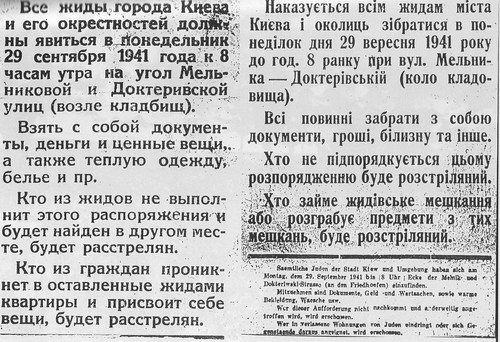
(Note 1: A. Kuznetsov quotes another version of the notice, in which the names of the streets were transcribed as "Mel'nikovskoj i Dokhturovskoj", not as "Mel'nikovoj i Dokterivskoj"; the real streets were actually called Mel'nikova street and Degtyaryovskaja street - it is obvious that the Germans used some bad translator, not a local.
Note 2: the word used in the Russian version is "zhidy", at that time an offensive term, probably better translated as "kikes".
Note 3: the notice actually consists of 1 column - the first part is in Russian, the second in Ukrainian, the third - in German.)
The next day thousands of Jews gathered for a "resettlement". The fate of these Jews is described in at least 9 German war-time documents.
From testimonies of survivors, perpetrators, bystanders, and from the extraordinary set of photos made by Johannes Haehle we know that the massacre happened in the ravine known as Babiy Yar (Babij Jar, Babyn Yar, Baby Yar). Given the wealth of documentary evidence, I won't even start citing the testimonial evidence for the massacre.
Now, no sane and smart person would even think of challenging the event supported by such iron-clad evidence. But, of course, Holocaust deniers do just that - they either deny or minimize the massacre. Let's see what tricks they use.
Our first patient is certain Herbert Tiedemann, who has written an article "Babi Yar: Critical Questions and Comments" (old version) for Rudolf's Dissecting the Holocaust.
There is not much sense in responding to each and every little "point" Tiedemann makes. It will be sufficient to point out the most significant flaws.
1) Tiedemann does not deal with the documents quoted above except in the most general terms. For example, he mentions the document no. 7 only to cast doubt on it, by citing its exaggerated estimate of pre-war Jewish population of Kiev, as if that could discredit the document in any way. He doesn't quote the incriminating part.
2) In the old version Tiedemann was not even aware of Anatolij Kuznetsov's magnificient Babi Yar: A Document in the Form of a Novel, which just shows that this ignoramus undertook his "debunking" without ever reading one of the most important books on the subject.
3) In both versions Tiedemann quotes only one Jewish Sonderkommando, Vilkis (without designating him as such). Even after finally finding Kuznetsov's book, he doesn't mention Vladimir Davydov, whose testimony is contained therein. Neither is he aware of Kaper, Budnik or Trubakov. Such ignorance is breathtaking.
4) Tiedemann shows his total lack of understanding of Holocaust historiography in general. Consider this:
5) Tiedemann uses the most important rule of denial: if any source reporting about an event is wrong, the event itself is to be doubted. Tiedemann's article consists mainly of quotes of secondary sources, reporting (often incorrectly) about the massacre, and his silly comments. Consider this example:
Note Tiedemann's "poignant" questions. Since nobody argues that the Jews were drowned in Dniepr, why ask them? Beating dead horses seems to be Tiedemann's hobby.
Another example:
Since Tiedemann employs this trick throughout the article, it can be safely dismissed as one big non sequitur.
6) Tiedemann shows absolute lack of comprehension of Soviet realities. All his examples of official Soviet reactions to Babiy Yar (Khrushchev's remarks, garbage dump, etc.) are not in the least surprising to those knowledgeable about post-war Soviet Jewish policy. One could think that Tiedemann's treatment of this topic could not have been more ridiculous, but he surpasses himself by asking:
Well, enough of this. Even reading through this "study" makes one feel stupid. There are still some points to be addressed, such as the overall number of victims and aerial photos, and that will be done in due time.
Previous << Part II: Deniers and the graves of Marijampole
Next >> Part IV: Deniers and Babiy Yar massacre (2)
All Jews of the city of Kiev and its vicinity are to arrive by 8 o'clock on the morning of Monday, September 29th, 1941, to the corner of Mel'nikova and Dokterivskaja streets (near the cemeteries).
They are to take with them documents, money, valuables, as well as warm clothes, underwear, etc.
Any Jew not carrying out this instruction and who is found elsewhere will be shot.
Any citizen entering flats abandoned by the Jews and stealing property will be shot.

(Note 1: A. Kuznetsov quotes another version of the notice, in which the names of the streets were transcribed as "Mel'nikovskoj i Dokhturovskoj", not as "Mel'nikovoj i Dokterivskoj"; the real streets were actually called Mel'nikova street and Degtyaryovskaja street - it is obvious that the Germans used some bad translator, not a local.
Note 2: the word used in the Russian version is "zhidy", at that time an offensive term, probably better translated as "kikes".
Note 3: the notice actually consists of 1 column - the first part is in Russian, the second in Ukrainian, the third - in German.)
The next day thousands of Jews gathered for a "resettlement". The fate of these Jews is described in at least 9 German war-time documents.
- Operational Situation Report USSR No. 97, 28.09.1941:
On September 24, violent explosions in the quarters of the Feldkommandatur; the ensuing fire has not yet been extinguished. Fire in the center of the town. Very valuable buildings destroyed.
Source.
[...]
As has been proved, Jews played a pre-eminent part. Allegedly 150,000 Jews living here. Verification of these statements has not been possible yet. 1,600 arrests in the course of the first action, measures being evolved to check the entire Jewish population. Execution of at least 50,000 Jews planned. German Army welcomes measures and demands drastic procedure. Garrison commander advocates public execution of 20 Jews. - Operational Situation Report USSR No. 101, 02.10.1941:
Sonderkommando 4a in collaboration with Einsatzgruppe HQ and two Kommandos of police regiment South, executed 33,771 Jews in Kiev on September 29 and 30, 1941.
Source. - Secret report of Hans Koch about the situation in Kiev, 05.10.1941:
Fire in Kiev on Sepember 24-29, 1941 has destroyed the center of the city, i.e. its most beautiful and majestic part... The fire affected an area of about 2 square kilometers, about 50 thousand were left without shelter; with difficulty they're quartered in abandoned flats. In punishment for an obvious sabotage, on September 29-30 Jews of the city have been exterminated, all in all (according to operational SS detachments) about 35 thousand persons, half of them - women...
Quoted by Mikhail Koval' in "Tragedija Babjego Jara: istorija i sovremennost'", Novaja i novejshaja istorija, 1998, no. 4. He quotes another secondary source, but gives the archival source as GARF, f. 7445, op. 2, d. 138, l. 269. - Operational Situation Report USSR No. 106, 07.10.1941:
As a result of the destruction of buildings in particular and of the evacuation of the endangered districts ordered by the authorities, approximately 25,000 persons were deprived of shelter and had to spend the first few days of the occupation outdoors. The inconveniences resulting from this were accepted by the population with calm. No serious incidents or panic occurred. Meanwhile the evacuated apartments, as far as they were not destroyed by fires or explosions, have again been put at the disposal of the population. Besides an adequate number of apartments has been evacuated through the liquidation of approximately 35,000 Jews on 29 and 30 September 1941, so that now shelter for the homeless is secured and has meanwhile also been allocated.
Source.
[...]
Partly because of the better economic situation of the Jews under the Bolshevist regime and their activities as informers and agents of the NKVD, partly because of the explosions and the resulting fires, the public feeling against the Jews was very strong. As an added factor it was proved that the Jews participated in the arson. The population expected adequate retaliatory measures by the German authorities. Consequently all Jews of Kiev were requested, in agreement with the city commander, to appear on Monday, 29 September by 8 o'clock at a designated place. These announcements were posted by members of the Ukrainian militia in the entire city. Simultaneously it was announced orally that all Jews were to be moved. In collaboration with the group staff and 2 Kommandos of the police regiment South, the Sonderkommando 4a executed on 29 and 30 September, 33,771 Jews. Money, valuables, underwear and clothing were secured and placed partly at the disposal of the NSV [Nazi Party Public Welfare Organization] for use of the racial Germans, partly given to the city administration authorities for use of the needy population. The transaction was carried out without friction. No incidents occurred. The "Resettlement measure" against the Jews was approved throughout by the population. The fact that in reality the Jews were liquidated was hardly known until now, according to up-to-date experiences it would, however, hardly have been objected to. The measures were also approved by the Wehrmacht. The Jews who were not yet apprehended as well as those who gradually returned from their flight to the city were in each case treated accordingly.
(Note: the difference in numbers in this report most probably stems from the fact that it was automatically compiled from earlier reports. Figures "35,000" and "33,771" are situated in two separate parts of the report - "Kiev" and "Executions and Other Measures"; cf. Koch's report) - Operational Situation Report USSR No. 111, 12.10.1941:
Sonderkommando 4a now has reached the total number of more than 51,000 executions. Apart from the special action in Kiev of 28 and 29 September, for which 2 Kommandos of the Police Regiment South were detached, all executions carried out so far were made by that special Kommando without any assistance from outside. The executed persons were mainly Jews, a minor part was political officials as well as saboteurs and looters.
Source. - Activity Report of 454th Security Division For Period From 1-10 October 1941, 12.10.1941:
The Jews of the city were ordered to present themselves at a certain place and time for the purpose of numerical registration and housing in a camp. About 34000 reported, including women and children. After they had been made to give up their clothing and valuables, all were killed; this took several days.
Source. - Activity and Situation Report no. 6. of the Task Forces of the Security Police and the SD in the USSR, covering 01-31.10.1941:
The embitterment of the Ukrainian population against the Jews is extremely great, because they are thought responsible for the explosions in Kiew. They are also regarded as informers and agents of the NKVD, who started the terror against the Ukrainian people. As a measure of retaliation for the arson at Kiew, all Jews were arrested and altogether 33,771 Jews were executed on the 29th and the 30th September. Money, valuables and clothing were secured and put at the disposal of the National-Socialist League for Public Welfare [NSV], for the equipment of the National Germans [Volksdeutschen] and partly put at the disposal of the provisional city administration for distribution to the needy population.
Source. - Operational Situation Report USSR No. 128, 03.11.1941:
Several retaliatory measures were carried out as large-scale actions. The largest of these actions took place immediately after the occupation of Kiev. It was carried out exclusively against Jews and their entire families.
Source.
The difficulties resulting from such a large-scale action, in particular concerning the round-up, were overcome in Kiev by requesting the Jewish population to assemble, using wall posters. Although at first only the participation of 5-6000 Jews had been expected, more than 30,000 Jews arrived who, until the moment of their execution, still believed in their resettlement, thanks to extremely clever organization. - Finally, Christopher Browning provides the following information:
Undersecretary Luther himself wrote a summary of the sixth report, noting that in the Ostland all male Jews over 16 other than doctors and council members would be executed, and that at the conclusion of the action only 500 Jewish women and children would be left alive. He also noted that 33,000 Jews in Kiev, 3,000 in Vitebsk and 5,000 east of the Dnieper had been shot. The summary was initialed by State Secretary Weizsaecker the day it was written.
The Origins of the Final Solution, 2004, p. 402.
From testimonies of survivors, perpetrators, bystanders, and from the extraordinary set of photos made by Johannes Haehle we know that the massacre happened in the ravine known as Babiy Yar (Babij Jar, Babyn Yar, Baby Yar). Given the wealth of documentary evidence, I won't even start citing the testimonial evidence for the massacre.
Now, no sane and smart person would even think of challenging the event supported by such iron-clad evidence. But, of course, Holocaust deniers do just that - they either deny or minimize the massacre. Let's see what tricks they use.
Our first patient is certain Herbert Tiedemann, who has written an article "Babi Yar: Critical Questions and Comments" (old version) for Rudolf's Dissecting the Holocaust.
There is not much sense in responding to each and every little "point" Tiedemann makes. It will be sufficient to point out the most significant flaws.
1) Tiedemann does not deal with the documents quoted above except in the most general terms. For example, he mentions the document no. 7 only to cast doubt on it, by citing its exaggerated estimate of pre-war Jewish population of Kiev, as if that could discredit the document in any way. He doesn't quote the incriminating part.
2) In the old version Tiedemann was not even aware of Anatolij Kuznetsov's magnificient Babi Yar: A Document in the Form of a Novel, which just shows that this ignoramus undertook his "debunking" without ever reading one of the most important books on the subject.
3) In both versions Tiedemann quotes only one Jewish Sonderkommando, Vilkis (without designating him as such). Even after finally finding Kuznetsov's book, he doesn't mention Vladimir Davydov, whose testimony is contained therein. Neither is he aware of Kaper, Budnik or Trubakov. Such ignorance is breathtaking.
4) Tiedemann shows his total lack of understanding of Holocaust historiography in general. Consider this:
According to the Brockhaus Enzyklopädie the "order for the final solution of the Jewish question" was issued on July 31, 1941 (Nuremberg Trial Document NG 2586e), and was announced on the occasion of the 'Wannsee Conference' (January 20, 1942).Well, duh! Anybody seriously interested in the matter knows that Wannsee conference was concerned with the "solution of the Jewish question" not on the Soviet territory, but rather in a pan-European framework. Genocide of the Jews in USSR started much earlier than in the rest of Europe, and before Hitler decided that all European Jews were to be killed. This is Holocaust Historiography 101.
Quite aside from the fact that historians and other interested persons are still searching in vain for this order for mass extermination, it is more than odd that many tens of thousands would have been slaughtered in Babi Yar before the order was even made known.
5) Tiedemann uses the most important rule of denial: if any source reporting about an event is wrong, the event itself is to be doubted. Tiedemann's article consists mainly of quotes of secondary sources, reporting (often incorrectly) about the massacre, and his silly comments. Consider this example:
On July 20, 1942, the Podziemna Obsluga Prasy Pozagettowej, the Warsaw ghetto's underground press agency, claimed:Pray tell, how this is relevant at all? Yes, an underground agency made a wrong claim. How does this affect the historicity of event itself?
"Not a single Jew is left in Kyiv because Germans have thrown the entire Jewish population in Kyiv into the river Dnjepr."
Was there not one among all those tens of thousands who could swim? This killing method would have endangered the troops' own water supply, while also causing a very considerable danger of epidemic - a nightmare for any troop commander.
The bodies would have drifted downstream and been noticed by countless witnesses. Why are there no such witnesses?
Note Tiedemann's "poignant" questions. Since nobody argues that the Jews were drowned in Dniepr, why ask them? Beating dead horses seems to be Tiedemann's hobby.
Another example:
A physician named Dr. Gustav Wilhelm Schübbe allegedly killed 21,000 persons single-handedly, with morphine injections. 110,000 to 140,000 victims were allegedly killed in this way at the "German Annihilation Institute" in Kyiv.Again, one strives to find a reason for inclusion of this into the article about Babiy Yar, and doesn't find it. Worst of all, Tiedemann does not even mention the most relevant fact - that Schuebbe was a crippled drug addict.
Injections of morphine, which was in very short supply and badly needed for wounded soldiers? And how long would it take one physician to give 21,000 injections?
According to the files of the US Document Center in Berlin, which holds more than one million records pertaining to members of the NSDAP ('Nazi' Party), Dr. Gustav Wilhelm Schübbe was never stationed in Kyiv.
Why did neither the USSR nor the Jews ever search for the location of this "Annihilation Institute"?
Since Tiedemann employs this trick throughout the article, it can be safely dismissed as one big non sequitur.
6) Tiedemann shows absolute lack of comprehension of Soviet realities. All his examples of official Soviet reactions to Babiy Yar (Khrushchev's remarks, garbage dump, etc.) are not in the least surprising to those knowledgeable about post-war Soviet Jewish policy. One could think that Tiedemann's treatment of this topic could not have been more ridiculous, but he surpasses himself by asking:
Was he able to find a 'Tiraspolskaja Street' (that's how it would be written correctly!) on a street map of Kyiv, and near the 'place' Babi Yar (which is not a 'place' at all)?As any decent map of Kiev will show, there still IS Tiraspolskaja street, which is indeed situated not far from former Babiy Yar. How even the idea itself to ask such a question came into poor Tiedemann's head? Oh, inanity!
Well, enough of this. Even reading through this "study" makes one feel stupid. There are still some points to be addressed, such as the overall number of victims and aerial photos, and that will be done in due time.
Previous << Part II: Deniers and the graves of Marijampole
Next >> Part IV: Deniers and Babiy Yar massacre (2)
Subscribe to:
Posts (Atom)