The book A Writer at War:A Soviet Journalist with the Red Army, 1941-1945, edited and translated by Antony Beevor and Luba Vinogradova, features some interesting pieces of Soviet journalist Vassili Grossman's writing as a war correspondent with the Soviet Army. One of the most impressive of these is Grossman's article about Treblinka extermination camp, which appeared in November 1944 in the magazine Znamya under the title "The Hell Called Treblinka".
Showing posts with label Grossman. Show all posts
Showing posts with label Grossman. Show all posts
Monday, November 19, 2012

Sunday, October 28, 2012
The Jäger Report (7)
The Jäger Report (1)
The Jäger Report (2)
The Jäger Report (3)
The Jäger Report (4)
The Jäger Report (5)
The Jäger Report (6)
The Jäger Report (8)
The seventh blog of this series addresses the events that led to a temporary suspension of the extermination of Lithuania’s Jews after the massacres organized by Einsatzkommando 3 in 1941, and the fate of this Jewish community’s remainders. Like in the previous blogs of this series, the information presented in this blog is mostly based on German historian Wolfram Wette’s biography of Karl Jäger (Wolfram Wette, Karl Jäger. Mörder der litauischen Juden, S. Fischer Verlag, Frankfurt am Main 2011, hereinafter "Wette, Jäger").
The Jäger Report (2)
The Jäger Report (3)
The Jäger Report (4)
The Jäger Report (5)
The Jäger Report (6)
The Jäger Report (8)
The seventh blog of this series addresses the events that led to a temporary suspension of the extermination of Lithuania’s Jews after the massacres organized by Einsatzkommando 3 in 1941, and the fate of this Jewish community’s remainders. Like in the previous blogs of this series, the information presented in this blog is mostly based on German historian Wolfram Wette’s biography of Karl Jäger (Wolfram Wette, Karl Jäger. Mörder der litauischen Juden, S. Fischer Verlag, Frankfurt am Main 2011, hereinafter "Wette, Jäger").
Sunday, September 23, 2012
The Jäger Report (4)
The Jäger Report (1)
The Jäger Report (2)
The Jäger Report (3)
The Jäger Report (5)
The Jäger Report (6)
The Jäger Report (7)
The Jäger Report (8)
The present blog addresses mass killings by Einsatzkommando 3 at Vilna (Vilnius) and Kaunas and isolated instances of Jewish resistance. Like in the previous blogs of this series, the information presented in this blog is mostly based on German historian Wolfram Wette’s biography of Karl Jäger (Wolfram Wette, Karl Jäger. Mörder der litauischen Juden, S. Fischer Verlag, Frankfurt am Main 2011, hereinafter "Wette, Jäger").
The Jäger Report (2)
The Jäger Report (3)
The Jäger Report (5)
The Jäger Report (6)
The Jäger Report (7)
The Jäger Report (8)
The present blog addresses mass killings by Einsatzkommando 3 at Vilna (Vilnius) and Kaunas and isolated instances of Jewish resistance. Like in the previous blogs of this series, the information presented in this blog is mostly based on German historian Wolfram Wette’s biography of Karl Jäger (Wolfram Wette, Karl Jäger. Mörder der litauischen Juden, S. Fischer Verlag, Frankfurt am Main 2011, hereinafter "Wette, Jäger").
Saturday, April 28, 2012
The Jäger Report (1)
The Jäger Report (2)
The Jäger Report (3)
The Jäger Report (4)
The Jäger Report (5)
The Jäger Report (6)
The Jäger Report (7)
The Jäger Report (8)
The report dated 1 December 1941 by SS-Standartenführer Karl Jäger, head of Einsatzkommando 3 of Einsatzgruppe A, is probably the most detailed and explicit document about Nazi mobile killing operations. It contains a tabulation, by date and place, of executions carried out by Einsatzkommando 3 on Lithuanian territory between 4 July and 25 November 1941. For each execution the number of victims is stated, broken down into Jews and (where existing) non-Jews, the number of Jews often further broken down into Jewish men, women and children.
The Jäger Report (3)
The Jäger Report (4)
The Jäger Report (5)
The Jäger Report (6)
The Jäger Report (7)
The Jäger Report (8)
The report dated 1 December 1941 by SS-Standartenführer Karl Jäger, head of Einsatzkommando 3 of Einsatzgruppe A, is probably the most detailed and explicit document about Nazi mobile killing operations. It contains a tabulation, by date and place, of executions carried out by Einsatzkommando 3 on Lithuanian territory between 4 July and 25 November 1941. For each execution the number of victims is stated, broken down into Jews and (where existing) non-Jews, the number of Jews often further broken down into Jewish men, women and children.
Monday, December 26, 2011
Belzec, Sobibor, Treblinka. Holocaust Denial and Operation Reinhard. Chapter 3: Aktion Reinhard and the Holocaust in Poland (2). The Origins of Aktion Reinhard.
The Origins of Aktion Reinhard
It is
typical of Mattogno – and negationism as a whole - that until Sobibór
(2010), he made absolutely no effort to address the origins of Aktion Reinhard.
Not a word is expended in Treblinka (2002) or Bełżec (2004) about
the direct decision-making processes leading up to the establishment of the
Aktion Reinhard camps. Instead, Mattogno simply assumes that his version of
Aktion Reinhard must have been ordered from the centre by Hitler, neatly
absolving himself of the necessity of dealing with a variety of inconvenient
evidence. A reader asking ‘why did the Nazis build Belzec, Sobibor and
Treblinka?’ comes away empty-handed after reading Treblinka or Bełżec.
Despite the addition of 25,000 words ostensibly on the ‘Führerbefehl and the
Origins of the “Extermination Camps in the East”, Sobibór doesn’t
actually answer the question, either. Instead, Chapter 8 turns out to be a
mishmash of previous Mattogno texts together with newer scrapings, with very
little of direct relevance to the evolution of Nazi Jewish policy in the
Generalgouvernement or the origins of Aktion Reinhard. Section 8.1 is a
ham-fisted gloss on the debate on the origins of the Final Solution as a whole,
which has already been dealt with in Chapter 2 of this critique. Several later
sections deal with the minutiae of the construction of gas chambers, and as
such will be examined in Chapter 5 of this critique. Meanwhile, Section 8.5 is
ostensibly dedicated to ‘Euthanasia and Aktion Reinhardt’, belatedly trying to
paper over one of the greatest dishonesties of the preceding volumes of the
‘trilogy’ – the utter silence on the connection between the T4 euthanasia
program and its six gas chambers, and the three death camps of Aktion Reinhard.
Sunday, December 25, 2011
Belzec, Sobibor, Treblinka. Holocaust Denial and Operation Reinhard. Chapter 1: The Hoax That Dare Not Speak Its Name (2). Wartime Reports.
Wartime Reports
Mattogno’s
exegeses of wartime reports from the death camps all share in common a number
of bogus assumptions. One such a priori assumption is even clearly spelled out
in the titles of several of his books: that the reports can be dismissed as
“propaganda”.[24]
Yet nowhere in his oeuvre does Mattogno explain what is meant by this term or
justify why calling something ‘propaganda’ necessarily implies its
falsity. That Mattogno doesn’t understand the meaning of the terms he is using
is proven by his frequent invocation of something he calls “black propaganda”,
apparently an especially nasty type of propaganda, if one follows the usage of
the slogan through his oeuvre.[25] But in
actual fact the term ‘black propaganda’ has a very precise meaning, which
Mattogno himself inadvertently quotes when citing Walter Laqueur speaking of
how Polish underground courier Jan Karski “engaged in ‘black propaganda’ among
German soldiers, printing and distributing leaflets in German”.[26] This is
a correct use of the term. Black propaganda is propaganda purporting to come
from the enemy side. Mattogno’s “black propaganda” is nothing of the sort.
Instead, it is just a hysterical repetition of a phrase he liked when he first
read and commented on Laqueur’s book back in 1991, and which is not being
correctly used.[27]
Saturday, December 24, 2011
Belzec, Sobibor, Treblinka. Holocaust Denial and Operation Reinhard. Introduction (2). Overview and Historiography of Aktion Reinhard.
Overview and Historiography of Aktion Reinhard
Between March 1942 and
October 1943, nearly 1.4 million Jews were deported to the camps of Belzec,
Sobibor and Treblinka. The camps were operated under the auspices of the SS and
Police Leader (SS- und Polizeiführer, SSPF) Lublin, Odilo Globocnik, and used
the codename ‘Einsatz Reinhardt’ or ‘Aktion Reinhard’. German SS men along with
companies of Ukrainian auxiliaries trained at the Trawniki camp manned the
camps in detachments designated ‘SS-Sonderkommando’. The majority of the German
staff had previously served in six euthanasia ‘institutes’ in Germany as part
of the T4 organisation named after its headquarters on Tiergartenstrasse 4 in
Berlin. There they had helped murder 70,000 ‘incurable’ psychiatric patients
using carbon monoxide gas dispensed from cylinders, and to cremate the bodies.
Wednesday, June 22, 2011
June 22, 1941
On this day 70 years ago, Nazi Germany attacked the Soviet Union and began the most devastating conflict in recorded history, which accounted for the overwhelming majority of World War II deaths in Europe. About 26.6 million of these deaths, according to demographic calculations, occurred among the population of the Soviet Union. A significant part of Soviet deaths was due to the Nazi invaders’ criminal actions.
Tuesday, February 16, 2010
http://www.hsrdb.com: Legitimate Revision or Denial?
This site [screenshot] claims that
The site claims that its aim is "to assist historians, scholars and students interested in analyzing and comparing historical information". The original name of the site, obtained by Googling its mailing address, was Legitimate Revision [screenshots a, b]. We are of course wholly in favour of legitimate revision, but we might be curious as to why the site changed its name.

This is NOT a Holocaust denial website, it is a FACT that the Holocaust happened.How sincere is this claim? And why is it being made in the first place?
The site claims that its aim is "to assist historians, scholars and students interested in analyzing and comparing historical information". The original name of the site, obtained by Googling its mailing address, was Legitimate Revision [screenshots a, b]. We are of course wholly in favour of legitimate revision, but we might be curious as to why the site changed its name.


Wednesday, February 03, 2010
Response to C. Yeager
by Joachim Neander, PhD
Dear Mrs. Yeager, on January 24, 2010, you published, at the Revisionist blog Inconvenient History, a critical look on my analysis of Irene Weisberg Zisblatt’s memoir The Fifth Diamond,[1] published here on the Holocaust Controversies blog on January 9, 2010.[2] I feel your essay deserves a response, and I have chosen for it the form of an “open letter.”
Dear Mrs. Yeager, on January 24, 2010, you published, at the Revisionist blog Inconvenient History, a critical look on my analysis of Irene Weisberg Zisblatt’s memoir The Fifth Diamond,[1] published here on the Holocaust Controversies blog on January 9, 2010.[2] I feel your essay deserves a response, and I have chosen for it the form of an “open letter.”
Sunday, May 31, 2009
Vasily Grossman's Letters and Notebooks
The book A Writer At War consists of extracts from Vasily Grossman's family letters (preserved by his daughter and step-son) and notebooks (preserved in RGALI: the Russian State Archive for Literature and the Arts). Their private nature removes any doubt that they are primary sources of Grossman's true observations. They provide insurmountable problems for deniers. Here is one example.
Read more!
The letter from which this extract was taken was written to his wife whilst on the journey from Kiev to newly liberated Berdichev, where his mother was one of the Germans' victims:
Read more!
The letter from which this extract was taken was written to his wife whilst on the journey from Kiev to newly liberated Berdichev, where his mother was one of the Germans' victims:
Dear Lyusenka, I reached my destination today. Yesterday I was in Kiev. It's hard to express what I felt and what I suffered in the few hours when I visited the addresses of relatives and acquaintances. There are only graves and death. I am going to Berdichev today. My comrades have already been there. They said that the city is completely devastated, and only a few people, maybe a dozen out of many thousands, tens of thousands of Jews who lived there, have survived. I have no hope of finding Mama alive.If deniers still wish to claim that Grossman's account of the genocide in Kiev and Berdichev, written at the time of their liberation, is totally false propaganda, they will have to explain this second extract, in which Grossman describes mass rapes perpetrated by his own side in Schwerin:
Horrifying things are happening to German women. An educated German whose wife has received 'new visitors' - Red Army soldiers - is explaining with expressive gestures and broken Russian words, that she has already been raped by ten men today. The lady is present...Why would Grossman lie, in his private writings, about Berdichev, about the murder of his own mother, but tell the truth about these rapes, which are damaging to the image of the Soviets?
Women's screams are heard from open windows...
A story about a breast-feeding mother who was being raped in a barn...the hungry baby was crying the whole time.
Friday, October 06, 2006
How the convergence of evidence works: the gas van of Auschwitz
Deniers often complain about the concept of the convergence of evidence, claiming that the allegedly contradictory claims by eyewitnesses constitute a divergence of evidence. They miss the point most of the time, and mostly compare apples and oranges (e.g., comparing hearsay to direct eyewitness testimonies, or not taking into account objective factors which may be responsible for apparent contradictions, etc.).
The convergence of evidence, however, is a strong tool. It may be compared to a stack of papers – you can easily tear one page, but tearing a stack of pages is more difficult.
Below you’ll find a nice demonstration of how it works.
When I was reading Christian Gerlach’s article “Failure of Plans for an SS Extermination Camp in Mogilëv, Belorussia", I noticed that in a footnote he referred to an unpublished Einsatzgruppe B report, which allegedly mentioned gas vans. My curiosity was understandably piqued – every documentary piece of evidence for the existence of gas chambers (of which gas vans are a subset) is quite important for the refutation of deniers.
So, I wrote to Dr. Gerlach and soon received an excerpt from Taetigkeits- und Lagebericht der Einsatzgruppe B fuer die Zeit vom 16. bis 28. Februar 1942., and a little bit later the whole report. (Months later I received another copy from Nick, from a different archive; I refer to Gerlach’s article for archival data, p. 77n83).

Click!
The report did indeed contain numerous mentions of Gaswagen


Click!
The report informs about two Gaswagen with some defects which arrived in Smolensk for the use of Einsatzkommandos. We're also informed about other gas vans, already in use.
Now, for any unbiased person, this evidence confirms the numerous testimonies about gas vans, and also the surviving gas vans documentation (like PS-501).
But of course, deniers wouldn’t be deniers if they wouldn’t try to find an alternative explanation for the use of this term, no matter how far-fetched. Thus, they argue, Gaswagen were actually producer-gas vehicles.
No matter that in the report, as one semi-denier pointed out, Gaswagen is a functional designation, along with Tankwagen and Werkstattwagen (p. 8), not a technical designation. No matter that if the term Gaswagen was indeed used for innocuous producer-gas vehicles, we would expect deniers to quote hundreds of innocuous documents containing this term. Deniers will still grasp at the last remaining straw in order to save their Faith.
And here’s where convergence of evidence comes into play.
I don’t remember exactly how I came upon this information, but in Fritjof Meyer’s infamous article I discovered the following footnote:

Click!
(* At this time the camp resistance was composing a list of criminals from Auschwitz to be broadcast by the BBC.)
This document by itself also may be discarded as absolute evidence for the existence of gas vans in general and in Auschwitz in particular. After all, even the Auschwitz Museum researchers didn’t think it was strong evidence.
But what happens when we tie the two documents – EG B report and Auschwitz resistance report – together?
These documents are completely independent from each other – written in different times, in different places, under different circumstances.
Yet, they obviously refer to the same vehicle, gas van Pol. 71462. Auschwitz report explicitly claims that it is a homicidal gas van. EG B report doesn’t claim that, but Einsatzgruppe B itself was a killing squad.
The coincident descriptions (“gas van", registration number) prove that this particular Auschwitz resistance message is credible. The author did not dream up this van. It really existed. Thus, the message can also be trusted on the description of the function of this gas van – it was indeed a homicidal gas van. We could have deduced it already from EG B report only (see above), but convergence of evidence proves our deduction beyond a reasonable doubt.
That’s how it works.
PS: And since we're talking about convergence of evidence, how about this: one of PS-501 documents [1, 2] mentions three S-Wagen/Spezialwagen-Saurer related to a certain "special mission" (Sonderauftrag) and tied to Sonderbehandlung of Jews. Given that the registration number of one of these vans is 71463, guess what we can say about the purpose of these S-Wagen despite any "revisionist" complaints?
Testimonies about the use of the gas vans in Auschwitz, translated from Polish and German by Dr. Steve Paulsson (who also translated the above resistance message).
Testimony of Stanislaw Dubiel (Höß Trial, vol. 25, p. 82):
Testimony of Edward Wrona (Höß Trial, vol. 26, p. 8.):
Testimony of Kazimierz Grabowski (Höß Trial, vol. 26, p. 32, 33):
Testimony of Jozef Sliwa (APMAB, Collection "Statements", vol. 3, p. 336, 337):
Testimony of Zbigniew Kazmierczyk (APMAB, Collection "Statements", vol. 45, p. 4):
Testimony of Wladyslaw de Rosenberg Grohs, police prisoner from Block 11 (APMAB. Collection "Statements", vol. 73, p. 38):
Testimony of Artur Meyer (APMAB, Collection "Statements", vol. 93, p. 23, 23a):
Testimony of George Goiny-Grabowski (APMAB, Collection "Statements", vol. 61, p. 167):
Testimony of Kazimierz Czyzewski (Höß Trial, vol. 35, p. 163):
The convergence of evidence, however, is a strong tool. It may be compared to a stack of papers – you can easily tear one page, but tearing a stack of pages is more difficult.
Below you’ll find a nice demonstration of how it works.
When I was reading Christian Gerlach’s article “Failure of Plans for an SS Extermination Camp in Mogilëv, Belorussia", I noticed that in a footnote he referred to an unpublished Einsatzgruppe B report, which allegedly mentioned gas vans. My curiosity was understandably piqued – every documentary piece of evidence for the existence of gas chambers (of which gas vans are a subset) is quite important for the refutation of deniers.
So, I wrote to Dr. Gerlach and soon received an excerpt from Taetigkeits- und Lagebericht der Einsatzgruppe B fuer die Zeit vom 16. bis 28. Februar 1942., and a little bit later the whole report. (Months later I received another copy from Nick, from a different archive; I refer to Gerlach’s article for archival data, p. 77n83).
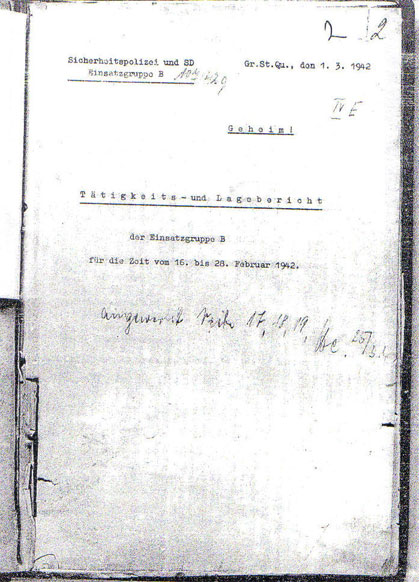
Click!
The report did indeed contain numerous mentions of Gaswagen
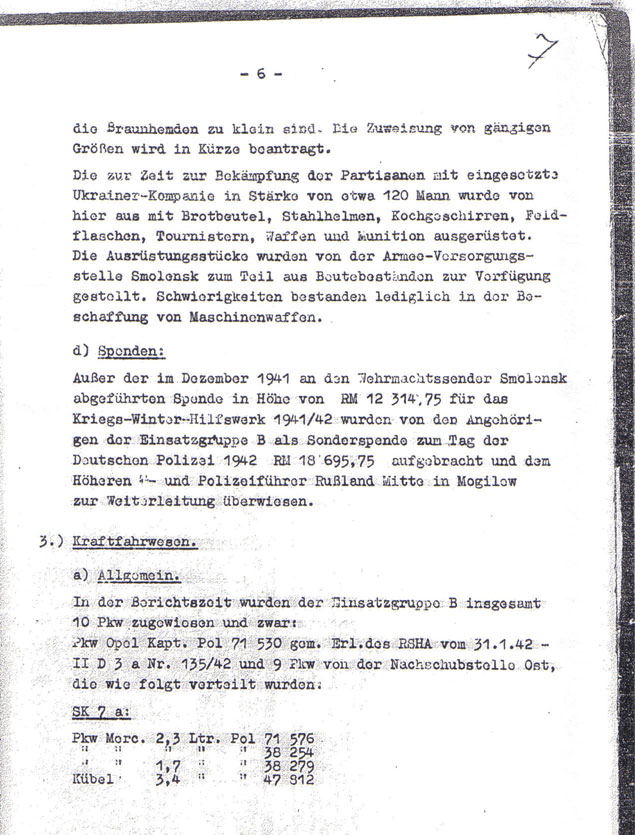
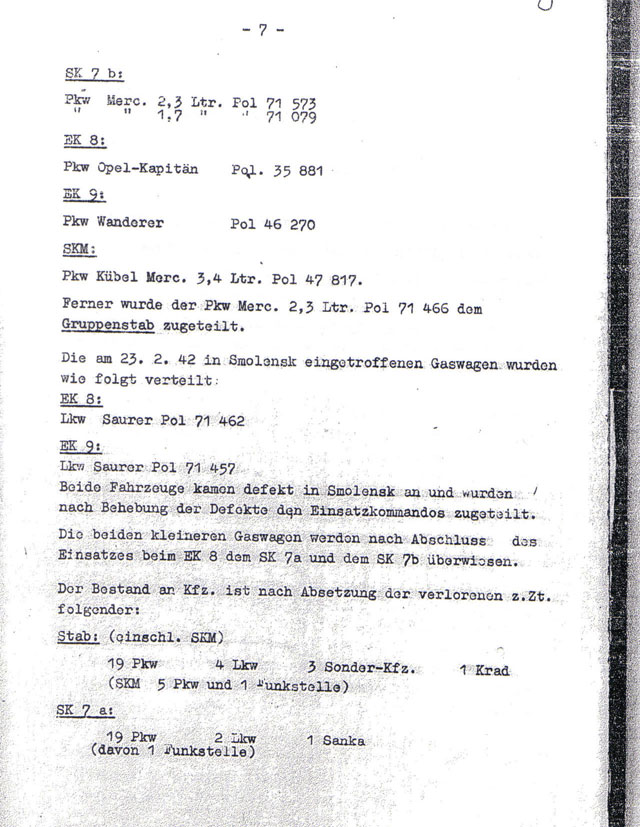
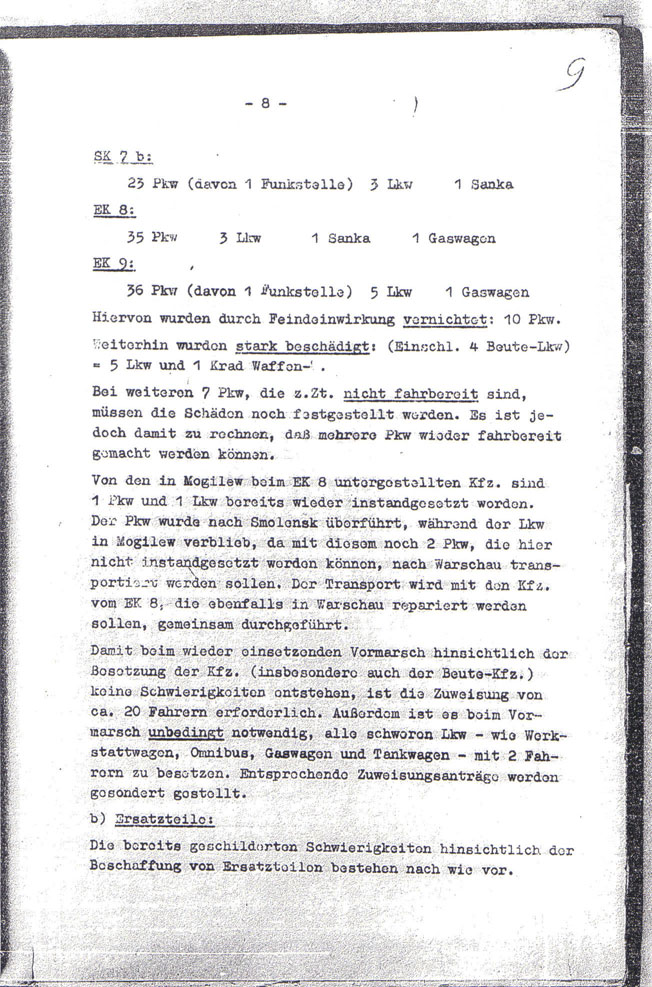
Click!
The report informs about two Gaswagen with some defects which arrived in Smolensk for the use of Einsatzkommandos. We're also informed about other gas vans, already in use.
Now, for any unbiased person, this evidence confirms the numerous testimonies about gas vans, and also the surviving gas vans documentation (like PS-501).
But of course, deniers wouldn’t be deniers if they wouldn’t try to find an alternative explanation for the use of this term, no matter how far-fetched. Thus, they argue, Gaswagen were actually producer-gas vehicles.
No matter that in the report, as one semi-denier pointed out, Gaswagen is a functional designation, along with Tankwagen and Werkstattwagen (p. 8), not a technical designation. No matter that if the term Gaswagen was indeed used for innocuous producer-gas vehicles, we would expect deniers to quote hundreds of innocuous documents containing this term. Deniers will still grasp at the last remaining straw in order to save their Faith.
And here’s where convergence of evidence comes into play.
I don’t remember exactly how I came upon this information, but in Fritjof Meyer’s infamous article I discovered the following footnote:
33. Filip Friedman: To jest Oswiecim! Warsaw 1945, p. 70. - The same: Tadeusz Holuj: Oswiecim, mit einem Vorwort von Dr. Waclaw Barcikowski. Warsaw 1945, p. 81. - F. Friedman: This was Oswiecim. London 1946, p. 47 ff., 2nd ed., p. 54: A gas van is said to have been used for smaller groups, namely in a sandpit by a special commando Ruryck (version of 1946: Ryryck), using a Saur lorry which had been in service in Russia, with the registration number Pol 71-462, 4m long, 2,5m wide, chauffeur: Oberwachtmeister Arndt. Friedman based his account on the report of a resistance group in Auschwitz which on 21.9.1943 sent the information to Cracow that "a gas van of the make Saur was stationed with an engine plough, in order to carry out executions with engine fumes on order of the police summary court martial". The Auschwitz inmate Mordechai Zirulnizki reported that shootings at the "Black Wall" in Auschwitz, i.e. in the main camp, had been replaced in 1944 by the "Duschegubka" (Soul-Vendors) as the Russians called the gas vans; Wassili Grossmann/Ilja Ehrenburg/Arno Lustiger: Das Schwarzbuch. Der Genozid an den sowjetischen Juden. Reinbeck 1995, p. 935.Gas van with the registration number Pol 71-462? What the heck, this is the same Gaswagen which is mentioned on page 7 of EG B report!
EK 8: Lkw Saurer Pol 71 462Armed with this information I wrote to the Auschwitz Musuem to learn what is known about gas vans in Auschwitz. Soon a reply from the Head of the Archives, Dr. Piotr Setkiewicz arrived. According to him, several testimonies about the use of the gas vans in Auschwitz existed, but the Museum researchers could not completely confirm the accuracy of these claims:
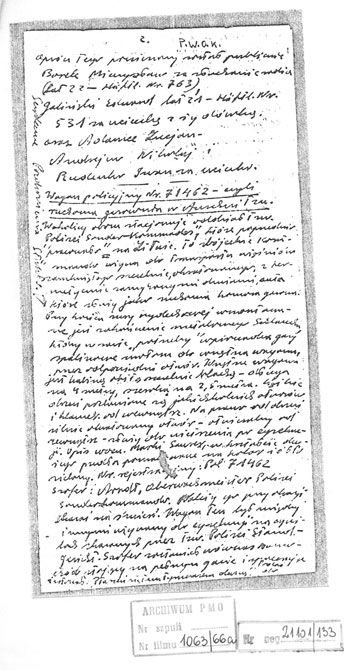
Unfortunately, we have not been able to locate in the records of Fahrbereischaft any hint about existence or repairing of this truck there. Since many details in reports by the resistance or survivors' testimonies seemed to be imprecise or even vague and - what is more important - there were no practical need to exploit this sort of transportable gas vans at Auschwitz together with more efficient and simple to operate stationary gas chambers, my colleague Mr. Piper in his essay about extermination facilities in the camp considered those testimonies uncertain, but he did not rejected them categorically. Of course your suggestion is very important or - I would rather say - decisive in this regard and must be taken into account in our further publications.Dr. Setkiewicz was very kind to supply me with numerous excerpts from various testimonies, which mentioned the gas vans. I quote them below in the appendix. He has also sent me an image of the resistance report, on which Friedman relied. This is the message from Stanislaw Klodzinski to Teresa Lasocka-Estreicher ("K. Tell") and Edward Halon ("Boruta") sent in September of 1944 (Camp Resistance Files, vol. 2. p. 161; Friedman got the year wrong):
Click!
Police wagon no. 71462 - in other words a mobile gas chamber in Auschwitz. A unit of the so-called "Polizei-Sonderkommando", which previously worked in Lithuania, is stationed in the vicinity of the camp. This criminal commando used a car that was sealed, with a grate and hermetically closed doors, which served as mobile gas chambers (sic) to transport prisoners. To the end of the exhaust pipe there is attached the end of a metal hose, which when "needed" leads the wagon's exhaust gases into the wagon's interior through an appropriate opening. The inside of the wagon is a cabin made airtight by a tin lining, 4 metres long and 2.5 metres wide. The heavy doors lack any openings and have no latch on the inside. To the right of the doors is an opening covered by a heavy grating which can be opened from the outside and serves to air the wagon out after an execution. Description of the wagon: model Saurex (sic), in the shape of a long box, painted greenish-yellow. Registration no. Pol 71462, driver: Arndt, Oberwachtmeister of the Polizei-Sonderkommando. He should by the way be sentenced to death*. This wagon was used among other things to execute civilians convicted by the so-called Polizei-Sondergericht. The driver on that occasion left the van standing with the throttle open and, while walking around, joked: 'meanwhile, the little birds are choking in there.' Send to. (sic)
Cordial greetings - Staklo.
(* At this time the camp resistance was composing a list of criminals from Auschwitz to be broadcast by the BBC.)
This document by itself also may be discarded as absolute evidence for the existence of gas vans in general and in Auschwitz in particular. After all, even the Auschwitz Museum researchers didn’t think it was strong evidence.
But what happens when we tie the two documents – EG B report and Auschwitz resistance report – together?
These documents are completely independent from each other – written in different times, in different places, under different circumstances.
Yet, they obviously refer to the same vehicle, gas van Pol. 71462. Auschwitz report explicitly claims that it is a homicidal gas van. EG B report doesn’t claim that, but Einsatzgruppe B itself was a killing squad.
The coincident descriptions (“gas van", registration number) prove that this particular Auschwitz resistance message is credible. The author did not dream up this van. It really existed. Thus, the message can also be trusted on the description of the function of this gas van – it was indeed a homicidal gas van. We could have deduced it already from EG B report only (see above), but convergence of evidence proves our deduction beyond a reasonable doubt.
That’s how it works.
PS: And since we're talking about convergence of evidence, how about this: one of PS-501 documents [1, 2] mentions three S-Wagen/Spezialwagen-Saurer related to a certain "special mission" (Sonderauftrag) and tied to Sonderbehandlung of Jews. Given that the registration number of one of these vans is 71463, guess what we can say about the purpose of these S-Wagen despite any "revisionist" complaints?


Testimonies about the use of the gas vans in Auschwitz, translated from Polish and German by Dr. Steve Paulsson (who also translated the above resistance message).
Testimony of Stanislaw Dubiel (Höß Trial, vol. 25, p. 82):
It was Sturmbannführer Henschel who at first seemed to us to have a very good character. And in a few days, he found another method – gassing in a car. The car goes to Birkenau, by the time it gets there everyone is dead. The driver explained how it works, that the exhaust pipe goes straight into the car. By the time the driver gets to where he’s going, they’re already dead. That was the behaviour of this supposedly good man.Testimony of Jan Dziopek (Höß Trial, vol. 8, p. 109):
They were carried out at Block 11 until October 1944, after that the condemned were killed only at Birkenau, where they were taken from our place* in a prison van. That type of van was very tightly sealed and had apparatus for gassing the people inside. The gassing apparatus was built in the automobile workshops of the Fahrbereitschafts–Kommando.* I.e. Auschwitz main camp.
Testimony of Edward Wrona (Höß Trial, vol. 26, p. 8.):
I think none of the witnesses has emphasized that gas vans were used at Auschwitz. I assume that the accused Höß knew about it, because he went every day to look at his beautiful limousine in the automobile workshops and saw the three vans in which people were murdered standing there. Working at the water pumping station in Block 18, I leaned my head out and observed how girls and men were packed into these vans and the executions were carried out. I witnessed how one night a German general was executed, supposedly just for refusing to carry out an order in wartime. That time around 50 limousines drove up with a huge retinue of generals and the camp command, and the execution* was carried out ceremoniously, lighting up the wall of death and the square behind Block 11 with a searchlight.* Possibly this refers to different, "regular" execution.
Testimony of Kazimierz Grabowski (Höß Trial, vol. 26, p. 32, 33):
Presiding judge: Was there* a truck there designated in advance for gassing people?* I.e. in the camp automobile repair workshops.
Witness: Once one van that was especially encased in wood came in for repairs, I didn’t know what kind of van it was. German vehicles ran on methanol. There it was fitted with an exhaust pipe, round with small holes, when the prisoners were inside the van, the gas got in that way. After 15 minutes a person was ready. Before it even reached the crematorium, there were only corpses in the van. I ran across only one vehicle like that, on which I worked.
Pres: Was the van constantly in use?
Witness: Constantly, unless it was damaged, then it went in to be fixed.
Pres: Was this van used inside the camp, or outside?
Witness: That I don’t know.
Testimony of Jozef Sliwa (APMAB, Collection "Statements", vol. 3, p. 336, 337):
When a larger number of sick people had accumulated*, they were taken in vans to Auschwitz. I saw the vans – gas chambers, into which transports of Muselmans were loaded. I went inside and saw the gassing apparatus, i.e. pipes to let the exhaust gases in.* In the Golleschau sub-camp.
Testimony of Zbigniew Kazmierczyk (APMAB, Collection "Statements", vol. 45, p. 4):
Commissions often came from Auschwitz, which carried out selections among sick prisoners in the hospital. The selected prisoners were taken away to Auschwitz by vehicles, already gassing them on the way. I know from what friends told me that they were dark green, reinforced, sealed when closed, into which exhaust gas was let in.
Testimony of Wladyslaw de Rosenberg Grohs, police prisoner from Block 11 (APMAB. Collection "Statements", vol. 73, p. 38):
Yes, well out of my hall sometimes only two persons out of 100 were transferred as prisoners to one of the blocks in the camp, the rest were loaded into trucks. In any case, at that time executions were not carried out in the courtyard of Block 11. We were convinced that the prisoners sentenced to death by the police Special Court were suffocated with exhaust products in the boxes of vans – before they got as far as the crematoria.
Testimony of Artur Meyer (APMAB, Collection "Statements", vol. 93, p. 23, 23a):
Moreover, in Auschwitz there was a special apparatus. It was a van - gas chamber. Up to 14 people were loaded into this van, it was hermetically sealed and by the time the van arrived at Birkenau, its passengers were gassed to death.
Testimony of George Goiny-Grabowski (APMAB, Collection "Statements", vol. 61, p. 167):
As the Russian front approached Auschwitz, a police Einsatzkommando arrived, whose members wore uniforms with green cuffs. Among their vehicles were two gas vans, which I had an opportunity to examine in detail. The exhaust gases could be led into the box [of the van which was] filled with condemned people... The gas vans had an image showing a human head with a hand holding its nose.
Testimony of Kazimierz Czyzewski (Höß Trial, vol. 35, p. 163):
Hitlerite civilian special courts. They arrived every 14 days and tried hundreds of civilians in this Block 11. After the verdict, these people were driven into a hermetically sealed yellow van. Up to 50 people fit into it - the SS driver drove them to the crematorium (the prisoners did not know where they were going), and in this van the people were gassed, the corpses were thrown out and cremated.
Sunday, May 21, 2006
Mass Graves in the Polesie
Deniers are fond of pretending that no mass graves have ever been found containing the bodies of murdered Jews. That's why Germar Rudolf lied about the mass grave outside Marijampole in Lithuania, why in spite of at least nine pieces of documentary evidence, they also lie about Babi Yar.
So it was no surprise that when we reported the news that a mass grave had been uncovered in Smalyarka, Belarus, that some fourth-rate deniers on the internet insisted, lemming-like, that the story could not possibly be true.
Yet documents show that there is not just one more mass grave for 'revisionists' to deny, but many dozens in this one region of Belarus, known as the Polesie, alone.
Read more...
The first step towards enlightenment is to ditch political correctness and call Smalyarka by its Russian name, Smoliarka. The Lukashenko government has for all intents and purposes declared Russian the official language of Belarus, and unsurprisingly, you'll get more results from Google if you use the Russian and not the Belarusian spelling, as we will from here on out.
Smoliarka lies around five kilometres away from the town of Bereza Kartuska, not far from the village of Bronnaia Gora, located in Berezovskii district (raion) of the Brest province (oblast) in Belarus. It is so small that it is not even marked on the map provided on the local district council's website. Yet the same website records the murder of 1,500 people at Smoliarka on its chronology of the district's history. The event, then, is hardly unknown.
The uncovering of the mass grave at Smoliarka, as was reported in the original news story about the excavation, was the work of school students from the village of Bronnaia Gora who had visited the Brest oblast archive and found records of the Soviet Extraordinary Commission into German war crimes describing the location of several mass graves in which up to 1,500 Jews from Bereza Kartuska ghetto and other nearby villages had been buried after being shot circa September 1942 by German policemen.
The incident was so well-known to Soviet investigators that it was included in the so-called Black Book, compiled by Vasily Grossman and Ilya Ehrenburg, in 1946, and from there found its way into the yizkor book for Bereza Kartuska:
So the recent excavations broke no new ground: instead, they were an attempt to re-locate a grave that had been opened in 1944, when the Extraordinary Commission first surveyed the Berezovskii district, but which had been forgotten thereafter.
The reason why Smoliarka had been forgotten is because an even larger mass grave was to be found nearby, outside Bronnaia Gora itself. To quote from the Black Book again:
The German historian Christian Gerlach, along with many other commentators, has given in his book Kalkulierte Morde even higher figures of up to 50,000 killed at Bronnaia Gora, and indeed, this is the number recorded on the memorial stone there. The killing-site, whose name in Polish would translate to 'harrow hill' from Polish, is almost unique in the 'occupied eastern territories: instead of the killers coming to the ghettos, the ghettos were brought to the killers. Jews from Antopol, Bereza Kartuska, Kobryn, Gorodets and Mikroshevichi were brought by train from June to November 1942 to the site and murdered there, instead of being killed near to their homes.
Proof of the scale and extent of the mass-murders of Jews in the Brest region is extensive. The main unit responsible for the killings, Polizeibataillon 310 (also known as III./Polizeiregiment 15), left behind its war diary, which has received extensive scholarly commentary from many historians. Indeed, Edward Westermann, a professor at the US Air Force University, has written a whole article on the subject.
Not only do we have the unit records, we also have an embarrassment of information from Brest itself. These fall into two categories: reports sent to the Ostministerium from the Gebiets- and Stadtkommissar appointed to the Brest region, and records left behind in the retreat. The Ostministerium papers can be found in the US National Archives II in College Park, microfilmed under NARA RG 242 T454. According to the Lagebericht of the Stadtkommissar Brest of November 21, 1941, a total of 17,574 Jews were registered as inhabiting the city of Brest (NARA T454/102/7).This was fewer than had lived there on June 22, 1941, since Ereignismeldung UdSSR Nr. 32, compiled by the RSHA from activity reports of the Einsatzgruppen on July 24, 1941, recorded that 3950 Jews and 400 Russians had been 'liquidated' (NARA T175/233/2721638). From other records, in particular reports of the 221st Security Division, we know that the perpetrators of this massacre were Polizeibataillon 307.
The fate of the surviving 17,574 Jews left from more than 21,000 inhabitants of Brest before the outbreak of war is especially well-documented in the subsequent monthly reports of the Stadtkommissar Brest. Moreover, the Brest Oblast archive contains an almost unique collection of over 12,000 passports issued to all Jews over the age of 14 inhabiting the Brest ghetto. The collection has now been digitised and is available here.
The 'evacuation' of 19,000 Brest Jews was recorded in the report of the Gendarmerie-Gebietsführer Brest for the month of October 1942, dispatched on November 11, 1942 (NARA T454/104/999, excerpts are published in Paul Kohl, 'Ich wundere mich, dass ich noch lebe.' Sowjetische Augenzeugen berichten, Gütersloh, 1990, p.198). The war-diary of Polizeibataillon 310 gives a lower figure, of 16,000. Meanwhile, a retrospective report (Der Ortsbeauftragte Brest-Litowsk, Betr.: Bericht über die Tätigkeit der Zivilverwaltung, November 11, 1943, NARA T454/104/1680) gave a figure of 18,000. Without the benefit of any access to German reports at all, the Black Book of Grossman and Ehrenburg estimated that between 17 and 20,000 Jews were sent from Brest to the killing-site at Bronnaia Gora.
Martin Dean, author of Collaboration in the Holocaust, has added yet more evidence, this time from reports of the Polish Underground:
In March 1944, the Bronnaia Gora site was visited by Sonderkommando 1005, the SS unit under Paul Blobel responsible for exhuming and cremating the evidence of German mass murder. In central Russia and Belorussia, SK 1005 was active near many of the larger towns: reports survive of its operations at Smolensk, Mogilev, Borisov, Bobruisk and Minsk. But not, it would seem, at the smaller raion capitals and the rural shtetls. Thus, while Soviet investigators found at Bronnaia Gora only ashes and empty graves of the dimensions described above, elsewhere in the Brest region and the Polesie as a whole, they repeatedly were directed by eyewitnesses and local informants to the sites of a score of other intact mass graves.
Smoliarka, then, was one such exhumation. Christian Gerlach mentions another, at the town of Drogichin, where the Extraordinary Commission recorded in Akt No. 5 of November 2, 1944 that a mass grave totalling a volume of 1092 cubic metres was opened. It was evidently exhumed in its entirety, as the report indicates 3,186 corpses were found in the mass grave: 895 men, 1083 women and 1838 children.
Such precision was far from always the case with Soviet exhumation protocols: unsurprisingly, most of the investigators preferred to open a grave, measure its dimensions, check the identity of the corpses (i.e., whether in military uniform and therefore Soviet prisoners of war, or in civilian clothing), and estimate their number based on a volume calculation.
Because of these methods, and because the Germans did not always leave reports behind, an absolutely precise figure for the number of victims, Jewish and non-Jewish alike, of Nazi occupation policies and genocide will never be known. Yet the convergence of evidence from both German reports, eyewitnesses and exhumation protocols is more than sufficient to prove the extent and scale of the genocide of Jews in the former Soviet Union. Before the war, the Brest region had belonged to the Polesie woewodstwo (voivodship) of Poland. In 1931, the official Polish census recorded 113,988 Jews by religious confession in the Polesie woewodstwo. In September 1939, the entirety of the Polesie was annexed to the Soviet Union and split into two provinces, Brest and Pinsk oblasti.
Estimates vary of the total number of victims in both oblasti, but one source puts the number of Jews murdered in the Polesie at 113,451, an entirely plausible number when it is remembered that the Jewish population grew perhaps 10% before the outbreak of war, and was further swollen by the arrival of refugees from the western districts after the partition of Poland between Nazi Germany and the Soviet Union. The Belarusian historians Emanuil Ioffe and Viacheslav Selemenev uncovered an NKVD report in the National Archives of the Republic of Belarus (NARB) in Minsk concerning the number of Jewish refugees in the Belorussian Soviet Socialist Republic as of February 1940. According to this document, a total of 65,796 Jews had fled over the Nazi-Soviet 'interest border' by this date, of whom 9,879 resided in the former Polesie province; 7,916 in Brest and 1,963 in Pinsk oblast (‘Jewish Refugees from Poland in Belorussia, 1939-1940’, Jews in Eastern Europe, Spring 1997, pp.45-50). From the exhaustive reconstruction of the fate of the Jews of Pinsk published by E.S. Rozenblat and I.E Elenskaia (Pinskie evrei: 1939-1944 gg. Brest, 1997), we know that around half of these refugees were deported in the summer of 1940 by the NKVD; the rest stayed.
For non-Russian-speakers, the Israeli historian Tivka Fatal-Knaani has given a decent enough overview of the fate of the Jews of Pinsk in Yad Vashem Studies Vol. 29 [PDF]. It was was identical to those of Brest, even down to the involvement of the same perpetrators, Polizeibataillon 310. The sole difference was that Heinrich Himmler intervened personally to order the destruction of the Pinsk ghetto:
Not only did Himmler leave a documentary trail, so, too, did Hauptmann der Schutzpolizei Helmut Saur of Polizeibataillon 310. His after-action report is to be found in the files of the battalion that were captured by the Soviets after the war. It was submitted to the International Military Tribunal at Nuremberg as document USSR-119a, and can today be found in its original in GARF Fond 7445, Moscow, while published versions are also to be found in The Black Book and elsewhere. There is no mistaking the language used in Saur's Erfahrungsbericht of what transpired on October 29, 30, and 31, and November 1, 1942:
From the wording of the report, it is unclear whether Saur had reported the execution of 16,200 or 26,200 Jews. Most specialists (Gerlach, Fatal-Knaani, Dean, Rozenblat/Elenskaia) tend towards the latter view, based on the available contextual sources. There are numerous eyewitnesses who testified along the lines of the higher number. The Wehrmacht Lieutenant-General Feuchtinger, stationed in Pinsk during 1943, and captured by the British after serving in France, gave the following account to a fellow prisoner of war in 1945, without knowing he was being recorded by the British:
Soviet investigators after liberation found 34 mass graves in and surrounding Pinsk, containing a total of 59,084 corpses, of whom 20,000 were Soviet POWs and 38,342 civilians (Akt, 24 aprelia 1945 g, g. Pinsk, NARB 845-1-13, p.1).
I have not discussed the August 1941 massacre of up to 9000 Jews in Pinsk by the SS-Kavallerie-Regiment 2, because it has been so admirably dealt with by both Christian Gerlach and, lately, Martin Cüppers in his doctoral dissertation, Wegbereiter der Shoa. Die Waffen-SS, der Kommandostab Reichsführer-SS und die Judenvernichtung 1939-1945. English-speaking readers can also consult the Pinsk memorial book here.
Instead, this survey of mass graves will end in the easternmost Polesie, in the district of Luninets. As at Brest and Pinsk, the first massacres were carried out in 1941, in this case also by SS-Kavallerie-Regiment 2, in the district capital of Luninets. Cüppers cites an order indicating that the staff of the 'mounted detachment' (Reitende Abteilung as well as one whole squadron of cavalrymen, 4./SS-Kavallerie-Regiment 2, arrived in Luninets on August 11, 1941. (Funkspruch Reit.Abt, 11.8.41, Bundesarchiv-Militaerachiv, RS 4/936). The regiment reported soon after:
As Gerlach and many other historians have demonstrated, in early August 1941, 'plunderer' was SS code for Jewish men of military age (between 17 and 45). Soviet investigations located the following mass grave in 1945:
The remaining elderly, women and children of the Luninets ghetto and the neighbouring towns of Lakhva and Koshangrodek were exterminated in early September 1942, by detachments of the KdS Wolhynien-Podolien, Aussenstelle Pinsk, as a West German trial at Frankfurt in Main (see here for more details: Nr.787, Pinsk) established in 1973. The clinical summary of the Soviet investigators should be enough to indicate the dimensions of these mass murders:
By a rare coincidence, the boundaries of Luninets raion corresponded with those of the pre-war Polish powiat of Luniniec. In 1931, the census recorded 8,072 Jews on a confessional basis in the county. Soviet investigations found that 7,127 Jews had been murdered in Luninets raion. Approximately 80-90% of all Jews in the county had been exterminated, and their bodies recovered.
This, then, is the dirty secret that deniers do not want you to know: there were many, many more mass graves littering the landscape of Eastern Europe than just those at Babi Yar, Belzec or Treblinka. In Poland, there were 1,657 Jewish communities, of whom at least a quarter were murdered in or nearby to their home towns. In the Soviet Union, a further 800 ghettos have been identified, all of which were wiped out by 1943. To speak of a 'limited' number of 'justified' reprisal executions, as deniers sometimes concede, is arrant nonsense. Nor can one identify the mass shooting actions solely with the Einsatzgruppen. In none of the cases presented here did a Kommando of Einsatzgruppe B carry out the exterminations. Instead, the perpetrators were the Ordnungspolizei, the Waffen-SS and the static detachments of the Sicherheitspolizei. When was the last time you heard a revisionist discuss the activities of these units? Almost never.
Russian demographers have worked out that 26 million Soviet citizens died between 1941 and 1945. A cautious calculation of the number of Jews murdered in the Soviet Union indicates that 10% of this number, 2.6 million, were killed in the Holocaust. Of these, 144,000 were killed in Russia, at least 250,000 in pre-war Belorussian SSR, 656,000 in the Ukrainian SSR, 100,000 in present-day Moldova, 218,000 in the Baltic States of Lithuania, Latvia and Estonia; and 1.2 million on the territory of eastern Poland annexed to the Soviet Union as western Belorussia and western Ukraine in 1939.
Deniers would have us believe there is no evidence for this litany of horror. Yet the evidence exists in abundance: in German documents, in eyewitness accounts from perpetrators, victims and bystanders, and in exhumation protocols repeated from the Caucasus to the Polish border with monotonous consistency. The fact that Belarusian school students can take Soviet investigative reports from 60+ years ago and today relocate mass graves only proves what deniers cannot cope with: that mass murder took place, and took place repeatedly.
So it was no surprise that when we reported the news that a mass grave had been uncovered in Smalyarka, Belarus, that some fourth-rate deniers on the internet insisted, lemming-like, that the story could not possibly be true.
Yet documents show that there is not just one more mass grave for 'revisionists' to deny, but many dozens in this one region of Belarus, known as the Polesie, alone.
Read more...
The first step towards enlightenment is to ditch political correctness and call Smalyarka by its Russian name, Smoliarka. The Lukashenko government has for all intents and purposes declared Russian the official language of Belarus, and unsurprisingly, you'll get more results from Google if you use the Russian and not the Belarusian spelling, as we will from here on out.
Smoliarka lies around five kilometres away from the town of Bereza Kartuska, not far from the village of Bronnaia Gora, located in Berezovskii district (raion) of the Brest province (oblast) in Belarus. It is so small that it is not even marked on the map provided on the local district council's website. Yet the same website records the murder of 1,500 people at Smoliarka on its chronology of the district's history. The event, then, is hardly unknown.
The uncovering of the mass grave at Smoliarka, as was reported in the original news story about the excavation, was the work of school students from the village of Bronnaia Gora who had visited the Brest oblast archive and found records of the Soviet Extraordinary Commission into German war crimes describing the location of several mass graves in which up to 1,500 Jews from Bereza Kartuska ghetto and other nearby villages had been buried after being shot circa September 1942 by German policemen.
The incident was so well-known to Soviet investigators that it was included in the so-called Black Book, compiled by Vasily Grossman and Ilya Ehrenburg, in 1946, and from there found its way into the yizkor book for Bereza Kartuska:
Soviet citizens of the city of Bereza and of the villages of this area were transported in trucks to the graves, in the suitable place. The sufferings and the slaughters of the peaceful inhabitants of the village of Smoliarka was similar to those of the genocide in Brona Gura [Polish spelling of Bronnaia Gora]. Five common graves were discovered there and they all had Soviet citizens. Each sepulcher had the same measures: 10 meters long, 4 meters wide and 2.5 meters deep. The genocide of Soviet citizens in the area of the village Smoliarka was carried out in September 1942. There they were shot - according to eye witnesses - about 1000 persons.
So the recent excavations broke no new ground: instead, they were an attempt to re-locate a grave that had been opened in 1944, when the Extraordinary Commission first surveyed the Berezovskii district, but which had been forgotten thereafter.
The reason why Smoliarka had been forgotten is because an even larger mass grave was to be found nearby, outside Bronnaia Gora itself. To quote from the Black Book again:
According to the program prepared by Fascist conquerors in the forests of Brona Gura, at a distance of 400 meters NE to the railroad station of Brona Gura, between May and June of 1942, they dug graves on a surface of 16.800 (square) meters.
To do this work Germans used peasants of the area, between 600 and 800 people daily. To speed up the work they used different explosive materials.
After digging the graves, by the middle of June of 1942, Germans began to transfer in railroad boxcars Soviet citizens from different places and from fields in Bereza, Brest, Dohitzin, Yanov, Horodetz and other fields in Belarus, to the station Brona Gura. Soviet citizens were also transferred on foot to the area of Brona Gura
Boxcars were replete and among them were many that died. Then they took them to the railroad crossing, where there were military deposits, some 250 meters of the central station of Brona Gura. They stopped the boxcars close to the prepared graves, and they discharged people on the land surrounded by wires of spikes.
After discharging people from boxcars, they ordered them to undress, to throw their clothes, and were left naked. Then they led them by a kind of narrow corridor among wires of spikes toward the graves. The first ones descended to the graves by a stairway and were forced to lie face down, one next to another. After filling the first "layer" they shot them with automatic weapons. Germans dressed the uniforms of the ASD and SS. In the same way they filled the second and third layer until filling the moat. The screams of men, women and children broke the heart. After shooting all the citizens, they loaded the clothes and objects on the boxcars toward an unknown destination.
The arrival and discharge of people in the boxcars, were carried out under the severe surveillance of the station chiefs in Brona Gura, Pikeh and Schmidt, of German origin. In order to erase all sign of the cruelties made in Brona Gura, Germans shot all the citizens (more than 1000 people) that inhabited the area in which were in the past military deposits.
On the surface where the terrible slaughter was made, were eight wells. The first sepulcher had 63 meters long and 6,6 meters wide. The second, 36 meters long and 6.5 wide. The third was 36 meters long and 6 meters wide. The fourth was 37 meters long and 6 meters wide. The fifth was 52 meters long and 6 meters wide. The sixth was 24 meters long and 6 meters wide. The seventh was 16 meters long and 4.5 wide. The depth of all the sepulchers was between 3.5 to 4 meters.
From June until November of 1942 Germans murdered more than 30,000 citizens in the area of Brona Gura.
The German historian Christian Gerlach, along with many other commentators, has given in his book Kalkulierte Morde even higher figures of up to 50,000 killed at Bronnaia Gora, and indeed, this is the number recorded on the memorial stone there. The killing-site, whose name in Polish would translate to 'harrow hill' from Polish, is almost unique in the 'occupied eastern territories: instead of the killers coming to the ghettos, the ghettos were brought to the killers. Jews from Antopol, Bereza Kartuska, Kobryn, Gorodets and Mikroshevichi were brought by train from June to November 1942 to the site and murdered there, instead of being killed near to their homes.
Proof of the scale and extent of the mass-murders of Jews in the Brest region is extensive. The main unit responsible for the killings, Polizeibataillon 310 (also known as III./Polizeiregiment 15), left behind its war diary, which has received extensive scholarly commentary from many historians. Indeed, Edward Westermann, a professor at the US Air Force University, has written a whole article on the subject.
Not only do we have the unit records, we also have an embarrassment of information from Brest itself. These fall into two categories: reports sent to the Ostministerium from the Gebiets- and Stadtkommissar appointed to the Brest region, and records left behind in the retreat. The Ostministerium papers can be found in the US National Archives II in College Park, microfilmed under NARA RG 242 T454. According to the Lagebericht of the Stadtkommissar Brest of November 21, 1941, a total of 17,574 Jews were registered as inhabiting the city of Brest (NARA T454/102/7).This was fewer than had lived there on June 22, 1941, since Ereignismeldung UdSSR Nr. 32, compiled by the RSHA from activity reports of the Einsatzgruppen on July 24, 1941, recorded that 3950 Jews and 400 Russians had been 'liquidated' (NARA T175/233/2721638). From other records, in particular reports of the 221st Security Division, we know that the perpetrators of this massacre were Polizeibataillon 307.
The fate of the surviving 17,574 Jews left from more than 21,000 inhabitants of Brest before the outbreak of war is especially well-documented in the subsequent monthly reports of the Stadtkommissar Brest. Moreover, the Brest Oblast archive contains an almost unique collection of over 12,000 passports issued to all Jews over the age of 14 inhabiting the Brest ghetto. The collection has now been digitised and is available here.
The 'evacuation' of 19,000 Brest Jews was recorded in the report of the Gendarmerie-Gebietsführer Brest for the month of October 1942, dispatched on November 11, 1942 (NARA T454/104/999, excerpts are published in Paul Kohl, 'Ich wundere mich, dass ich noch lebe.' Sowjetische Augenzeugen berichten, Gütersloh, 1990, p.198). The war-diary of Polizeibataillon 310 gives a lower figure, of 16,000. Meanwhile, a retrospective report (Der Ortsbeauftragte Brest-Litowsk, Betr.: Bericht über die Tätigkeit der Zivilverwaltung, November 11, 1943, NARA T454/104/1680) gave a figure of 18,000. Without the benefit of any access to German reports at all, the Black Book of Grossman and Ehrenburg estimated that between 17 and 20,000 Jews were sent from Brest to the killing-site at Bronnaia Gora.
Martin Dean, author of Collaboration in the Holocaust, has added yet more evidence, this time from reports of the Polish Underground:
Brest. The liquidation of the Jews has been continuing since 15 October. During the first 3 days about 12 000 people were shot. The place of execution is Bronna Gora. At present the rest of those in hiding are being liquidated. The liquidation was being organised by a mobile squad of SD and local police. At present the 'finishing off' is being done only by the local police, in which Poles represent a large percentage. They are often more zealous than the Germans. Some Jewish possessions go to furnish German homes and offices, some are sold at auction. Despite the fact that during the liquidation large quantities of weapons were found the Jews behaved passively.
In March 1944, the Bronnaia Gora site was visited by Sonderkommando 1005, the SS unit under Paul Blobel responsible for exhuming and cremating the evidence of German mass murder. In central Russia and Belorussia, SK 1005 was active near many of the larger towns: reports survive of its operations at Smolensk, Mogilev, Borisov, Bobruisk and Minsk. But not, it would seem, at the smaller raion capitals and the rural shtetls. Thus, while Soviet investigators found at Bronnaia Gora only ashes and empty graves of the dimensions described above, elsewhere in the Brest region and the Polesie as a whole, they repeatedly were directed by eyewitnesses and local informants to the sites of a score of other intact mass graves.
Smoliarka, then, was one such exhumation. Christian Gerlach mentions another, at the town of Drogichin, where the Extraordinary Commission recorded in Akt No. 5 of November 2, 1944 that a mass grave totalling a volume of 1092 cubic metres was opened. It was evidently exhumed in its entirety, as the report indicates 3,186 corpses were found in the mass grave: 895 men, 1083 women and 1838 children.
Such precision was far from always the case with Soviet exhumation protocols: unsurprisingly, most of the investigators preferred to open a grave, measure its dimensions, check the identity of the corpses (i.e., whether in military uniform and therefore Soviet prisoners of war, or in civilian clothing), and estimate their number based on a volume calculation.
Because of these methods, and because the Germans did not always leave reports behind, an absolutely precise figure for the number of victims, Jewish and non-Jewish alike, of Nazi occupation policies and genocide will never be known. Yet the convergence of evidence from both German reports, eyewitnesses and exhumation protocols is more than sufficient to prove the extent and scale of the genocide of Jews in the former Soviet Union. Before the war, the Brest region had belonged to the Polesie woewodstwo (voivodship) of Poland. In 1931, the official Polish census recorded 113,988 Jews by religious confession in the Polesie woewodstwo. In September 1939, the entirety of the Polesie was annexed to the Soviet Union and split into two provinces, Brest and Pinsk oblasti.
Estimates vary of the total number of victims in both oblasti, but one source puts the number of Jews murdered in the Polesie at 113,451, an entirely plausible number when it is remembered that the Jewish population grew perhaps 10% before the outbreak of war, and was further swollen by the arrival of refugees from the western districts after the partition of Poland between Nazi Germany and the Soviet Union. The Belarusian historians Emanuil Ioffe and Viacheslav Selemenev uncovered an NKVD report in the National Archives of the Republic of Belarus (NARB) in Minsk concerning the number of Jewish refugees in the Belorussian Soviet Socialist Republic as of February 1940. According to this document, a total of 65,796 Jews had fled over the Nazi-Soviet 'interest border' by this date, of whom 9,879 resided in the former Polesie province; 7,916 in Brest and 1,963 in Pinsk oblast (‘Jewish Refugees from Poland in Belorussia, 1939-1940’, Jews in Eastern Europe, Spring 1997, pp.45-50). From the exhaustive reconstruction of the fate of the Jews of Pinsk published by E.S. Rozenblat and I.E Elenskaia (Pinskie evrei: 1939-1944 gg. Brest, 1997), we know that around half of these refugees were deported in the summer of 1940 by the NKVD; the rest stayed.
For non-Russian-speakers, the Israeli historian Tivka Fatal-Knaani has given a decent enough overview of the fate of the Jews of Pinsk in Yad Vashem Studies Vol. 29 [PDF]. It was was identical to those of Brest, even down to the involvement of the same perpetrators, Polizeibataillon 310. The sole difference was that Heinrich Himmler intervened personally to order the destruction of the Pinsk ghetto:
OKW has informed me that region of Brest-Gomel suffers increasingly from gang attacks, which bring into question the need for additional troops. On the basis of the news, which has been reported to me, one must regard in the Ghetto of Pinsk the center for the movement of the gangs in the region of the Pripyat marshes.
Therefore I order, in spite of economic considerations, the destruction and obliteration of the Ghetto of Pinsk. 1000 male workers may be spared, in the event that the operation allows for this, to be made available to the Wehrmacht, for the production of wooden prefabricated huts. These 1000 men must be kept in a well-guarded camp, and if security not be maintained, these 1000 are to be destroyed.
(Published in Helmut Heiber (ed),‘Reichsführer!...’ Briefe an und von Himmler. Stuttgart, 1968, p.165)
Not only did Himmler leave a documentary trail, so, too, did Hauptmann der Schutzpolizei Helmut Saur of Polizeibataillon 310. His after-action report is to be found in the files of the battalion that were captured by the Soviets after the war. It was submitted to the International Military Tribunal at Nuremberg as document USSR-119a, and can today be found in its original in GARF Fond 7445, Moscow, while published versions are also to be found in The Black Book and elsewhere. There is no mistaking the language used in Saur's Erfahrungsbericht of what transpired on October 29, 30, and 31, and November 1, 1942:
"Die Juden, nun aufmerksam geworden, sammelten sich zum groessten Teil freiwillig auf allen Strassen und mit Hilfe von 2 Wachtmeistern gelang es, schon in der ersten Stunden einige tausend zum Sammelplatz zu lotsen. Da nun der andere Teil der Juden sah, wohin es ging, schlossen sie sich dem Zuge an, sodass die vom SD am Sammelplatz in Aussicht genommene Sichtung auf Grund des starken und ploetzlichen Anlaufs nicht mehr erfolgen konnte. (Man hatte fuer den ersten Tag der Durchkaemmung nur mit 1-2000 Personen gerechnet.) Die erste Durchkaemmung war um 17.00 Uhr beendet unt verlief ohne Zwischenfaelle. Am 1. Tag wurden cr. 10 000 Personen exekutiert. Fuer die Nacht lag die Komp. in Alarmbereitschaft im Soldatenheim.
Am 30.X. wurde das Ghetto zum zweiten-, am 31.X zum dritten- und am 1.XI zum vierten Male durchkaemmt. Es wurden insgesamt cr. 15 000 Juden dem Sammelplatz zugefuehrt. Kranke Juden und einzelne, in den Haeusern zurueckgelassene Kinder wurden sofort im Ghetto auf dem Hof exekutiert. Im Ghetto wurden cr. 1200 Juden exekutiert. Zu Zwischenfaelle kam es bis auf einem Fall nicht."
From the wording of the report, it is unclear whether Saur had reported the execution of 16,200 or 26,200 Jews. Most specialists (Gerlach, Fatal-Knaani, Dean, Rozenblat/Elenskaia) tend towards the latter view, based on the available contextual sources. There are numerous eyewitnesses who testified along the lines of the higher number. The Wehrmacht Lieutenant-General Feuchtinger, stationed in Pinsk during 1943, and captured by the British after serving in France, gave the following account to a fellow prisoner of war in 1945, without knowing he was being recorded by the British:
“When I was at Pinsk I was told that in the previous year there had been still 25000 Jews living there and within three days these 25000 Jews were fetched out, formed up on the edge of a wood or in a meadow – they had been made to dig their own graves beforehand – and then every single one of them from the oldest greybeard down to the new-born infant was shot by a police squad. That was the fiest time I myself had actually heard and seen what happened there. I had previously not believed or considered it possible, that anything like that went on. The nurse at the officers’ hostel where I lived told me that: “For heaven’s sake, don’t say anything about my having told you that.”
(Report on information obtained from Senior Officer PW on 1-6.6.45, GRGG 311, 8.6.45, PRO WO 208/4178
Soviet investigators after liberation found 34 mass graves in and surrounding Pinsk, containing a total of 59,084 corpses, of whom 20,000 were Soviet POWs and 38,342 civilians (Akt, 24 aprelia 1945 g, g. Pinsk, NARB 845-1-13, p.1).
I have not discussed the August 1941 massacre of up to 9000 Jews in Pinsk by the SS-Kavallerie-Regiment 2, because it has been so admirably dealt with by both Christian Gerlach and, lately, Martin Cüppers in his doctoral dissertation, Wegbereiter der Shoa. Die Waffen-SS, der Kommandostab Reichsführer-SS und die Judenvernichtung 1939-1945. English-speaking readers can also consult the Pinsk memorial book here.
Instead, this survey of mass graves will end in the easternmost Polesie, in the district of Luninets. As at Brest and Pinsk, the first massacres were carried out in 1941, in this case also by SS-Kavallerie-Regiment 2, in the district capital of Luninets. Cüppers cites an order indicating that the staff of the 'mounted detachment' (Reitende Abteilung as well as one whole squadron of cavalrymen, 4./SS-Kavallerie-Regiment 2, arrived in Luninets on August 11, 1941. (Funkspruch Reit.Abt, 11.8.41, Bundesarchiv-Militaerachiv, RS 4/936). The regiment reported soon after:
11-13.8.41: Die Durchkämmung der Pripjet-Sümpfe wurde durch Reitende Abteilung erfolgreich beendet... 2325 Plünderer wurden in der Berichtszeit erschossen. Insgesamt wurden bisher 7730 Plünderer, Kommunisten, Kommissare, Parteisekretäre, Agitationaredner und Partisanen erschossen.
SS-Kav.Rgt. 2, Tätigkeitsbericht für die Zeit vom 11-13.8.41, NARA T354/785/327
As Gerlach and many other historians have demonstrated, in early August 1941, 'plunderer' was SS code for Jewish men of military age (between 17 and 45). Soviet investigations located the following mass grave in 1945:
On the outskirts of the town of Luninets the commission examined mass graves of victims of fascist terror: in the direction of Mochula 7 graves were found, located 400 metres to the north of the embankment of the reserve railway line Luninets-Pinsk. The dimension of each of the three large graves was 6 x 2 x 2.5 metres, the dimensions of the four small graves was 4 x 2 x 1.5 metres. In these 7 graves were buried 1312 male persons.
(Akt rassledovaniia zlodeianii nemetsko-fashistskikh zakhvatchikov na vremmenno okkupirovannoi territorii Luninetskogo raiona Pinskoi oblasti, 10 aprelia 1945 goda, go. Luninets, NARB 645-1-13, p.12)
The remaining elderly, women and children of the Luninets ghetto and the neighbouring towns of Lakhva and Koshangrodek were exterminated in early September 1942, by detachments of the KdS Wolhynien-Podolien, Aussenstelle Pinsk, as a West German trial at Frankfurt in Main (see here for more details: Nr.787, Pinsk) established in 1973. The clinical summary of the Soviet investigators should be enough to indicate the dimensions of these mass murders:
Luninets
2932 corpses found in a single mass grave measuring 50 x 4 x 3 metres (600 cbm)
of which
- 106 men
- 1429 women
- 1397 children
Date of 'action' was September 4, 1942
Lakhva
1946 corpses were found in a mass grave measuring 25 x 4 x 2.5 metres (250 cbm)
of which
- 524 men
- 698 women
- 724 children
Date of 'action' September 3, 1942
Koshangrodek
937 corpses were found in a mass grave measuring 12 x 4 x 3 metres (144 cbm)
of which
- 311 men
- 325 women
- 301 children
Date of 'action' September 3, 1942
Akt, 10.4.45, NARB 845-1-13, pp.12-13
By a rare coincidence, the boundaries of Luninets raion corresponded with those of the pre-war Polish powiat of Luniniec. In 1931, the census recorded 8,072 Jews on a confessional basis in the county. Soviet investigations found that 7,127 Jews had been murdered in Luninets raion. Approximately 80-90% of all Jews in the county had been exterminated, and their bodies recovered.
This, then, is the dirty secret that deniers do not want you to know: there were many, many more mass graves littering the landscape of Eastern Europe than just those at Babi Yar, Belzec or Treblinka. In Poland, there were 1,657 Jewish communities, of whom at least a quarter were murdered in or nearby to their home towns. In the Soviet Union, a further 800 ghettos have been identified, all of which were wiped out by 1943. To speak of a 'limited' number of 'justified' reprisal executions, as deniers sometimes concede, is arrant nonsense. Nor can one identify the mass shooting actions solely with the Einsatzgruppen. In none of the cases presented here did a Kommando of Einsatzgruppe B carry out the exterminations. Instead, the perpetrators were the Ordnungspolizei, the Waffen-SS and the static detachments of the Sicherheitspolizei. When was the last time you heard a revisionist discuss the activities of these units? Almost never.
Russian demographers have worked out that 26 million Soviet citizens died between 1941 and 1945. A cautious calculation of the number of Jews murdered in the Soviet Union indicates that 10% of this number, 2.6 million, were killed in the Holocaust. Of these, 144,000 were killed in Russia, at least 250,000 in pre-war Belorussian SSR, 656,000 in the Ukrainian SSR, 100,000 in present-day Moldova, 218,000 in the Baltic States of Lithuania, Latvia and Estonia; and 1.2 million on the territory of eastern Poland annexed to the Soviet Union as western Belorussia and western Ukraine in 1939.
Deniers would have us believe there is no evidence for this litany of horror. Yet the evidence exists in abundance: in German documents, in eyewitness accounts from perpetrators, victims and bystanders, and in exhumation protocols repeated from the Caucasus to the Polish border with monotonous consistency. The fact that Belarusian school students can take Soviet investigative reports from 60+ years ago and today relocate mass graves only proves what deniers cannot cope with: that mass murder took place, and took place repeatedly.
Subscribe to:
Posts (Atom)