On this day 70 years ago, three years to the day after the beginning of Nazi Germany’s attack on the Soviet Union, the Soviet army launched an offensive codenamed Operation "Bagration", which led to the Wehrmacht’s greatest defeat on the Eastern Front.
Showing posts with label Hoefle telegram. Show all posts
Showing posts with label Hoefle telegram. Show all posts
Sunday, June 22, 2014

Sunday, June 13, 2010
«Evidence for the Presence of "Gassed" Jews in the Occupied Eastern Territories» (1)
Last Monday RODOH moderator nexgen586 opened a thread called Here be holonails...or not., in which he presented a link to the article Evidence for the Presence of "Gassed" Jews in the Occupied Eastern Territories, Part 1 by Thomas Kues, which appeared in the "Revisionist" journal Inconvenient History.
The accompanying comment of nexgen586 ("I have either been given a link to an exciting cache of newly manufactured holonails for you Manitou or a rather large loose screw. Anyway there may be something worth discussing for you all.") made me curious about whether Thomas Kues had indeed, as this comment suggested he might have, produced something a cut above run-of-the-mill "Revisionist" propaganda. Thus I had a closer look at Kues' article and presented my comments about that article on the aforementioned RODOH thread (posts 12308, 12309, 12310, 12311 and 12312).
These posts will be reproduced, with the necessary formatting and minor editing changes, in the present blog and further blogs to follow in the next days.
The accompanying comment of nexgen586 ("I have either been given a link to an exciting cache of newly manufactured holonails for you Manitou or a rather large loose screw. Anyway there may be something worth discussing for you all.") made me curious about whether Thomas Kues had indeed, as this comment suggested he might have, produced something a cut above run-of-the-mill "Revisionist" propaganda. Thus I had a closer look at Kues' article and presented my comments about that article on the aforementioned RODOH thread (posts 12308, 12309, 12310, 12311 and 12312).
These posts will be reproduced, with the necessary formatting and minor editing changes, in the present blog and further blogs to follow in the next days.
Wednesday, April 28, 2010
Thomas Dalton responds to Roberto Muehlenkamp and Andrew Mathis (2)
I. Introductions
III. Policy
IV. Techno-babble and Conclusions
II. Documents and Numbers
In his response to Andrew Mathis and me following our radio conversation with Kevin Barrett on American Freedom Radio, "Revisionist" author "Thomas Dalton" writes:
III. Policy
IV. Techno-babble and Conclusions
II. Documents and Numbers
In his response to Andrew Mathis and me following our radio conversation with Kevin Barrett on American Freedom Radio, "Revisionist" author "Thomas Dalton" writes:
(3) On the Korherr report, it is true that I do not address it in my book Debating the Holocaust. This is because it is, in my estimation, an insignificant and inconclusive matter in the overall debate. The report was not secret, and nothing in it points to mass killing of Jews. It does, however, talk about mass evacuations, which were indeed occurring at that time (early 1943). And there are internal contradictions, in that the conclusions do not follow from the statistics, which suggests either significant error or ulterior motives of some kind. Finally, Korherr himself stated in 1977 that the “special treatment” cited in the report referred to “Jews who were to be resettled,” not killed.
Wednesday, December 16, 2009
Animal Carcass Burning Experiments by Dr. Lothes and Dr. Profé
In his persistent attempts to get rid of historical facts inconvenient to his ideological beliefs, "Revisionist" coryphée Carlo Mattogno sometimes unwillingly divulges material that helps the deconstruction and exposure of "Revisionist" nonsense.
A case in point is the translation in Mattogno&Graf's Treblinka Extermination Camp or Transit Camp of the reports dated 13.11.1945 and 29.12.1945 by Polish examining judge Zdzisław Łukaszkiewicz about his investigations of the Treblinka extermination camp crime site.
Another is the translation in Mattogno's Belzec book of Regional Investigative Judge Czeslaw Godzieszewski's report of 12 October 1945 and the related coroner's report of 13 October 1945, both about mass graves and human remains found in the area of Belzec extermination camp, which is mentioned as a favor of Mattogno's to historiography in my blogs "Muehlenkamp accepts nafcash's challenge" - 10th Update and Belzec Mass Graves and Archaeology: My Response to Carlo Mattogno (3).
Yet another is found in Mattogno's article about his Combustion Experiments with Flesh and Animal Fat.
A case in point is the translation in Mattogno&Graf's Treblinka Extermination Camp or Transit Camp of the reports dated 13.11.1945 and 29.12.1945 by Polish examining judge Zdzisław Łukaszkiewicz about his investigations of the Treblinka extermination camp crime site.
Another is the translation in Mattogno's Belzec book of Regional Investigative Judge Czeslaw Godzieszewski's report of 12 October 1945 and the related coroner's report of 13 October 1945, both about mass graves and human remains found in the area of Belzec extermination camp, which is mentioned as a favor of Mattogno's to historiography in my blogs "Muehlenkamp accepts nafcash's challenge" - 10th Update and Belzec Mass Graves and Archaeology: My Response to Carlo Mattogno (3).
Yet another is found in Mattogno's article about his Combustion Experiments with Flesh and Animal Fat.
Sunday, November 01, 2009
Samuel K. and Belzec
Interesting news from Germany, as the judicial proceedings against a former Nazi extermination camp guard John Demjanjuk (Ivan Demjanyuk) are about to begin on Nov. 30.
One of the witnesses called for the trial is Samuel K., a Trawniki man himself, as Der Spiegel informs us.
He served at Belzec as a guard. Turns out he was never prosecuted, even though he had been interrogated by the German authorities in 1969, 1975 and 1980. Apparently noting this curious double standard, the Ludwigsburg Central Office of the State Justice Administration for the Investigation of National Socialist Crimes has started an official inquiry regarding his past.
There are two more interesting bits in this story that caught my eye. First of all, the man's testimony. He never denied what happened in Belzec:
The second bit is the possible charge against Samuel K.:
The main German body dealing with the prosecution of Nazi war criminals now seems to accept the Hoefle telegram's number of Jewish victims of Belzec. Not long ago the reasonable estimates ranged from about 500,000 to 600,000, but the telegram found and published [PDF] in 2001 by historians Tyas and Witte put the number at 434,508 victims until the end of 1942 (and Belzec stopped functioning at the end of 1942). Thus the new research enters the "public sphere", slowly but surely.
One of the witnesses called for the trial is Samuel K., a Trawniki man himself, as Der Spiegel informs us.
He served at Belzec as a guard. Turns out he was never prosecuted, even though he had been interrogated by the German authorities in 1969, 1975 and 1980. Apparently noting this curious double standard, the Ludwigsburg Central Office of the State Justice Administration for the Investigation of National Socialist Crimes has started an official inquiry regarding his past.
There are two more interesting bits in this story that caught my eye. First of all, the man's testimony. He never denied what happened in Belzec:
Uns war allen klar, dass dort die Juden vernichtet und später dann auch verbrannt wurden.
We were all aware that Jews were being exterminated there, and later also burnt.
The second bit is the possible charge against Samuel K.:
dringend verdächtig, Beihilfe zu der grausamen Ermordung von mindestens 434.000 Menschen geleistet zu haben
strongly suspected to have aided the brutal murder of at least 434,000 people
The main German body dealing with the prosecution of Nazi war criminals now seems to accept the Hoefle telegram's number of Jewish victims of Belzec. Not long ago the reasonable estimates ranged from about 500,000 to 600,000, but the telegram found and published [PDF] in 2001 by historians Tyas and Witte put the number at 434,508 victims until the end of 1942 (and Belzec stopped functioning at the end of 1942). Thus the new research enters the "public sphere", slowly but surely.
Thursday, November 29, 2007
CODOH Ignorance: Hoefle Telegram
One way to measure the CODOH forum's ignorance is to trace how its contributors handle a new piece of evidence. Below I summarize how they have distorted and misread the Hoefle Telegram.
Read more!
The first denier attempt to address this document was John Weir's screed, 'The Razor And The Ring', which was published by Rudolf's IHR 'journal' in early 2002. Weir's garbage was recycled several times by Hargis on CODOH, despite a glaring error that revealed Weir's stupidity:
However, it is notable that, when the Hoefle Telegram re-emerged in 2007 on this CODOH thread, Hargis had dropped his Weir gambit and instead encouraged his underlings to paint the document as a forgery:
In conclusion, therefore, we have a clear chronology: CODOH's idiots misinterpreted the document's contents when they thought the telegram contained a fact that contradicted the normative history, but, when this fallacious interpretation no longer became usable, it was dropped in favour of a 'forgery' interpretation based on fallacious and dishonest assumptions.
Read more!
The first denier attempt to address this document was John Weir's screed, 'The Razor And The Ring', which was published by Rudolf's IHR 'journal' in early 2002. Weir's garbage was recycled several times by Hargis on CODOH, despite a glaring error that revealed Weir's stupidity:
The document doesn't say the Jews were killed, it only indicates the number at each camp: 24,733 at Majdanek, 434,508 at Belzec, 101,370 at Sobibor and 713,555 at Treblinka. The document also provides a total of 24,733 for Lublin (Lemberg), but since Lublin is not considered by the keepers of the Holocaust to be an extermination camp, that is omitted from the article.The imbecile had not realised that 'Lublin' was a codeword for Majdanek, and that this explained why the figure for that category was simply a restatement of the one for Majdanek. Jonnie 'Hannover' Hargis was therefore either stupid or dishonest when he reproduced Weir's idiotic ramblings on this CODOH thread.
However, it is notable that, when the Hoefle Telegram re-emerged in 2007 on this CODOH thread, Hargis had dropped his Weir gambit and instead encouraged his underlings to paint the document as a forgery:
Irving's 'document' doesn't pass the smell test.This desire to 'prove' that Hoefle is a forgery led to multiple idiocies on this thread, especially from a poster called 'Breker', who commented:
Peculiar, actually it is 'Einsatz Reinhardt', sometimes mistakenly said to be 'Reinhard', but now we have 'Reinhart' in the shown document. How does such a spelling get into a document that is claimed to be a German authentic?The idiot wasn't even aware that the Hoefle Telegram is a decode, not a document found in a German archive. He also overlooked the fact that Hoefle's section often mis-spelled 'Reinhardt', a fact that Witte and Tyas had made clear in their original paper:
The subject of the radio telegram reads "fortnighty report Einsatz REINHART [sic] " The same idiosyncratic spelling Einsatz Reinhart appears in both the printed and the typewritten office letterheads of Höfle's section in Globocnik's staff. Whether it reflects Höfle's inability to spell is not clear, though the latter is well documented.Again, Hargis made no attempt to correct this ignorance, choosing instead to leave the impression that the document may be suspicious.
In conclusion, therefore, we have a clear chronology: CODOH's idiots misinterpreted the document's contents when they thought the telegram contained a fact that contradicted the normative history, but, when this fallacious interpretation no longer became usable, it was dropped in favour of a 'forgery' interpretation based on fallacious and dishonest assumptions.
Tuesday, October 30, 2007
Euphemisms and Camouflage (Part 2)
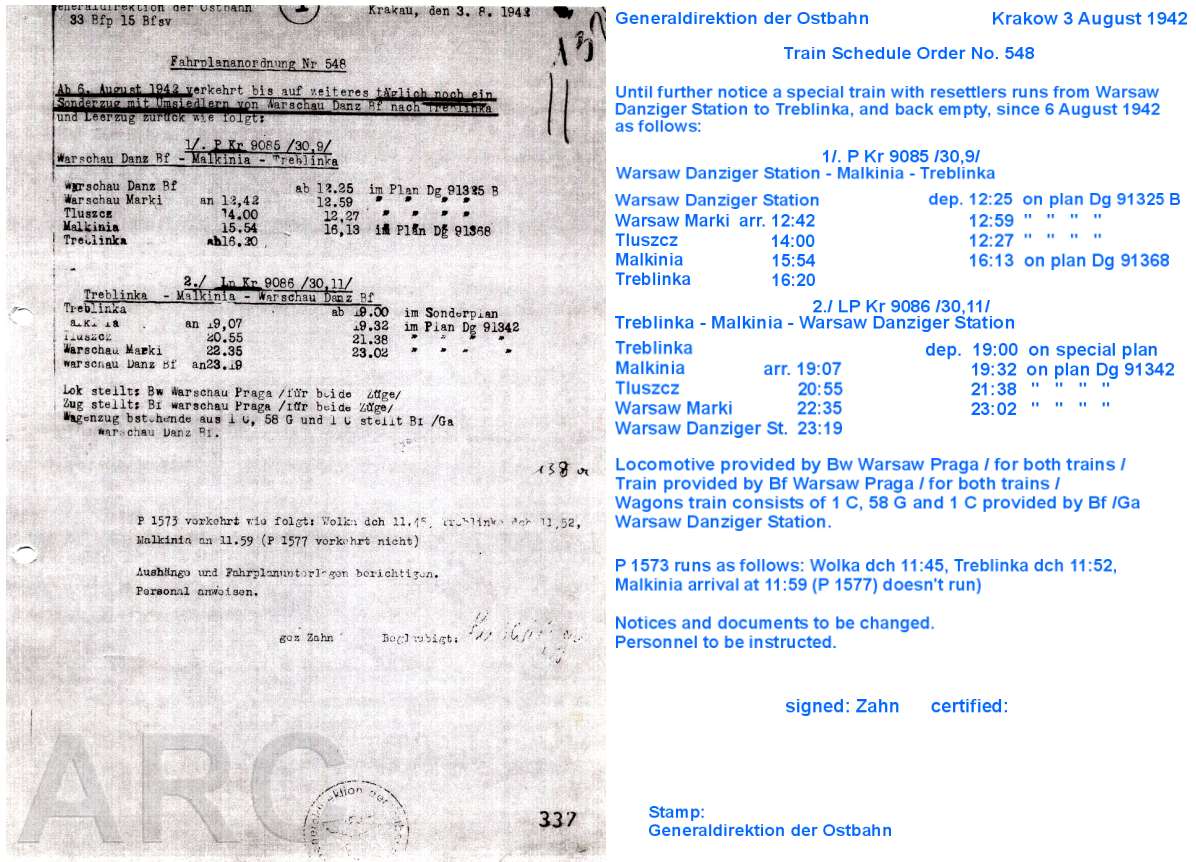
I noted in Part 1 how Korherr and Hoefle got their euphemisms in a twist. The same contradiction can be found when we trace the original instructions for transports from the ghettos to Treblinka.
Read more!
On the one hand, official documentation listed the Jews transported from Warsaw to Treblinka as "resettlers". However, transports from Grodno/Bialystok to Treblinka were listed as labour transports, according to this trial judgement:
It seems to me that the most likely reason why the euphemism 'transit camps' was not used for the Bialystok/Grodno transports was that such camouflage would obviously have seemed ridiculous to anyone reading the order, because they would have known that the transports were going from east to west. If the SS and RSHA had worked out this obvious fact in 1942, why are deniers still struggling with the concept in 2007?
Read more!
On the one hand, official documentation listed the Jews transported from Warsaw to Treblinka as "resettlers". However, transports from Grodno/Bialystok to Treblinka were listed as labour transports, according to this trial judgement:
However, Altenloh and Errelis deny they knew that the final destination was Treblinka, and that the intent of the order was the extermination of the Jews. They claim they believed the purported official motivation: relocation of Jews for conscripted labor.Deniers who insist that Treblinka was a transit camp must therefore explain why the Grodno transports had this 'labour' euphemism.
It seems to me that the most likely reason why the euphemism 'transit camps' was not used for the Bialystok/Grodno transports was that such camouflage would obviously have seemed ridiculous to anyone reading the order, because they would have known that the transports were going from east to west. If the SS and RSHA had worked out this obvious fact in 1942, why are deniers still struggling with the concept in 2007?
Thursday, October 04, 2007
More Holocaust Denial Fallacies
Andrew recently wrote an excellent article for The Holocaust History Project, published here, in which he used the principles of general semantics to expose the fallacies of Holocaust deniers. Below I explore five more fallacies that I have encountered in 'revisionist' literature and in on-line debates with deniers on RODOH.
Read more!
1. 'The fact that there is no evidence that the Reinhardt Camps were transit camps is not evidence that they were not transit camps'. This argument is a perverse application of Carl Sagan's dictum that 'absence of evidence is not evidence of absence'. The dictum was infamously deployed by Donald Rumsfeld in 2003 to claim that absence of WMD being found in Iraq is not evidence that WMD were never present. It has also been deployed in medical discussions, such as here, to claim that the failure of a product to produce a demonstrable effect is not evidence that such effects are always absent. Such claims have been debunked brilliantly by Dr. Marvin J. Schissel here. Schissel points out that:
Consequently, the 'absence of evidence' gambit is a fallacy because there are powerful reasons why evidence of resettlement should be present.
2. 'Evidence of gassing at camps such as Treblinka and Auschwitz does not meet an absolute standard of scientific proof'. This is the burden of proof fallacy. It is fallacious to demand that historians meet a higher burden of proof than would be required in a court of law. It is also fallacious to ignore the fact that the Nazis systematically destroyed evidence of their crimes so historians must reconstruct the Holocaust from fragmentary documentation. In view of the incomplete documentary record, the high degree of convergence in the remaining evidence is conclusive proof of genocide, beyond reasonable doubt. Moreover, even scientific experiments carried out in a laboratory are subject to an uncertainty principle, so the deniers' burden of proof is not even accepted by physical scientists.
3. 'The story keeps changing'. As with the burden of proof fallacy, this claim appeals to an audience that is ignorant of historical method, legal procedure and the sociology of knowledge. There is no historical event which is currently interpreted in exactly the same way that it was in 1945. Demanding that the Holocaust 'story' remains static is thus bone-headed.
4. 'The Soviets lied about Katyn and the Ukrainian famine so they could have fabricated the Holocaust and lied about that too.' This fallacy ignores two obvious facts. Firstly, evidence of Katyn and the famine did reach the west, both at the time and since, and the Russians did eventually admit to Katyn in the post-Glasnost era, so this denier fallacy simply begs the question as to why no evidence of Soviets fabricating the Holocaust has ever come to light. Secondly, the Soviets did not have a monopoly of access to Nazi documents or eyewitnesses. For example, the gas van documents submitted to the IMT (as bundle 501-PS) were discovered by the US 12th Army in Germany, not by the Soviets (see John C. Zimmermann, Holocaust Denial, pages 357-358).
5. 'The allies fabricated propaganda of German atrocities in World War I so obviously did so in World War II as well.' There is no evidence cited to support this claim, and it ignores the fact that many Nazi atrocities were documented by the Nazis themselves. Deniers are falsely equating atrocity stories from WWI that never had supporting evidence with a historical record from WWII that contains an overwhelming convergence of evidence.
Read more!
1. 'The fact that there is no evidence that the Reinhardt Camps were transit camps is not evidence that they were not transit camps'. This argument is a perverse application of Carl Sagan's dictum that 'absence of evidence is not evidence of absence'. The dictum was infamously deployed by Donald Rumsfeld in 2003 to claim that absence of WMD being found in Iraq is not evidence that WMD were never present. It has also been deployed in medical discussions, such as here, to claim that the failure of a product to produce a demonstrable effect is not evidence that such effects are always absent. Such claims have been debunked brilliantly by Dr. Marvin J. Schissel here. Schissel points out that:
While absence of evidence is not absolute evidence of absence, it is generally evidence of a high probability of absence.With reference to the Reinhardt camps, we do, of course, have a convergence of evidence from transport records, contemporary documents, the Korherr Report, the Hoefle Telegram, eyewitnesses, perpetrators and site investigations which shows, beyond reasonable doubt, that over a million Jews were murdered at the camps. Revisionists have had over sixty years in which to find records of transports taking Jews from the camps to the USSR, or records of resettlement, or even eyewitnesses of such resettlement, but have been unable to uncover any such evidence. They have been unable to explain why no defendants at postwar trials, including those such as Eichmann who had direct responsibility for 'evacuation' transports, ever used the 'transit camp' gambit in their defence, despite the fact that this would surely have been the most obvious defence available, had it been true. Moreover, they ignore the fact that the Soviets signed repatriation agreements with Poland in September 1944 and July 1945 but the total number of Polish Jews who returned under those agreements was only 230,700 (source: Yosef's Litvak's essay in Polonsky and Davies, Jews in Eastern Poland and the U.S.S.R., 1939-46, p.235).
Consequently, the 'absence of evidence' gambit is a fallacy because there are powerful reasons why evidence of resettlement should be present.
2. 'Evidence of gassing at camps such as Treblinka and Auschwitz does not meet an absolute standard of scientific proof'. This is the burden of proof fallacy. It is fallacious to demand that historians meet a higher burden of proof than would be required in a court of law. It is also fallacious to ignore the fact that the Nazis systematically destroyed evidence of their crimes so historians must reconstruct the Holocaust from fragmentary documentation. In view of the incomplete documentary record, the high degree of convergence in the remaining evidence is conclusive proof of genocide, beyond reasonable doubt. Moreover, even scientific experiments carried out in a laboratory are subject to an uncertainty principle, so the deniers' burden of proof is not even accepted by physical scientists.
3. 'The story keeps changing'. As with the burden of proof fallacy, this claim appeals to an audience that is ignorant of historical method, legal procedure and the sociology of knowledge. There is no historical event which is currently interpreted in exactly the same way that it was in 1945. Demanding that the Holocaust 'story' remains static is thus bone-headed.
4. 'The Soviets lied about Katyn and the Ukrainian famine so they could have fabricated the Holocaust and lied about that too.' This fallacy ignores two obvious facts. Firstly, evidence of Katyn and the famine did reach the west, both at the time and since, and the Russians did eventually admit to Katyn in the post-Glasnost era, so this denier fallacy simply begs the question as to why no evidence of Soviets fabricating the Holocaust has ever come to light. Secondly, the Soviets did not have a monopoly of access to Nazi documents or eyewitnesses. For example, the gas van documents submitted to the IMT (as bundle 501-PS) were discovered by the US 12th Army in Germany, not by the Soviets (see John C. Zimmermann, Holocaust Denial, pages 357-358).
5. 'The allies fabricated propaganda of German atrocities in World War I so obviously did so in World War II as well.' There is no evidence cited to support this claim, and it ignores the fact that many Nazi atrocities were documented by the Nazis themselves. Deniers are falsely equating atrocity stories from WWI that never had supporting evidence with a historical record from WWII that contains an overwhelming convergence of evidence.
Thursday, September 27, 2007
The Crazy World of Walter Sanning (Part 3)
In Part 2 of this series, we examined Sanning's distortion of a wartime Jewish source. In this third part, we examine his false dating of Nazi demographic data.
Read more!
Sanning builds a deliberate deception into Table 6 (p.75-78), which purports to show the populations of major cities in the Soviet Union (including former eastern Poland) immediately prior to the Nazi invasion of June 1941. Sanning’s footnote ‘j’ (p.78) reveals that most of these data are taken from a Nazi document written in January 1943:
Sanning's distortions concerning the Soviet Union are systematic. For example, Zimmerman has shown how Sanning repeatedly distorts sources relating to Soviet evacuation policy to give the misleading impression that most Jews were evacuated, when in fact those sources state explicitly that most Jews "could not or would not leave."
The date of Sanning’s Nazi source is also revealing because it coincides with that of the Korherr Report, which covered the same time frame as Sanning’s source (i.e. up the end of 1942) but openly admitted that the reductions in population were caused by Nazi policy. For example, at the foot of page 2 of his “short” report (which was specifically produced for Hitler’s attention), Korherr helpfully summarized the results of Nazi killings. Roberto has translated this table as follows:
Sanning’s failure to discuss this report reveals his discomfort with its contents. For example, Sanning's fraudulent figures are clearly exposed by the transportation data to the Operation Reinhard camps that can be found in the Korherr Report, and also in the Hoefle Telegram and Arad’s Belzec, Sobibor, Treblinka. These all tell a similar story. Sanning had claimed that only 857,000 Jews were left in western Poland after the rest fled over the demarcation line, yet Korherr’s figures show that a higher number of Jews than this was transferred to the Reinhard camps and Chelmno:
Arad estimates the total transported at 1.7 million. Furthermore, Arad’s breakdown of transports from specific locations refutes Sanning’s claim that the reductions in population occurred before the Nazi invasion. For example, Sanning (p.42) claims that 50,000 Jewish refugees had been deported from Lvov by the Soviets, but Arad demonstrates that over 70,000 Jews were deported from Lvov to Belzec.
Read more!
Sanning builds a deliberate deception into Table 6 (p.75-78), which purports to show the populations of major cities in the Soviet Union (including former eastern Poland) immediately prior to the Nazi invasion of June 1941. Sanning’s footnote ‘j’ (p.78) reveals that most of these data are taken from a Nazi document written in January 1943:
j. Zentralblatt des Reichskommissars für die Ukraine, Rowno, 2. Jahrgang, No. 2, 9. January 1943, S. 8-20.On page 85, Sanning uses this same document to note that the “local population living under German administration in the RK Ukraine numbered 16.91 million as of January 1, 1943.” Sanning must therefore know that the figures in Table 6 should apply to that date, not the date that the Nazis invaded the USSR, yet he still brazenly goes on to claim that reductions in the population of Ukraine between 1939 and January 1, 1943, were due entirely to Soviet action, despite the fact that the Nazis had been in the Ukraine for eighteen months at that point:
…the pre-war population of the Ukraine must have numbered more than 22.5m; however, the Germans found less than 17 million. One-quarter of the population had disappeared.Sanning has therefore deliberately converted the Jews murdered by the Nazis between June 1941 and January 1943 into Soviet deportees by conflating the two dates and pretending the population data for January 1943 refer to June 1941.
Sanning's distortions concerning the Soviet Union are systematic. For example, Zimmerman has shown how Sanning repeatedly distorts sources relating to Soviet evacuation policy to give the misleading impression that most Jews were evacuated, when in fact those sources state explicitly that most Jews "could not or would not leave."
The date of Sanning’s Nazi source is also revealing because it coincides with that of the Korherr Report, which covered the same time frame as Sanning’s source (i.e. up the end of 1942) but openly admitted that the reductions in population were caused by Nazi policy. For example, at the foot of page 2 of his “short” report (which was specifically produced for Hitler’s attention), Korherr helpfully summarized the results of Nazi killings. Roberto has translated this table as follows:
Region; Time of Taking over of Power; Number of Jews before Taking over of Power; Number of Jews on 31.12.1942
Old Reich and Sudetenland; 30.1.1933 and 29.9.1938; 561,000 and 30,000; 51,327
Ostmark [Austria after annexation, translator’s note]; 13.3.1938; 220,000; 8,102
Bohemia and Moravia; 16.3.1939; 118,000; 15,550
Eastern Territories (with Bialystok); September 1939 (June 1940); 790,000; 233,210
General Government (with Lemberg); September 1939 (June 1940); 2,000,000; 297,914.
Sum Total; - ; 3,719,000; 606,103
Sanning’s failure to discuss this report reveals his discomfort with its contents. For example, Sanning's fraudulent figures are clearly exposed by the transportation data to the Operation Reinhard camps that can be found in the Korherr Report, and also in the Hoefle Telegram and Arad’s Belzec, Sobibor, Treblinka. These all tell a similar story. Sanning had claimed that only 857,000 Jews were left in western Poland after the rest fled over the demarcation line, yet Korherr’s figures show that a higher number of Jews than this was transferred to the Reinhard camps and Chelmno:
Number passed through the camp in the general government [of Poland]... 1,274,166 [and] through the camp at Warthegau [Chelmno]…145,301The Hoefle Telegram repeated the total of 1,274,166, consisting of 24,733 at Majdanek, 434,508 at Belzec, 101,370 at Sobibor and 713,555 at Treblinka.
Arad estimates the total transported at 1.7 million. Furthermore, Arad’s breakdown of transports from specific locations refutes Sanning’s claim that the reductions in population occurred before the Nazi invasion. For example, Sanning (p.42) claims that 50,000 Jewish refugees had been deported from Lvov by the Soviets, but Arad demonstrates that over 70,000 Jews were deported from Lvov to Belzec.
Subscribe to:
Posts (Atom)