Showing posts with label documents. Show all posts

Tuesday, September 03, 2019

German Document Reveals Kulmhof (Chelmno) As a Nazi Extermination Camp

In this series of postings, the Nazi extermination camp Kulmhof (Chelmno) was presented in the light of contemporary German sources. The documents show, among other things, that Kulmhof was run by a killing commando that gassed about 100,000 Jews from December 1941 to Summer 1942.

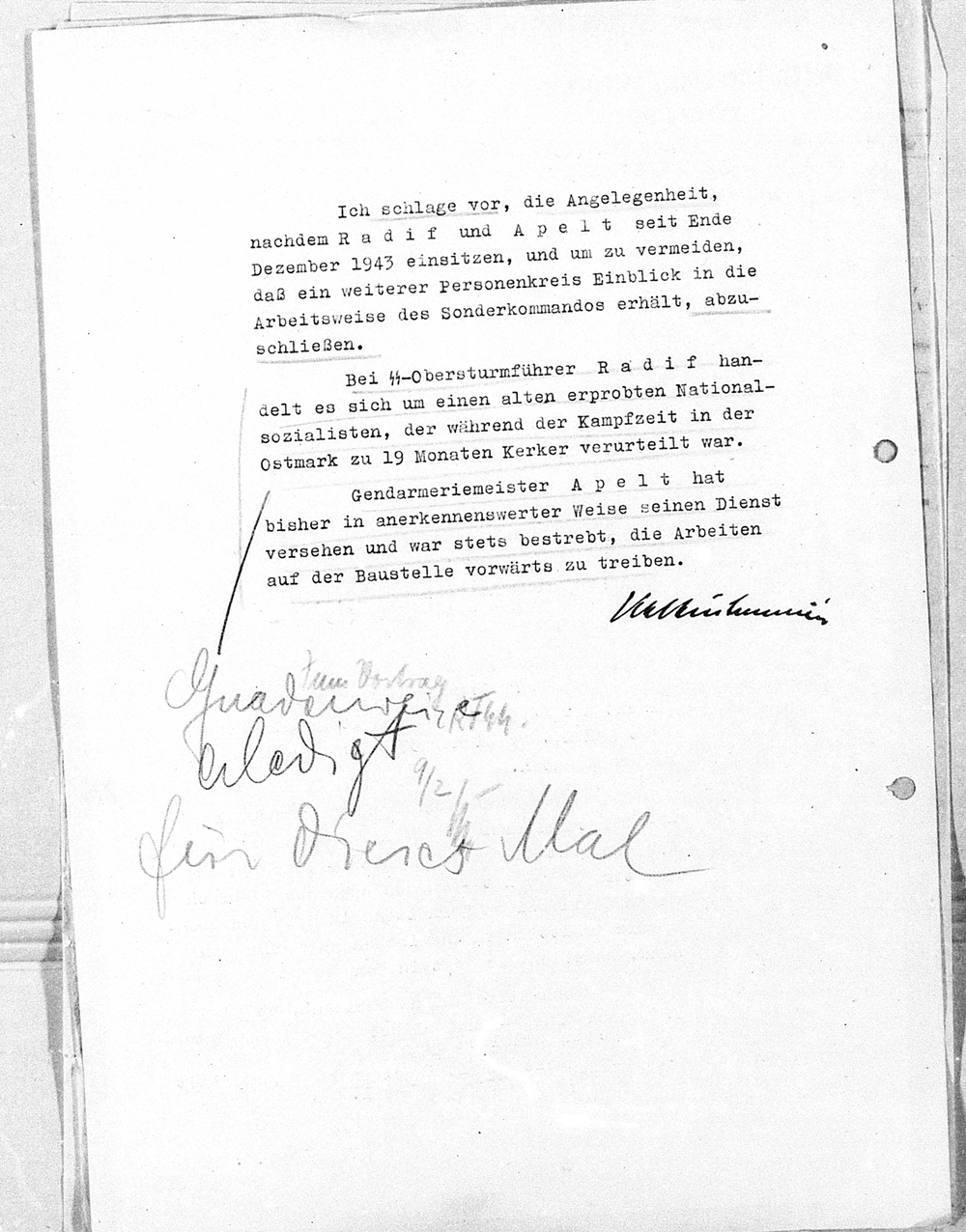
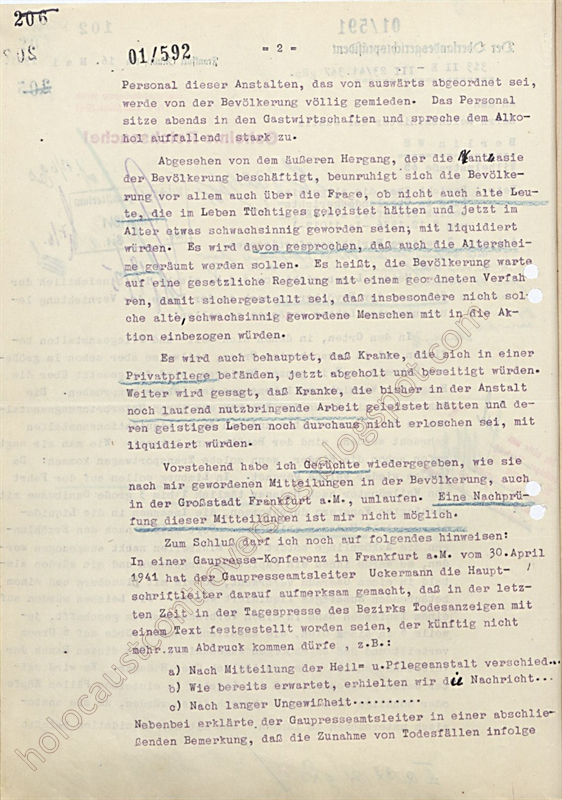
Here is another previously unpublished Nazi document, which reveals that the purpose of Sonderkommando Kulmhof was the  "immediate fight against and annihilation of state enemies", which was of "crucial importance for the solution of one of the most important ethnic problems" and required "in particular a manly and strong mental attitude" (see transcription and translation of the document below).


Friday, August 02, 2019

The Hagen Letter: "...to deal with 1/3 of the Poles - old people and children under the age of 10 - as with the Jews, that is to kill them."

On 17 February 1943, the Higher SS and Police Leader East Friedrich-Wilhelm Krüger forwarded to the Reichsführer-SS Heinrich Himmler correspondence of German officials in the General Gouvernement (BArch NS 19/1210).

The cause was a letter written by Wilhelm Hagen, the medical officer of Warsaw, to Adolf Hitler. In his letter of 7 December 1942, Hagen explained that Lothar Weirauch, head of the Department of Population and Welfare,  had revealed that "it is intended or considered, in the course of the resettlement of 200,000 Poles in the east of the General Government...to deal with a third of the Poles - with 70,000 old people and children under the age of 10, as with the Jews, that is, to kill them" (see document below). He did ask Hitler for his intervention and decision on the issue.

Saturday, July 27, 2019

Blobel, Eichmann's Office and a Denier's Ignorance

We have already observed the pattern that whenever the denier Carlo Mattogno claims on the Holocaust that something or someone is not known, had nothing to do with something else or did not exist, then there is a good chance that the exact opposite is true.

Examples:
  • Josef "quite unknown" Spacil (SS-Standartenführer, BdS Niederlande, SS economist at the HSSPF Süd-Russland, head of RSHA II)

  • Johann "completely unknown" Ernst (SS-Untersturmführer and Technischer Obersekretär, head of SiPo repair garages)

  • Guido "completely unknown" Huhn (SS-Obersturmführer, SS-Sondereinheit at concentration camp Auschwitz)

  • Friedrich "not a Major in any way" Pradel (SS-Sturmbannführer and Major der Schutzpolizei, RSHA II D 3 a)

  • on Sonderkommando 1005 German documents that "there are none" and that the designation "was invented by the Soviets".

  • on the Minsk gas-chamber dossier that the "signature of the note in question is by a different hand and is a rather clumsy attempted imitation" and that "there is no trace of any record of the presumed visit to Minsk itself by any Italian fascist delegation".

  • on homicidal gas vans that "the word 'Gaswagen,' in the sense of 'mobile homicidal gas chamber' was coined only after the Second World War by the victorious powers".

  • on homicidal gas vans that "the term 'Gaskammer' can only refer to a stationary 'gas chamber'".

  • on Saurer gasoline driven gas vans that "all Saurer trucks had diesel engines"

  • on intercepted decodes on the mass killing unit Sonderkommando Lange that "there is no mention of Sonderkommando Lange, or gas vans, or Novgorod, or mental patients to be killed!".

  • on a gas van document that "[c]ontrary to normal practise, the typed name of the author of the letter is missing, as are his name [sic!] and rank and  that steel bottles with carbon oxide "does not appear in any document".

  • on the testimony of von dem Bach-Zelewski that "the Jewish editors of Aufbau falsified the original document, shamelessly interpolating and adding entire paragraphs".

  • on the Auschwitz Jewish Sonderkommando that "not a single one had anything whatsoever to do with the crematoria" 

Mattogno never gets tired to deliver explosive ammunition that would have destroyed his reputation as a researcher - if he ever had one. In this posting, we take a look at another case in point from his recent "Holocaust Handbooks": Mattogno argues that the Aktion 1005 leader Paul Blobel "had nothing to do" with Eichmann's office - which is straight away refuted by numerous contemporary German documents.

Monday, March 04, 2019

Mattogno, his Einsatzgruppen book and the Gas Vans. Part VII: Semantics

 Mattogno, his Einsatzgruppen book and the Gas Vans

If we search through the books published before the Second World War, the word Gaswagen has been used with three meanings: a) short for Holzgaswagen (producer gas vehicle), short for Gastransportwagen (vehicle for transporting gas), c) any vehicle with an internal combustion engine (for sources see Mattogno and the Activity & Situation Report of Einsatzgruppe B on its Gas Vans). 

Between 1941 and 1944, the Nazis deployed homicidal gas vans with engine exhaust. The vehicles consisted of a closed cargo box mounted on a light to medium truck chassis and can be described as Kastenwagen (box wagon/van). Vergasungen (gassings) were carried out inside the closed box, so the vehicle would be something like a Vergasungskastenwagen. The bulky term can be shortened to Gaswagen (as in Gaskammer/gas-chamber, the prefix Vergasung- can be simplified to Gas-). It is semantically plausible that the Nazis would have called their homicidal gas vans as Gaswagen.

Friday, January 18, 2019

Mattogno, his Einsatzgruppen book and the Gas Vans. Part IV: The "Enormous Contradiction" That Is None

 Mattogno, his Einsatzgruppen book and the Gas Vans


Before I roll out the heavy artillery, here's a quick appetiser to illustrate Mattogno's cheating or ignorance (your choice again) on German documents on the gas vans. Even after having read 250 documents on the Einsatzgruppen and some 200 individual pieces of correspondence from or to the Einsatzgruppen, he argues like a beginner on the subject and even considers his lack of understanding as something especially clever no one else has noticed:

Tuesday, December 11, 2018

What's There to Hide? Camouflage and Secrecy of Nazi Extermination Sites

Contemporary German documents referring to the fate of Jews considered unfit for forced labour often do so in a conspicuously vague way. Instead of spelling out actual destinations or camps, general phrases like "eastwards" and "Russian East" were employed.

Elsewhere I've pointed out how the killing of Poles and mentally ill people in 1940 in East-Prussia was disguised by the Nazis. For "camouflaging" the "liquidation" of members of the Polish intelligentsia in the camp of Soldau, "the Poles in question had to sign a declaration of the content that they agreed with their deportation to the Generalgouvernement". The "mentally ill prisoners...liquidated by a special commando" were "evacuated" and "placed somewhere else" in SS correspondence.

The concept to camouflage murder with none or vague destinations was later also implemented for disguising the extermination of the Jews. The deception could work as it had a true core. The Jews had to gather in the towns and villages and were brought away. For the population and authorities parts of the operation could have appeared more or less like a real resettlement. Except that they never heard anything of those "resettled" again, as the "resettlers" were executed, buried and incinerated at the next extermination site.

Monday, April 30, 2018

Dirlewanger to an SS Investigator on Poisoning of Jews

In 1942, the SS Main Office "investigated" charges launched by the SD and the SS and Police court Cracow against Oskar Dirlewanger, the commander of the infamous SS penal unit Sonderkommando Dirlewanger, which included racial defilement, abuse of his own men, extortion, illegal hunting, illegal confiscations, illegal arrests and illegal killings in the Generalgouverment. 

During his interrogation of 1 September 1942, Dirlewanger explained to the SS court martial officer (Gerichtsoffizier) that the SD could not cope with the killing of the Jews caught violating Nazi regulations and that therefore in November 1941, the SS and Police Leader of the Lublin district Odilo Globocnik ordered they are to be handed over to Dirlewanger for execution. Initially, the Jews were just shot, but later they had to undress in a cellar under the pretense vaccination against typhus and were killed by injection of the poison strychnine. Their gold teeth were broken out to be used for the SS dental station and the clothes were provided to Russian POWs.

It is noteworthy that Dirlewanger tried within his sphere of influence and on a small scale what were to be basic elements of large scale Nazi mass extermination sites: disguise, poison and robbing of dead people.

Saturday, March 10, 2018

Sonderkommando Kulmhof in German Documents - Farewell (1943)

Mass Killing Unit of Warthegau

Sonderkommando Lange in German Documents:

Sonderkommando Kulmhof in German Documents:
Part III: Body Disposal (Appendix)
Part V: Funding
Part IX: Farewell (1943)

Until 31 December 1942, the Sonderkommando Kulmhof had systematically murdered about 4,400 Sinti and Roma and 145,301 Jews  (Document 234). The Jews of the Warthegau had been wiped out except for the "labour ghetto" in Litzmannstadt and Jews loaned to outside work-sites. Since life as a Sonderkommando member was comparable pleasant and beneficial - with bonus payments, free tabacco and alcohol, no front duty, absence of military discipline, access to cheap goods from the rich warehouses of the Litzmannstadt Ghetto Administration - and facing the prospect of front-line service, the Kulmhof commandant Hans Bothmann seemed to have stretched the dismantling and closing of the camp over the whole Winter 1942/43. [1]

Sunday, January 07, 2018

Sonderkommando Kulmhof in German Documents - Drinks and Tobacco (With Excursus on the Extermination of the Sinti and Roma)


Mass Killing Unit of Warthegau

Sonderkommando Lange in German Documents:

Sonderkommando Kulmhof in German Documents:
Part III: Body Disposal (Appendix)
Part V: Funding
Part IX: Farewell (1943)

The fate of the about 5,000 Sinti and Roma deported from the Reichsgaue Niederdonau (Lower Danube) and Steiermark in annexed Austria to the Litzmannstadt Ghetto in early November 1941 and forced to vegetate in the most inadequate conditions was sealed when a typhus epidemic broke out in early December 1941 [1] and, incidentally, an extermination camp was established 70 km North-West of Litzmannstadt: Kulmhof. The liquidation of the Sinti and Roma from the Ghetto by the Sonderkommando in December 1941/January 1942 was going beyond its initially assigned task to exterminate 100,000 Warthegau Jews and marked another escalation of the type of victims targeted after mental patients and unfit Jews.

Monday, October 02, 2017

Sonderkommando Kulmhof in German Documents - Pabianice Sorting Camp

Mass Killing Unit of Warthegau

Sonderkommando Lange in German Documents:

Sonderkommando Kulmhof in German Documents:
Part III: Body Disposal (Appendix)
Part V: Funding
Part IX: Farewell (1943)

The first commandant Herbert Lange could resort in Kulmhof to his experience in organizing the killing and burial of people. In the first months of the extermination, he did, however, not anticipate the necessary efforts for properly storing and processing the luggage from the large scale mass killing. The effects were piled up behind the palace, thrown into in the nearby church and granary building.

Saturday, July 29, 2017

Sonderkommando Kulmhof in German Documents - The Extermination of 100,000 Jews

Mass Killing Unit of Warthegau

Sonderkommando Lange in German Documents:

Sonderkommando Kulmhof in German Documents:
Part III: Body Disposal (Appendix)
Part V: Funding
Part IX: Farewell (1943)

Figure 1: Google Earth view on the final train stations (Kolo/Warthbrücken & Powierce), the ruins of Kulmhof Extermination Camp and its Body Disposal Site in Rzuchow Forest

Thursday, July 06, 2017

The Kinna Report - German Document on the Killing of Unfit Jews in Auschwitz

Introduction

In late 1942, several thousand Poles were deported from Zamosc to destinations according to their racial value attributed to them by Nazis since the area was declared "to the first German settlement area in the Generalgouvernement" (order of Himmler of 12 November 1942, Jaczynska, Sonderlaboratorium SS, p. 414). The racially most inferior defined people were sent to Auschwitz concentration camp. The transport left Zamosc with 644 Poles of this group on 10 December 1942. Several people escaped from the train, the rest was admitted to Auschwitz on 13 December 1942.

The SS officer Heinrich Kinna of the migration central office wrote a report about the transport on 16 December 1942, in which he also summarised his talk with the deputy commandant in Auschwitz, Hans Aumeier (who he spelled phonetically as "Haumeier"). Aumeier informed Kinna on the camp's lethal policy on unfit prisoners, an indiscretion only trumped by Kinna writing that down in plain words:
"Imbeciles, idiots, cripples and sick people have to be removed from the camp within a short time by liquidation to unburden the camp. But this measure has insofar complications as, according to the order from the RSHA, the Poles have to die of a natural death contrary to the measures applied to the Jews."
(extract from the report of Heinrich Kinna of 16 December 1942, reproduced in full below)

It is noteworthy that while Kinna's employer, the migration central office in Lodz, sounds rather innocent and unrelated to the murder of Jews, its men were dispatched to Chelmno/Kulmhof extermination camp in 1942 (see documents 16 and 17 in Sonderkommando Kulmhof in German Documents - Origin and Foundation), so that Kinna might have been already inside the circle of people knowing details on the extermination of Jews. In fact, in his job description Kinna himself included the task "carrying out measures [Zweckmaßnahmen] against Jews and anti-social people" (letter of Kinna to the SS Personnel Main Office of 13 July 1943, cited in Aly, "Endlösung". Völkerverschiebung und der Mord an den europäischen Juden, p. 20).

The significance of this contemporary German document lies in its reference to the killing of Jews unfit for work in Auschwitz without resorting to the usual camouflage language (see for instance Mattogno's special treatment of evidence and "Separate accommodation" in Auschwitz: a code word for extrajudicial executions).


Friday, June 16, 2017

Sonderkommando Kulmhof in German Documents - Origin and Foundation

Mass Killing Unit of Warthegau

Sonderkommando Lange in German Documents:

Sonderkommando Kulmhof in German Documents:
Part III: Body Disposal (Appendix)
Part V: Funding
Part IX: Farewell (1943)

On 16 July 1941, officials of the Reichsgau Wartheland discussed the "solution of the Jewish question", which was picked up by the head of the SD and Umwandererzentralstelle (migration centre office) Posen Rolf-Heinz Höppner and forwarded to Adolf Eichmann with the request "to have your reactions sometime". Höppner himself considered the proposals "in part fantastic, but in my view...thoroughly feasible". Among mass sterilisation and erection of a huge camp for the Jews of the Warthegau, it was discussed "to finish off those of the Jews who are not employable by means of some quick-working agent" as "this winter there is a danger that not all the Jews can be fed anymore" (Document 15). The feasibility of the secret mass killing of people in the Warthegau had been previously demonstrated by the clearing of the asylums by Sonderkommando Lange with its carbon monoxide gas van (see the previous posting of this series Sonderkommando Lange in German Documents: Euthanasia 1940/41). On 2 September 1941, Höppner urged Eichmann for a policy decision: [1]
"It is by the way essential that it is entirely clear from the start what shall happen with those evacuated ethnic groups, which are undesirable for the greater German settlements: if the aim is to permanently assure them a certain life or if they shall be wiped out [ausgemerzt] entirely."

Friday, May 19, 2017

Sonderkommando Lange in German Documents: Euthanasia 1940/41

Mass Killing Unit of Warthegau

Sonderkommando Lange in German Documents:

Sonderkommando Kulmhof in German Documents:
Part III: Body Disposal (Appendix)
Part V: Funding
Part IX: Farewell (1943)


Herbert Lange (source)
Herbert Lange, born 29 September 1909 in Menzlin in the Province of Pomerania, worked as criminal investigator at the Gestapo in Aachen before the war and took part in the Polish Campaign as member of Einsatzgruppe VI, which settled as Security Police headquarters in Poznan [1] (click or hover over footnotes to see references). For a short period of time until 16 October 1939, he was commandant of the Übergangslager (transition camp) Fort VII in Poznan [2]. Lange became the leader of a special detail (Sonderkommando) founded by and named after him, which specialized in the killing of mentally ill people with poison gas. In late 1941, he moved on to establish Chelmno (Kulmhof) extermination camp to wipe out the Jews of the Warthegau as well. He was replaced in Spring 1942 as commandant of the extermination camp by Hans Bothmann and employed as investigator in the RSHA. He supposedly died during the battle of Berlin at the end of the war.

Fort VII

Fort VII in Poznan; ref. 2, p. 13
The first Nazi gassings of people took place in Fort VII in Poznan in late 1939. Some experiments with the two most promising killing agents hydrogen cyanide and carbon monoxide may have been tried in casemates of the camp as early as October 1939. What seems like an experimental gassing with hydrogen cyanide soaked pellets (Degesch's "Zyklon") was mentioned en passant by the RSHA driver Wilhelm F. [3] :
"Right after the Polish Campaign I was sent with a group of officers to a town in Poland, I do not remember its name. There was a red haired Untersturmführer, who was called Becker as I now recall. This Becker made experiments with poison gas. A number of people were locked in a casemate and gas was introduced into the casemate through venting pipes. I remember exactly how Becker dropped something into the pipes."

"I have seen that Becker fetched a box with cans. He threw them [into the air shafts]."

From November 1939, mentally ill people were systematically killed with carbon monoxide gas in Fort VII [4]. Under the command of Lange the inmates of the asylums near Poznan were driven to the camp, locked in casemates and suffocated with carbon monoxide from pressurized steel bottles. The corpses were buried in mass graves in a forest near Oborniki, 30 km North of Poznan. The handling of the corpses was done by Polish prisoners of Fort VII assigned to Sonderkommando Lange, among those Henryk Mania and Henryk Maliczak, who testified on the killings after the war.

Monday, April 17, 2017

German Document on Chelmno Gas Van Driver Filling up Gasoline in Lodz

APL 221/30183, p. 11
A document from the Ghetto Lodz administration shows that on 2 September 1944 "Laabs" from the "SS police" refuelled his truck with the licence number "71449" two times with "45 liters" of gasoline at the tank station of the Ghetto Lodz administration. The driver "Laabs" of the "SS police" can be matched to the well known permanent gas van driver of the SS and police Sonderkommando Kulmhof Gustav Laabs (see testimonies in the appendix below). That this vehicle was indeed a homicidal gas van is supported by the fact that its license number of 71449 is close to those of other known gas vans 71457, 71462 and 71463 (see also How the convergence of evidence works: the gas van of Auschwitz, Mattogno and the Activity & Situation Report of Einsatzgruppe B on its Gas Vans and Rebuttal of Alvarez on Gas Vans: The Schäfer, Trühe & Rauff Telexes).

Sunday, March 12, 2017

Seminar Talk of SS leader Franz Six on "the Physical Elimination of the Jewry in the East"

On 3 and 4 April 1944, the German Foreign Office and the RSHA organized in a Hotel in Karpacz in Lower Silesia a seminar on anti-Jewish measures and propaganda outside the German Reich. One of the lead speakers was Franz Six, previously head of the RSHA office VII (Ideological Research and Evaluation) and leader of the so called Vorkommando Moskau of Einsatzgruppe B. Although details on the Jewish measures from the talks of Eberhard von Thadden and Heinz Ballensiefen were "not taken up into the protocol because of their secret character" (accompanying letter from Rudolf Schleier of 20 April 1944), the Nazi policy was indicated in the protocol of the talk from Six, who explained that "Jewry in Europe has ended its biological and at the same time political role" and that "the physical elimination of the Jewry in the East deprives Jewry of its biological reserves."

Monday, March 06, 2017

Evidence on the Babi Yar Massacre 29 & 30 September 1941: Contemporary Sources

The killing of more than 30,000 Jews on 29 and 30 September 1941 in the ravine Babi Yar in Kiev is known as the largest individual Nazi massacre. This posting continues and extends the collection of evidence in That's why it is denial, not revisionism. Part III: Deniers and Babiy Yar massacre (1). Numerous contemporary German sources cover the preparation and planning of the mass shooting (fabrication of wall posters by a Wehrmacht propaganda unit, delivery of 100,000 rounds of ammunition to the police forces of the Higher SS and Police Leader South-Russia and intention of Sonderkommando 4a to execute "at least 50,000 Jews"), its implementation (reports of Einsatzgruppen, Higher SS and Police Leader Russia-South, Wehrmacht, Reich Ministry for the Occupied Eastern Territories, German Foreign Office) and its clean up (Wehrmacht photographs). The mass killing was also echoed in contemporary diaries of the local population, contemporary Swiss, Soviet, Polish and US sources. A seperate posting will compile some of the testimonies of German paramilitary personnel, German civilians, local population and prisoners on the mass shooting and the later body disposal in 1943.

Part I: Contemporary Sources
German Sources (20 documents + 13 photographs)
Diaries of Local Population (2)
Swiss (3), Soviet (6), Polish (1), US Sources (1)

Testimonies of German Paramilitary Forces & Nazi Collaborateur
Testimonies of German Civilians
Testimonies of Local Population and Prisoners

Thursday, February 23, 2017

Order from the BdS Generalgouvernement That Prisoners and Jews "Are to Be Liquidated" When Evacuation Is Not Possible

The following reproduces an order from the Senior Commander of the Security Police and Security Service (BdS) Generalgouvernement Walther Bierkamp of 20 July 1944 - as it was circulated by the Commander of the Security Police and the Security Service Radom the day later - that "it is to be avoided under all circumstances that prisoners or Jews should be liberated by the enemy...or should fall into their hands alive". In case that the evacuation of the inmates of SD prisons turns out as not possible, these "are to be liquidated, and the bodies of those shot are to be disposed as far as possible (burning, dynamiting of the building, etc.)" and "Jews still employed in the armaments industry or on other work are to be dealt with in the same way".

According to Daniel Blatman, The Death Marches, p. 57ff., the order should be seen in the context of Heinrich Himmler's directive "Security of Concentration Camps in Case A" of 17 June 1944, which handed over the responsibility for the security of the camps from the WVHA to the Higher SS and Police Leaders in case of an emergency situation. The document was cited on this blog in Mattogno's Ineptitude on the Fate of Jewish Workers in the General Government.