Thursday, May 21, 2026

What Vladimir Davydov really said about the height of the Babyn Yar pyres.

It has long been a staple argument of the deniers against one Babyn Yar witness Vladimir Davydov (one, but not the only, contrary to the incompetent nincompoops Carlo Mattogno and Jürgen Graf's claim) that he claimed the height of 10-12 m for the Babyn Yar pyres in 1943.

Mattogno and Graf wrote:

On November 9, 1944, Major Lavrenko, member of the Commission for the Investigation of German Crimes in Kiev, questioned the Jewish witness Vladimir K. Davidov. The latter stated that on August 18, 1943, he, along with 99 other prisoners, for the most part also Jewish, had been selected from the Siretzki concentration camp 5 km from Kiev. The 100 prisoners were taken to Babi Yar and there were forced to dig up the bodies of the Jews shot in 1941. According to him, 70,000 bodies had been in the mass graves of Babi Yar. The prisoners had exhumed these and burned them on 'ovens' afterwards, which consisted of granite blocks - procured from the Jewish cemetery of Kiev - with train rails laid upon them. On these a layer of wood was piled and on top of this the bodies, so that an enormous stack of bodies 10 to 12 m high resulted! In the beginning there was merely a single 'oven,' but then 75 of them (literally seventy-five) were built.

No other witness claimed something like this and Davydov himself stated in 1967 that the height was actually 4 m.

But what of his original claim? Well, now we have the original BY investigation files from 1943 and 1944.

Monday, April 27, 2026

Otto Moll - Dear Gardener Next Door Or Psychopathological Mass Murderer?

Otto Moll, born in 1915 in Mecklenburg, trained as a gardener before joining the SS-Wachverband V "Brandenburg" in 1935. His early life was marked by personal hardship: a serious car accident in 1937 left him with a skull fracture and blindness in one eye, and in 1940 his first wife and unborn child died from blood poisoning. By April 1938, he was working in the SS garden at the Sachsenhausen concentration camp, and he soon became part of the expanding concentration camp system.

According to his own statement to US investigators from November 3, 1945, "from 1941 until January 1945, I likewise managed a gardening unit of the Economic and Administrative Main Office in the Auschwitz concentration camp". 

Afterwards, Moll was stationed at the Kaufering II subcamp of the Dachau concentration camp. Moll stated that "no prisoner in my camp died from illness or malnutrition, and none were hanged or shot. There was not a single death in my camp ... no mistreatment of any prisoners by any guards occurred. No prisoner was beaten, kicked, or otherwise abused by the guards".

SS-Hauptscharführer Otto Moll - the dear gardener from next door?   


Otto Moll (source)

At the CODOH Holocaust denial discussion forum, the poster Stubble writes that "Going over what there is, I can't rule out that he indeed just ran the garden (farm) detail and was hated for it, and thus framed up for something different". 

The record tells a very different story. 

Monday, March 23, 2026

Twenty years of HC blog

Happy birthday to us: exactly twenty years ago, the Holocaust Controversies blog was kicked off with the first of over 1,500 posts. It's a strange anniversary given how much time has elapsed and how different the world now is. 

Back then, the HC team met online at the original Real Open Debate on the Holocaust forum, an old-fashioned bulletin board, before any of today's social media platforms existed. While Holocaust 'revisionism' had been dealt a huge blow in 2000 with the defeat of David Irving's libel suit against Deborah Lipstadt in London, it seemed to be surging online, largely ignored by the mainstream media. Many of the HC team had been arguing with Holocaust deniers online for years. I myself stumbled across it when googling for materials on Auschwitz, and could scarcely avoid what seemed like a barrage of revisionist propaganda materials. Thus the decision to found the blog.

Twenty years on, the landscape is entirely different. Holocaust denial in 2026 presents an even more paradoxical picture: it has surged once again on various social media platforms, but in a largely headless form, part of a wider upsurge in antisemitism online in the past two to three years. And with that surge, HC's views have as well, passing six million since May 2010 in July 2025 and seven million in February 2026. 

Friday, July 25, 2025

German Footage of a Homicidal Gassing with Engine Exhaust. Part 7: Tactical Symbol & Homicidal Gas Van

 German Footage of a Homicidal Gassing with Engine Exhaust

Part 1: Provenance
Part 2: Location
 
 
If there were still anyone in the world who harbored even the slightest doubt about the authenticity of the film footage showing the Nazi gas killing operation at the psychiatric hospital in Mogilev, those doubts should now be dispelled.
 
Mogilev gassing footage

Friday, July 11, 2025

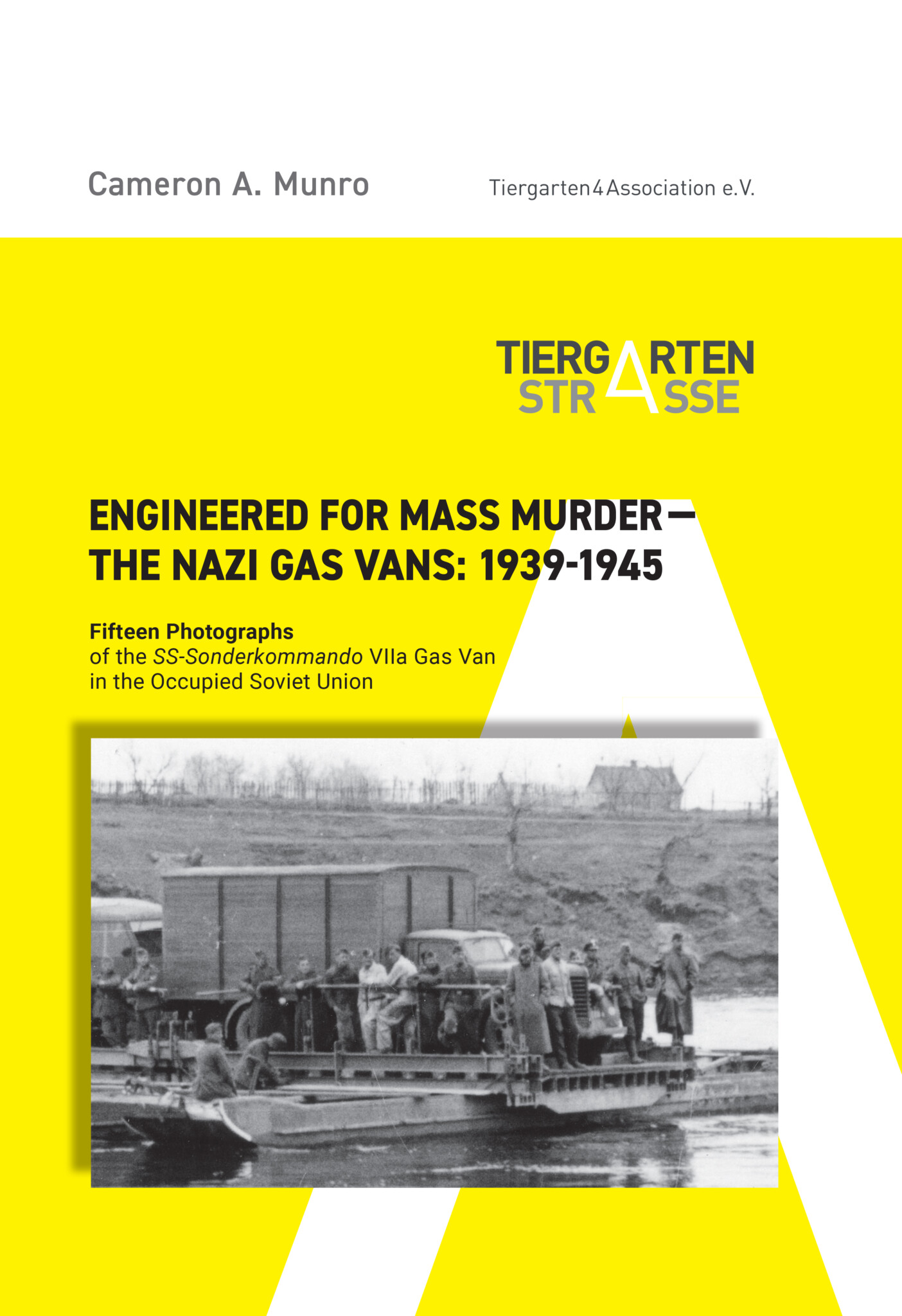
First Published Photographs of Nazi Homicidal Gas Van with Engine Exhaust

Cameron A. Munro has recently published "Engineered for Mass Murder – The Nazi Gas Vans: 1939–1945", a book in which he presents 15 photographs depicting a homicidal gas van built on a petrol-powered Diamond T chassis. 

These photographs were taken in April 1942 by SS-Rottenführer August Vielkind of the Waffen-SS reserve, who was part of the advance detachment of Sonderkommando 7a of Einsatzgruppe B, marching from Klintsy via Gomel to Sychyovka. The images were used by prosecutors in Dortmund during investigations into members of Sonderkommando 7a. However, as Munro notes, it seems they "did not forward the photographs to West-German investigators of other units" and "the photographs then lay forgotten in the files of the Landesarchiv Nordrhein-Westfalen in Münster for many years". 

It’s remarkable that such historically significant material can still be discovered after so many years. And fittingly - characteristic of authentic historical research - the deeper one digs, the more corroborating rather than contradicting evidence tends to emerge. 

I highly recommend it to anyone interested in the history and mechanics of the Nazi homicidal gas vans.


Saturday, May 24, 2025

Saurer Company or Why even Rudolf has shown the Diesel Issue is irrelevant on Gas Vans ("Rebuttal of "Holocaust Encyclopedia")

For decades, Holocaust deniers have claimed that the Saurer gas vans had to have diesel engines, and since diesel exhaust has lower carbon monoxide, they conclude the vans couldn’t have been used for murder. The argument is irrelevant as the RSHA turned chassis with gasoline engines into gas vans. A detailed refutation of the "diesel issue" argument was published ten years ago and has never been answered in substance to my knowledge (see Rebuttal of Alvarez on Gas Vans: Why the Diesel Issue is Still Irrelevant). Denier Alvarez’s new edition (2023) of his book "The Gas Vans" continues to repeat it, without a single source, counter-argument, or whisper of a rebuttal to the refutations that already exist. 

Germar Rudolf’s entry "Saurer Company" in CODOH's Holocaust Encyclopedia tries a fresh variation:

He notes that the RSHA motor pool acquired a number of Saurer 5-ton chassis in 1942  and the company Gaubschat in Berlin built a cargo box on each chassis - "for an unspecified purpose".  The historical consensus (or as Rudolf  like to call it "orthodoxy") holds that these were mobile gas chambers. Rudolf argues that because gasoline-engined trucks were supposedly "much easier" to obtain from other manufacturers, the RSHA’s Saurers “must have had diesel engines".

Here’s where the things get interesting. 

Rudolf concedes for the first time what deniers once swore was impossible and what we have pointed out at this blog: that Saurer did, in fact, produce gasoline-engine trucks during the war - in the French factory in Suresnes near Paris

Saturday, April 19, 2025

Why Producer Gas Wasn’t Used (Rebuttal of "Holocaust Encyclopedia")

Holocaust deniers often fixate on fringe technicalities or imagined inconsistencies to avoid confronting the overwhelming documentary, testimonial, and forensic evidence. One of their rhetorical questions goes something like this: "If gas chambers were real, why didn't the Nazis use producer gas?" 

Well, challenge accepted.


Wednesday, December 18, 2024

How We Already Debunked Your Franke-Gricksch Report Denial Before You Even Hit 'Publish'

There’s a relatively new holocaust denier blog called Holocaust Claims (https://www.holocaust.claims) churning out posts every other day in 2023. While the pace slowed considerably in 2024, the quality refused to improve.

There is piece titled The Franke–Gricksch Report from September 2023 which quotes  fellow denier Jürgen Graf and tosses in another shaky point gleaned from some video clip. The arguments have been dismantled right here on this blog back in 2019:

- number of muffles in the crematorium, here and here and here.

- coke consumption and freshly burnt, here  and here

- ventilation duration, here and here

 - death time, here

- cremation capacity, here and here and here and here

 - hiding jewelry, here and here

- special tracks in specially designated districts of the camp, here and here and here

It's also telling that, in 2023, a Holocaust denier still harps on Eric Lipman’s quick and dirty typed copy of the report as if the clean carbon copy we discovered and published in 2019 doesn’t exist.

Saturday, December 14, 2024

Never Change a Winning Method: How the Nazis Planned to Gas a French General with Carbon Monoxide

On October 28, 1944, the German General Fritz von Brodowski was shot in Allied captivity. Three months later, on 19 January 1945, the Nazis retaliated by shooting the French General Gustave Mesny in a staged escape attempt. 

Given the foreign policy implications, the German Foreign Office was involved in planning the killing and left behind a paper trail, see Kaltenbrunner’s Execution Proposal to Himmler: "Carbon Monoxide Introduced Via an Apparatus Operated From the Driver’s Seat". On December 30, 1944, RSHA chief Ernst Kaltenbrunner sent Himmler two murder options:

1) During the relocation of 5 individuals in 3 vehicles with Wehrmacht insignia, an escape scenario arises when the last vehicle breaks down, or

2) Carbon monoxide is introduced into the sealed rear compartment of the vehicle via an apparatus operated from the driver's seat. The device can be installed with the simplest means and removed immediately afterward. A suitable vehicle has now been obtained after significant difficulties.

The very next bright idea after shooting was gassing with carbon monoxide? It’s almost as if the Security Police had some prior experience with this method. Oh right - they had:

Before deniers start questioning why a suitable vehicle was needed despite the existence of gas vans, let’s set the record straight: First, by this stage of the war, the gas vans employed for mass gassings may have already been dismantled. Secondly, the plan was to gas the French General in a car befitting his rank, not in the cargo compartment of a truck.

Friday, November 29, 2024

Review of Holocaust Handbooks Volume 23 - Carlo Mattogno, Chełmno (Part IV - Testimony of Chełmno Escapee Szlama Winer)

Part I - Method

Part II - Scholarly Avoidance

Part III - Systematic Analysis of One Example

Part IV - Testimony of Chełmno Escapee Szlama Winer

Szlama Winer escaped Chełmno extermination camp on January 19, 1942 and upon arriving in the Warsaw Ghetto, provided a detailed account of the atrocities committed there. His report is extensive, comprising approximately 15,450 words and 692 sentences in its English translation. Carlo Mattogno even mocks the "extraordinary wealth of detail" and a "truly prodigious memory". It's remarkable that detailed recollection is now considered as a flaw in eyewitness testimony.  

Slzama Winer
Slzama Winer

One might think that such a detailed testimony would provide ample material for a thorough analysis. Yet, Mattogno, in his critique, chooses to come up with a mere handful of points - six, to be precise - in an attempt to discredit the entire account as "completely unreliable".