They burned a "B as in Bruce" quarter Billion pounds of wood in an area enclosed by a tree branch fence. Hmmm.
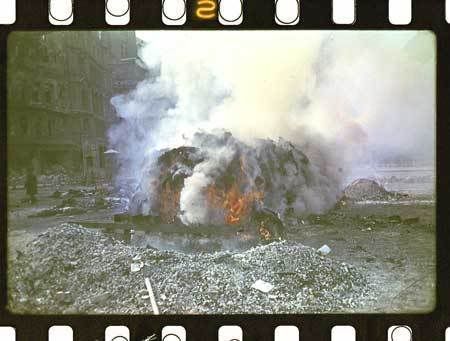
and contains the first out of several bullshit claims to be addressed in this article. The «quarter Billion pounds» of wood that Bud tries to impress his viewers with, 225,000,000 pounds or 102,058,283.25 kg, are arguably an exaggeration by a factor of at least 3.85, according to the calculations presented in my article about clip # 23. And even those calculations may be on the high side, if one thinks about the amount of wood and straw they could have poked under the steel girders at the Dresden Altmarkt, described by Irving and Taylor.
Read more!
The clip itself starts quite reasonably, with denierbud (hereinafter "Bud") demonstrating the high flammability of two small dry branches from his Christmas tree and explaining that, as dry tree branches are very flammable, it made sense to use such branches as kindling to light the cremation fires at Treblinka. Funny that Bud forgot about this important ingredient of efficient grid incineration in his own incineration experiments, as pointed out in my article about clip # 23.
Right after this reasonable introduction, however, the bullshit kicks in as Bud claims that it would have made no sense to have barbed-wire fences clad with highly flammable dry tree branches within 14 feet from the cremation grills («the same distance as it would take to walk across a bedroom floor», as Bud points out for the benefit of viewers who might fail to understand the meaning of the figure). How does he arrive at this distance? By the same fallacious reasoning that he has displayed in various clips of his video: he calculates the distance based on the map on page 39 in Arad’s book Belzec, Sobibor, Treblinka. The Operation Reinhard Death Camps, obvious though it is that this map is not drawn to scale and does not pretend to be an accurate representation of areas, sizes and distances in the camp or the exact location of objects, but a mere guide to help readers better follow the narrative and the quoted eyewitness accounts.
In the map on page 39 of Arad’s book, the death camp section has a width of 3.9 cm in the north-south direction and a length of 5.7 cm at its longest part and 4.4 cm at the shortest. The distance between the symbols representing the cremation grills and the fence is 0.3 cm. So Bud is telling us that 0.3 cm on the map corresponds to 14 feet in reality. This would mean that the death camp section is drawn on the map as being 182 feet (55.47 m) wide in the north-south direction, 266 feet (81.08 m) long at its longest part and 205.33 feet (62.58 m) long at its shortest. Such would be the measurements of the death camp section represented on the map if, as Bud obviously assumes, it had been drawn to scale. Yet on page 41 of Arad’s book we read the following (emphasis is mine):
The extermination area, or "Upper Camp", as it was called by the Germans, was in the southeastern section; there the mass murders were carried out. This area was completely isolated from the rest of the camp by a wire fence camouflaged with branches, which prevented observation from the outside. The entrances were hidden by a special screen. The upper camp was approximately 200 x 250 meters.
So according to Arad the extermination camp was not approximately 55 by 81 or 55 by 63 meters, as would correspond to the map according to Bud’s reasoning. It was approximately 200 x 250 meters. Upon reading this, at the latest, Bud should have realized what probably would become apparent to a ten year old boy from just looking at the map: that it is not drawn to scale, not meant to accurately represent relative sizes and distances of camp areas and objects located thereon, and therefore completely unsuitable as a basis for any calculations or conclusions about any sizes and distances in the camp. Is Bud’s reasoning too primitive to grasp this simple fact, or is he counting on an audience so primitive and gullible that it will fail to notice such elementary trickery? I leave it to our readers to answer this question.
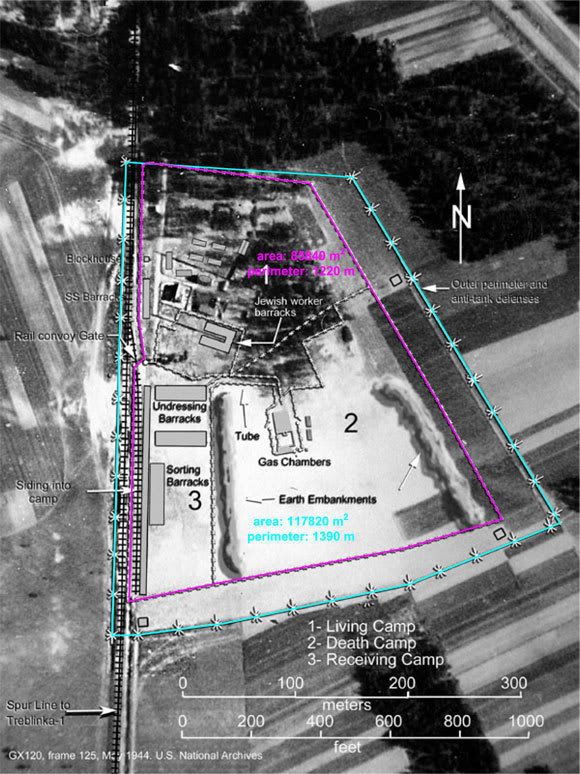
A map in which the features are drawn to scale (as close as possible) and the actual shape and size of the camp is taken in consideration (even though, as pointed out here, an exact representation of the camp would never be entirely possible with the available data) is Peter Laponder’s map of the camp in August 1943, which was already mentioned in my article about clip # 24. The distances between the three grids portrayed on this map and the closest fence section are 1.4, 2.5 and 2.6 cm, which considering the scale of the map would correspond to, respectively, 19.44 meters, 34.72 meters and 36.11 meters in reality. Even the closest of these distances, on the east side where there is a large sand heap between the grid and the fence, is almost five times larger than the distance that Bud inferred, in a dilettante or dishonest manner, from the map on page 39 of Arad’s book. However, it would also be hollow speculation to infer that Peter Laponder believed to have portrayed the exact location of the grids in the camp, due to the absence of any indication in this direction and the above mentioned caveat regarding the impossibility of drawing a completely accurate map of Treblinka. What is clearly shown by this map, as well as by Alex Bay’s air photo analysis also mentioned in my aforementioned article, is that there was enough space in the death camp section of Treblinka to place the incineration grids at a safe distance from any fence clad with tree branches, assuming that such was even necessary considering a factor overlooked by Bud, which will be addressed later in this article.
Bud wonders why no inmate ever set the fence on fire, surmising that this would be the natural thing to do for men in the situation that the permanent inmates of Treblinka were in, being forced to assist in the killing and burial or incineration of their people. He claims that doing so «would have caused great damage to the camp, due to how quickly the fire would have spread along the fence». He further claims that not only could the workers in the extermination section of Treblinka have easily set fire to the fence behind the barracks they were kept in as well as the guard towers by that fence, but that this very intense fire of dry tree branches would have quickly subsided and allowed them to escape.
Let us first address the last of these claims, which flies in the face of the following description on page 40 of Arad’s book, referred to in the clip:
The death camp formed a rectangle, 600 x 400 meters, surrounded by two sets of fences and barbed-wire obstacles. The inner fence was 3 to 4 meters high and intertwined with tree branches that hid the camp from outside view. A second fence, some 40 to 50 meters from the first, included chains of antitank obstacles ("Spanish horses") wrapped in barbed wire. The ground between the fences was barren – devoid of any vegetation or possible hiding place – to facilitate observation by the guards. In each corner of the camp, an 8-meter-high watchtower was constructed. An additional tower was built along the southern perimeter, between the two corners and near the gas chambers. It was later transferred to the center of the extermination area.
So here we have the main obstacles that the escape initiative Bud fantasizes about would have faced, assuming that the tree branches on the inner fence had caught fire as quickly and intensively as Bud claims they would have. The barbed wire of that fence would of course not have been consumed by the fire, and the poles of that fence, even if made of wood and not of concrete, would not have burned as rapidly as the tree branches. So at least for some time after the fire of the tree branches had subsided, the inmates would have been faced with an inner barbed wire fence not only intact, but probably also hot as hell due to the fire, and therefore somewhat harder to approach and cut through with pliers. During that time, and of course during the time the tree branch fire lasted, they would have been sitting ducks for guards firing at them, especially from the tower in the center of the extermination area after that had been transferred there, the approximate location of which in relation to the workers’ barracks is shown on Peter Laponder’s map. Those of the inmates who eventually managed to cut through the hot wire, or leap over the fence after it had collapsed due to the burning of the poles, would still have had to negotiate the barren ground between the inner and outer fences, followed by the «Spanish horses» wrapped in barbed wire of the outer fence. Even if the guard towers along the fence caught fire, as Bud claims they would have, and were accordingly abandoned by their occupants as one would expect an average human being to do, there would still have been the tower in the center of the extermination camp and the guards from the guard house also shown on Peter Laponder’s map to shoot down the surviving escapees as they tried to cross the outer fence. It seems improbable, in light of these obstacles, that many if any inmates would have survived such an escape attempt.
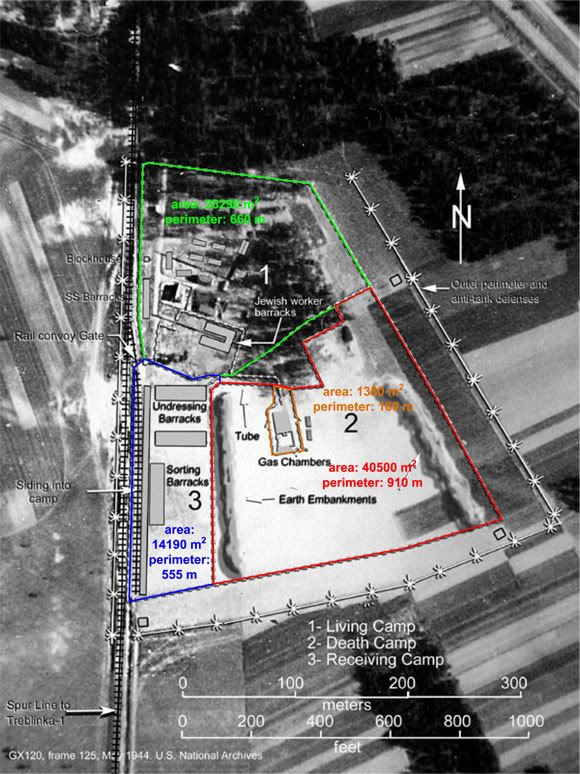
Now, what about resistance by setting fire to the branch-clad fences, especially those of the «tube»? Bud’s claim that any group of persons of any culture in the Treblinka inmates’ situation would have undertaken this is based on his irrelevant personal opinion alone, against which it can be argued that the primary concern of any individual from any culture is his or her own survival and that an expectably self-sacrificing act of heroism would only have been undertaken, by any inmate in his right mind, if he thought he could achieve more than however severe temporary damage to the camp’s facilities and a bloodbath among arriving deportees and his fellow inmates by guards who would probably have reacted by firing their machine-guns and machine-pistols at anything that moved. Even if the fences had burned as quickly and easily as Bud claims – the small Christmas tree branches he ignited over his sink took a couple of seconds until they burned with a huge flame, which makes it seem unlikely that large sections of four wire fence enclosures 160, 555, 660 and 910 meters long, as Sergey measured here, would have been totally on fire in a matter of minutes, as Bud presumes – the value and effect of such heroic act would have been somewhat dubious.
However, the chief factor speaking against any such attempt, or against an escape attempt as pictured by Bud, is that the tree branches on the camp’s inner fences were not dry but fresh branches. If they had been dry, their camouflage function would have been lost or at least considerably reduced, which is why the branches on the fence were being constantly replaced by fresh branches. This is mentioned on page 110 of Arad’s book; emphases in the following quote are mine:
The Forest Team(Waldkommando) and the Camouflage Team (Tarnungskommando)
[…]
In Treblinka, a second prisoners’ group worked outside the camp. It was called the camouflage team and numbered approximately twenty-five. Its task was to camouflage with branches the camp’s outer and inner fences, especially the fences around the extermination area and the "tube". This was intended to prevent outside observation of camp activities, as well as observation from within the camp of what transpired on the way to the gas chambers and in the extermination area. The team workers would cut branches in the forests near the camp and weave them into the barbed-wire fences. Since it was constantly necessary to replace dried-out branches with fresh ones, the camouflage work was continuous. These groups of prisoners left the camp confines under a strong guard of Germans and Ukrainians.
The daily work of the camouflage unit is vividly described in Richard Glazar’s memoirs translated into English as Trap with a Green Fence, which have already been mentioned in my article about clip # 23. The following excerpt is from page 127 of the 1999 edition of Trap with a Green Fence by Northwestern University Press, Illinois; emphases are mine:
The camouflage unit is the only one of the old work squads that still has enough real work to do. There is so much exterior and interior fencing that there are always repairs to be made. And if there are no repairs, then the camouflage unit is well suited for the forestry work in the vicinity of the camp – for clearing and cutting. Several times a day, under the supervision of the guards and little Sydow, some part of the twenty-five man unit has to go out into the forest, climb into trees, harvest large branches, and carry them back into the camp, where they will be used for repairs. The other part of the unit straightens and firms up the posts, tightens the barbed wire, and weaves the new pine boughs into the fence until there are no longer any gaps in the dense green wall. We know how to carry our two or three straps in such a way that everyone immediately understands: We are the camouflage unit. In the forest we bundle the pine boughs we have harvested and strap them onto our backs.
If the camouflage team renewed the foliage in the fences several times a day with fresh branches, it stands to reason that there can’t have been many dried branches at any part of the fence at any given time, even «in the hot summer sun during June and July, compounded with the heat from the cremation fires» (Bud). Of course fresh pine branches do not burn nearly as well as dry ones, which is why a natural Christmas tree with moisture in its branches and needles is stated to be no more flammable than a fresh flower..
This means that Bud’s vivid scenario of flaming fences goes down the drain, and the question that remains is: Did Bud simply overlook the above-quoted passage from Arad’s book about the constant renewal of the tree branches on the fences, or fail to grasp its significance? Or did he purposefully omit it because he knew it to be incompatible with the herring he tries to sell his viewers in this clip?
I leave it to our readers to answer this question.