Friday, December 27, 2019

On fakes, misunderstandings and sensationalist headlines.

Update 11.01.20: thankfully, The Tablet has fixed this, the article was renamed to "Did a Supposedly Nazi Document Fool the Experts?".

A few days ago Tablet published an article by Mel Laytner entitled "How a Fake Nazi Document Fooled the Experts".

The article itself is a good piece of research. Laytner points out that many publications and exhibitions have used an alleged document in which the Nazis supposedly calculated the "profitability" of the averge inmate including the allowance for the costs of cremation and the use of ashes and bones. From the information gathered by Laytner it becomes clear that claims about the alleged document are based on the data published by the survivor and historian Eugen Kogon in 1946 and then republished by Reimund Schnabel in the book Macht ohne Moral and then mistaken by various authors as an actual document.

Unfortunately, the title of the article, chosen not by the author but rather by a Tablet editor (acc. to a personal communication from Mel Laytner) is absolutely misleading. There is no actual document involved, so there was no "fake Nazi document" to speak of, nobody forged an actual document in this case.

Saturday, December 14, 2019

Still lying about Wiernik... and others.

In 2006, in the article Lying about Wiernik I exposed Mattogno and Graf's mendacity by showing that their accusations of plagiarism against Yankiel Wiernik were completely unfounded - they failed to prove that the map included in an early edition of his book was claimed to have been drawn by him (yet they still made the false claim of plagiarism) and they further falsely claimed that Wiernik claimed to have drawn his map in 1943 (he made no such claim) and by omitting the part where he explicitly says he drew it in 1944.

In a 2007 article If they're the best, what about the rest? I exposed Mattogno and Graf's dishonest omissions of eyewitness descriptions of openings on the roofs of the Treblinka gas chambers that would have been used to avoid overpressure in the chambers (even if some witnesses were unsure about their function). I pointed out that they ignored the cache of the 1944 Treblinka survivor statements given to the Soviets even while using some sketches from the same file. This alone tells everything one needs to know about their level of "research".

In the failed response (The "Extermination Camps" of "Aktion Reinhardt", 2013) to our debunking of denial on Treblinka, Belzec and Sobibor Mattogno returns to the topics of these posts insofar as they were discussed in our critique.

Friday, December 13, 2019

Correction Corner #9: Höß on how long the crematoria could work continuously.

In his methodologically brilliant rebuttal of the Auschwitz Holocaust denial of the David Irving variety The Case for Auschwitz, 2002, Robert Jan van Pelt quotes an excerpt from Rudolf Höß' testimony during his Cracow trial (p. 262):
Even as we added another 1,000 additional inmates to the squads sorting the luggage, there was no way to speed up the action. We had not enough space to store all these things, and this is why we failed in our effort to faster send out of the camp all the clothing and belongings these people had brought to Auschwitz. No improvements could be made to the crematoria. After eight to ten hours of operation the crematoria were unfit for further use. It was impossible to operate them continuously. As Eichmann had mentioned that we should expect by the end of the year 1944 and in 1945 more transports, we planned a larger crematorium. It was to be a huge, circular brick furnace, to be built underground. Due to lack of time, it was never designed.”
This quote was seized upon by the semi-revisionist Fritjof Meyer, whose pretty pathetic 2002 article on the number of the victims of Auschwitz misused various sources to severely reduce the number of the Jewish Auschwitz victims. The quote was one of the cornerstones of Meyer's argument, signifying to him that the ovens couldn't be used 24/7 and thus the number of the victims had to be lower.

Meyer's overall thesis was soundly debunked, but when responding to this particular point, Meyer's opponents merely appealed to Höß' other statements indicating that the ovens could indeed be operated longer than the 8-10 hours in the quote. This was done by Albrecht Kolthoff, John Zimmerman and Franciszek Piper. While this response did its job, it is necessary to check the Polish transcript in question.

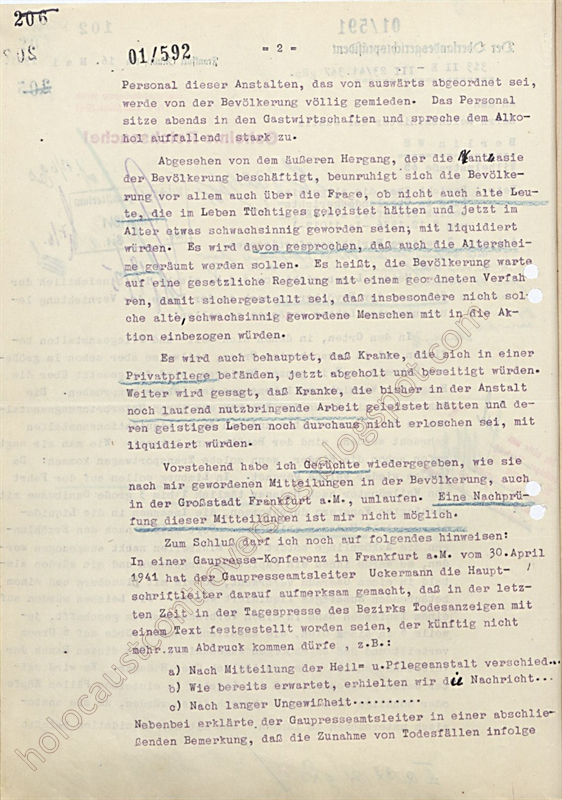
"Here They Go Again for Gassing" - Nazi Euthanasia in German Documents

On 16 May 1941, the Higher Regional Court President of Frankfurt, Arthur Ungewitter, reported to the Reichs Minister of Justice on what the population in the area talked about the "extermination of unworthy life":

The children are said to shout "here they go again for gassing" when they spot "the vehicles with which the sick are taken...to the liquidation institutes". It is also told that the victims are brought to a "gas room, where they would be liquidated with hydrogen cyanide and a numbing gas". Note that the actual killing agent was carbon monoxide gas, although hydrogen cyanide was another candidate considered for the Nazi Euthanasia and possibly tested earlier, in 1939, in Fort VII in Posen (see also Sonderkommando Lange in German Documents: Euthanasia 1940/41).

DOCUMENT

Sunday, December 01, 2019

Update of Posting Contemporary German Documents on Homicidal Gas Vans

We've updated the reference posting Contemporary German Documents on Homicidal Gas Vans with the following items:
  • image of radio telegram of Arthur Nebe to Einsatzgruppe B of 13 December 1941 on "special vehicles"
  •  
  • colored images of all other documents from the German Bundesarchiv (including the letter from Walther Rauff to the Criminal Technical Institute at the Reich Criminal Police Office of 26 March 1942, the letter from Harald Turner to Karl Wolff of 11 April 1942 and the memo of Willy Just of 5 June 1942)
  •  
  • addition of document 16.) letter from the Gaubschat company to the RSHA of 24 September 1942 on "Coachwork f. delivered 10 Saurer Chassis".