Showing posts with label Mogilev gassing. Show all posts

Friday, July 25, 2025

German Footage of a Homicidal Gassing with Engine Exhaust. Part 7: Tactical Symbol & Homicidal Gas Van

 German Footage of a Homicidal Gassing with Engine Exhaust

Part 1: Provenance
Part 2: Location
 
 
If there were still anyone in the world who harbored even the slightest doubt about the authenticity of the film footage showing the Nazi gas killing operation at the psychiatric hospital in Mogilev, those doubts should now be dispelled.
 
Mogilev gassing footage

Saturday, December 29, 2018

Mattogno, his Einsatzgruppen book and the Gas Vans. Part III: Genesis and Pictures That Say it All

 Mattogno, his Einsatzgruppen book and the Gas Vans

The genesis of the Einsatzgruppen gas vans can be traced back to Fort VII in Posen. Here, the Nazis conducted mass gassing experiments for the Euthanasia action in Winter 1939/40. One branch developed to stationary gas chambers in the Altreich, the other developed to a gas van in the Warthegau, both types operating with carbon monoxide (CO) from gas cylinders. A killing commando of the Gestapo Posen, Sonderkommando (SK) Lange, employed the CO gas van. The war against the Soviet Union with its extermination policy pushed the development of a new mass killing technique since the mass shooting of people not fit for military service posed a considerable strain on the German paramilitary forces. The method had to fit the use in the wide Russian territory. The carbon monoxide gas cylinders already in use were considered not suitable for logistic reasons. In September 1941, gassing with engine exhaust was tried on a large scale in mental asylums in Minsk and Mogilev, followed by the testing of a prototype gas van with engine exhaust.

Tuesday, December 18, 2018

Mattogno, his Einsatzgruppen book and the Gas Vans. Part I: A Dilettante at Work

 Mattogno, his Einsatzgruppen book and the Gas Vans

Some Holocaust deniers might have had high expectations that Carlo Mattogno would address his critics in the English translation of his Einsatzgruppen book, after Germar Rudolf's earlier comment that "we have submitted a long list of open issues -- including remarks made by the HC Blog -- to the author for his review". But deniers who had crossed their fingers that Mattogno would show a fierce reaction would have to be deeply disappointed. Rudolf's foreword tried to excuse Mattogno's decision not to consider internet critiques, lest it should force him to postpone publishing the book; a rather questionable strategy for Holocaust deniers to willfully ignoring the HC blog, given that anyone searching in the internet on the book would likely end up here and learn more about his dilettante treatment of the subject.

Friday, May 19, 2017

Sonderkommando Lange in German Documents: Euthanasia 1940/41

Mass Killing Unit of Warthegau

Sonderkommando Lange in German Documents:

Sonderkommando Kulmhof in German Documents:
Part III: Body Disposal (Appendix)
Part V: Funding
Part IX: Farewell (1943)


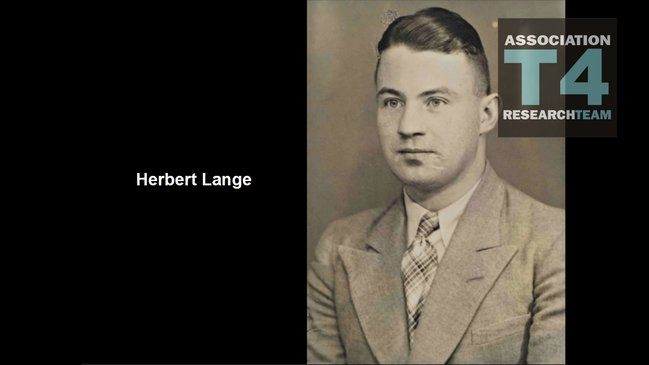
Herbert Lange (source)
Herbert Lange, born 29 September 1909 in Menzlin in the Province of Pomerania, worked as criminal investigator at the Gestapo in Aachen before the war and took part in the Polish Campaign as member of Einsatzgruppe VI, which settled as Security Police headquarters in Poznan [1] (click or hover over footnotes to see references). For a short period of time until 16 October 1939, he was commandant of the Übergangslager (transition camp) Fort VII in Poznan [2]. Lange became the leader of a special detail (Sonderkommando) founded by and named after him, which specialized in the killing of mentally ill people with poison gas. In late 1941, he moved on to establish Chelmno (Kulmhof) extermination camp to wipe out the Jews of the Warthegau as well. He was replaced in Spring 1942 as commandant of the extermination camp by Hans Bothmann and employed as investigator in the RSHA. He supposedly died during the battle of Berlin at the end of the war.

Fort VII

Fort VII in Poznan; ref. 2, p. 13
The first Nazi gassings of people took place in Fort VII in Poznan in late 1939. Some experiments with the two most promising killing agents hydrogen cyanide and carbon monoxide may have been tried in casemates of the camp as early as October 1939. What seems like an experimental gassing with hydrogen cyanide soaked pellets (Degesch's "Zyklon") was mentioned en passant by the RSHA driver Wilhelm F. [3] :
"Right after the Polish Campaign I was sent with a group of officers to a town in Poland, I do not remember its name. There was a red haired Untersturmführer, who was called Becker as I now recall. This Becker made experiments with poison gas. A number of people were locked in a casemate and gas was introduced into the casemate through venting pipes. I remember exactly how Becker dropped something into the pipes."

"I have seen that Becker fetched a box with cans. He threw them [into the air shafts]."

From November 1939, mentally ill people were systematically killed with carbon monoxide gas in Fort VII [4]. Under the command of Lange the inmates of the asylums near Poznan were driven to the camp, locked in casemates and suffocated with carbon monoxide from pressurized steel bottles. The corpses were buried in mass graves in a forest near Oborniki, 30 km North of Poznan. The handling of the corpses was done by Polish prisoners of Fort VII assigned to Sonderkommando Lange, among those Henryk Mania and Henryk Maliczak, who testified on the killings after the war.

Monday, January 16, 2017

On Mattogno's Hallucination That von dem Bach-Zelewski's Extended Testimony on the Minsk Shooting Is a Jewish Forgery

In a handwritten post-war manuscript, the former Higher SS and Police Leader for Central Russia Erich von dem Bach-Zelewski briefly mentioned the show mass shooting carried out by Einsatzgruppe B on 15 August 1941 for the Reichsführer-SS Heinrich Himmler in Minsk (NARA Record Group 238, M1270/1/111, p. 41, see Figure 1).

Figure 1: Page five from a declaration of von dem Bach-Zelewski on the "persecution of Jews".
The mass execution was also reported by numerous other witnesses. From a historiographic point of view, what is most significant in von dem Bach-Zelewski's account is that he described how after the shooting and visiting of a mental asylum in Minsk (which are both confirmed by Himmler's appointment diary) Himmler ordered the Einsatzgruppen B leader Arthur Nebe "to make use of a more human method of killing" on the mentally ill people, which links the incident to the subsequent mass killing trials with explosives and poison gas in asylums in Minsk and Mogilev. The connection between the events is supported by von dem Bach-Zelewski's own documented activity on the next day to get a demonstration of the mobile carbon monoxide gas chamber of Sonderkommando Lange (for obvious reasons, he kept quiet about this in his post-war testimony).

A more vivid and detailed description of the Minsk shooting by von dem Bach-Zelewski was published on 23 August 1946 in the German-Jewish newspaper Aufbau (Figure 2). The account is somewhat more general with respect to the scope of Himmler's order following the mass execution and asylum visit. He considered that "shooting is not the most human method", ordered Nebe "to think about it and submit a report based on the experiences made" and agreed to try explosives on mentally ill people in Minsk.

Figure 2: Aufbau, volume 12, issue 34, p. 2.

But if it were according to the Holocaust denier Carlo Mattogno, von dem Bach-Zelewski's account in Aufbau is a forgery based on his more brief statement from the NARA Record Group 238:
"This anecdote appeared on 23 August 1946 in the New York Jewish newspaper Der [sic!] Aufbau as part of a statement attributed to von dem Bach-Zelewski, but its contents had been massively manipulated by the editorial staff of the newspaper, as is apparent from a comparison with the original statement of this SS officer."
(Mattogno, Inside the Gas Chambers, 2nd edition, p. 58)

Unfortunately for Mattogno, this is rubbish. Upon systematically searching the Yad Vashem Archives digital collection of Yitzhak Stone, who "was a senior aid to the American prosecutor in the Nazi War Crimes Trials at Nuremberg" for interesting material for the blog (and there sure is, so stay tuned), I stumbled across the English translation of an undated, 60 pages long "declaration von dem Bach" (YVA, O.18/90, p. 20ff.). The declaration contains amongst other things also the passages reproduced in German in Aufbau (Figure 3).

Saturday, September 17, 2016

Mattogno and the Activity & Situation Report of Einsatzgruppe B on its Gas Vans

The operation and situation report of Einsatzgruppe B of 1 March 1942 explicitly mentions four "Gaswagen" (gas vans) in the group's motor pool. The report, which was published in the 90s, corroborates earlier evidence such as the testimony of the gas vans' drivers, and vice versa. This independent, mutual corroboration results in more powerful evidence on the reality of Germans homicidal gas vans.

As a starter and to provide some context, the activities of the group, which demanded the use of gas vans, and the contribution of the group to the development of gas vans will be outlined. The central part looks at what the Einsatzgruppe B report stated on its gas vans and relates this to other sources. The final section addresses why the "Revisionist" Carlo Mattogno failed once again with his denial of German homicidal gas vans.

Saturday, September 03, 2016

German Footage of a Homicidal Gassing with Engine Exhaust. Part 6: Forgery Allegation

German Footage of a Homicidal Gassing with Engine Exhaust

Part 1: Provenance
Part 2: Location

The Mogilev homicidal gassing footage discussed in the previous parts has been subjected to doubts about its authenticity. Interestingly, these were not limited to the usual suspects, but included a German public prosecutor investigating Nazi atrocities and Holocaust Museum staff. In any case, the suspicion that the footage was faked by the Allies is unsubstantiated in the light of the available evidence.

Saturday, July 23, 2016

German Footage of a Homicidal Gassing with Engine Exhaust. Part 5: Responsibility (III).

German Footage of a Homicidal Gassing with Engine Exhaust

Part 1: Provenance
Part 2: Location
 
The previous part proposed that the Mogilev gassing footage displays the experimental gassing carried out by the Einsatzgruppe B leader Arthur Nebe, Einsatzkommando 8 and Albrecht Widmann of the Criminal Technical Institute of the Security Police in September 1941. The following part will outline some conflicting evidence and evaluate alternative interpretations.

Saturday, July 02, 2016

German Footage of a Homicidal Gassing with Engine Exhaust. Part 4: Responsibility (II).

German Footage of a Homicidal Gassing with Engine Exhaust
Part 1: Provenance
Part 2: Location
Part 4: Responsibility (II)
Part 6: Forgery Allegation

In the previous parts of this series, it was established that the gassing footage (shown below as titled compilation and without the sound added after the war) was taken during an action by Einsatzkommando 8 in the Mogilev asylum. In this part, we will look more closely on the circumstances of what may picture the scene.

 (attention: graphic video!)

Friday, June 24, 2016

Update on Rebuttal of Alvarez on Gas Vans: The Ford Gas Wagon

Rebuttal of Alvarez on Gas Vans
Part IX: The Just Memo

Santiago Alvarez claimed that, according to the West-German trial verdict against Heinz Rie., there were "only" six hearsay witnesses on a homicidal gas van used by the Secret Field Police in Mogilev (GFP 570) and that the "story sounds more like a rumour than an established fact". However, as pointed out in the original posting, the verdict actually cited three eyewitnesses and five hearsay witnesses - all members of GFP 570 - on the operation of the gas van. Now, according to a report by West-German investigators, there is in fact, much more evidence on the existence and operation of this vehicle available.

Sunday, June 05, 2016

German Footage of a Homicidal Gassing with Engine Exhaust. Part 3: Responsibility (I).

German Footage of a Homicidal Gassing with Engine Exhaust
In 1961 - 1963, West-German investigators sought to find out who was responsible for the gassing action shown on the photographs available to them (they were not aware that the stills were taken from the film Nuremberg: Its Lesson for Today from 1948, see also the first part on provenance). The scene displays two German police vehicles with their exhaust tubes connected to a gas chamber, an Adler car with the license plate POL 28545 and a truck with the license plate POL 51628 as well as some military symbols. The key to track down the perpetrators of the scene was considered to identify the units to which these vehicles were assigned. Whoever placed and operated them at the site, was also responsible for the action.

Monday, May 23, 2016

German Footage of a Homicidal Gassing with Engine Exhaust. Part 2: Location.

German Footage of a Homicidal Gassing with Engine Exhaust
 
Part 1: Provenance
Part 2: Location


Having established the gassing film's provenance we shall now take a look at the issue of where the film was shot.

Note: this post contains lots of images.

It is usually claimed that the scene depicts a gassing in Mogilev. However there were also some testimonies about similar early gassings elsewhere (Minsk), so we should make sure that we have the right location. In order to do this we should examine photos of the Mogilev psychiatric hospital, specifically of the location where the gassing is claimed to have taken place.

Sunday, May 22, 2016

German Footage of a Homicidal Gassing with Engine Exhaust. Part 1: Provenance.

German Footage of a Homicidal Gassing with Engine Exhaust

Part 1: Provenance
Part 2: Location
 
The only known German footage of a homicidal gassing can be seen in the documentary Nuremberg: Its Lesson for Today (1948), partially available, among other places, at USHMM's website, 0:44-1:21. The USHMM description reads:
CU pipes from a German police car bearing a license plate POL-28545 and a German police truck with license POL-51628 (as well as military unit markings: 7 circle-with-flag IX). Apparently metal piping is directed into the brick work of a small brick building, in an area that appears to be a bricked up window or door. Projected against the wall is what appears to be the shadow of a man in uniform. Five emaciated men pass on an open farm cart/wagon to a wooded location; a tall naked emaciated man and two emaciated children (different from those seen first) are led by a man and a woman in white lab coats to the building. Small red cross appears on man's white coat sleeve. The man and woman put blankets around the patients' shoulders as they are led toward the building (and over a child lying on the cart). A uniformed man - probably German - is visible in the background, along the fence, watching the scene. CU car and pipes connecting the car exhaust to the building. [Scene is consistent with descriptions of September 1941 experimental killings by Einsatzgruppe B of patients from a local asylum in the area of Mogilev, Belarus. Corresponding still images were used in evidence at the trial of Albert Widmann.]
The question of what the events on the tape correspond to will be addressed by Hans in parts 3 to 5 of this multi-part article. In this part we'll take a look at the issue of the provenance of this footage.